Eva Xiao · · 6 min read
Making ‘Her’ a reality: how Baidu’s AI Lab plans to solve speech recognition
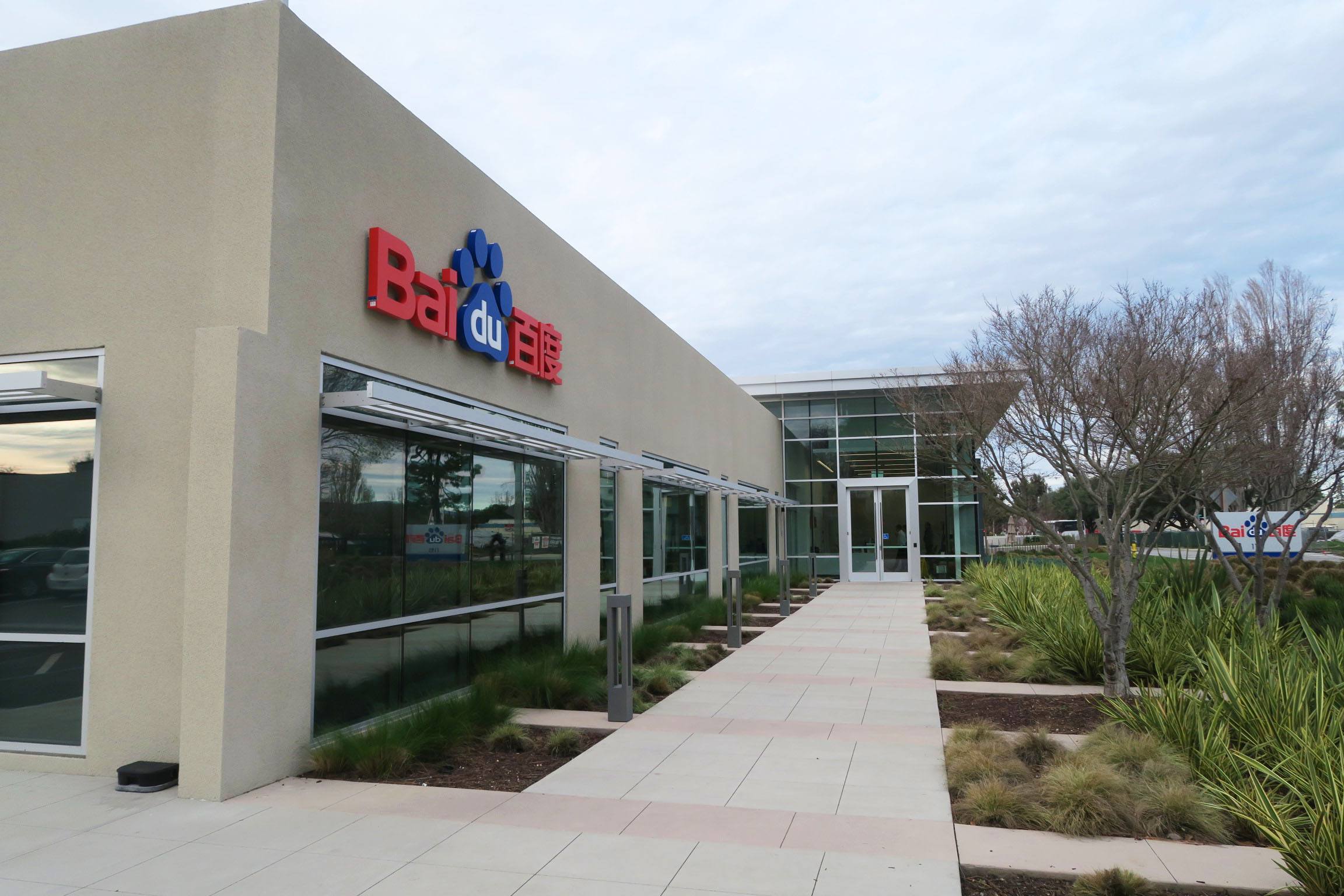
Baidu’s Silicon Valley AI Lab is based in Sunnyvale, California. Photo credit: Tech in Asia.
If it wasn’t for Baidu’s logo, the AI research lab of one China’s largest tech companies would be all but hidden inside a one-story, sand-colored building in Sunnyvale, California. Inside, the lab has the familiar trimmings of a Silicon Valley tech company: a snack bar, standing desks, meeting rooms with grandiose names like “The Great Wall.”
“The reason that the Silicon Valley AI Lab exists is to try to […] find the technology that could get a product to a level where you trust speech recognition the same way you trust a person to understand you,” Adam Coates, director of Baidu’s Silicon Valley AI Lab, tells Tech in Asia. “Our topline goal is to solve speech recognition.”
The AI industry could make or break the future of tech companies around the world.
Baidu wants to build a speech recognition engine that’s 99 percent accurate, a threshold that Andrew Ng, chief scientist at Baidu and founder of Google’s “Google Brain” deep learning project, believes will fundamentally change how humans interact with computers.
“Over the next couple of years, we want to have a software solution that can actually solve that problem,” says Adam.
Estimated to be worth US$16 billion by 2022, the artificial intelligence industry, which includes image recognition and autonomous driving, could make or break the future of tech companies around the world. US tech giants such as Google and Amazon are all heavily invested in their own AI initiatives. Alexa, Amazon’s virtual assistant and Siri competitor, powers Echo, its home assistant gadget; Google’s AI is astonishingly skilled at Pictionary.
See: Half the work people do can be automated: McKinsey
Acquiring AI startups is also a rising trend among large tech firms, which are eager to boost their AI capabilities. In 2014, Google bought DeepMind, the AI startup behind AlphaGo, for more than US$500 million. In January, Microsoft acquired Maluuba, a Canadian startup focusing on natural language processing and general artificial intelligence.

Adam Coates, director of Baidu’s Silicon Valley AI Lab, met Andrew Ng as an undergraduate student at Stanford University. After a machine learning project on teaching helicopters to fly on their own, he was hooked. Photo credit: Baidu.
Baidu, which opened its Silicon Valley AI Lab in 2014, is hoping to carve out a space for itself as a leader in speech recognition. So far, it’s making impressive headway. The company’s latest speech recognition engine, dubbed Deep Speech 2, uses deep learning to recognize words spoken in English and Mandarin, at times outperforming humans in the latter, according to Baidu.
“We can train this giant neural network that eventually learns to recognize speech on its own as well as a human can, and not spend so much of our time thinking about how words are structured,” says Adam. “Instead, [we] can just ask the computer system to learn those things on its own.”
Crunching data
The short answer to Baidu’s plan to conquer speech recognition is data – lots of it. Adam says Deep Speech 2 was trained on tens of thousands of hours of audio recordings. Some of it comes from public data, while another portion is from crowdsourcing services, such as Mechanical Turk, Amazon’s marketplace for odd jobs that require human intelligence.
More with less





Stay updated on the go with our mobile app.
Get latest insights with smoother, more personalized experience through TIA mobile app.