 Jonathan Chew · · 5 min read
My neighbor Southeast Asia: how Japanese firms can work with the region’s startups

There’s something about Southeast Asia that has caught the eye of Japanese investors, and it goes beyond the region’s growth potential.
“Many Southeast Asian startups have a special understanding of social issues,” says Kenji Minefuji, manager of the business innovation group at Mitsubishi Electric and investment lead at ME Innovation Fund (MEIF). The fund is the corporate venture capital arm of Tokyo-based multinational Mitsubishi Electric.
“They’re not just focused on technological innovation, but also offering products and solutions that directly address the needs of local communities,” he adds. “This level of social impact aligns very closely with Japanese business values, which are centered around contributing to society.”
Minefuji pointed out that many Southeast Asian entrepreneurs also “excel at scaling their businesses and possess a high ability to shape their ideas into reality.”
With this in mind, huge names like MEIF and Leave a Nest, a Japan-based consultancy firm that considers itself a “knowledge manufacturing” company, have taken a shine to Southeast Asia’s startups and are looking to forge closer ties.
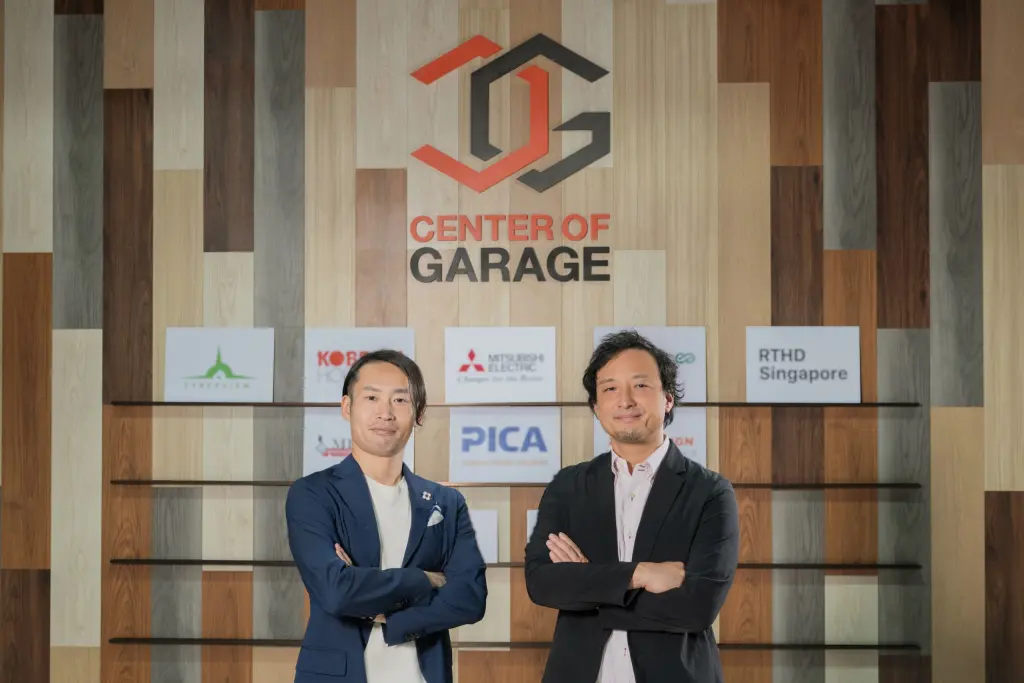
Kenji Minefuji (left), manager of the business innovation group at Mitsubishi Electric and investment lead at MEIF, and Yukihiro Maru, group CEO of Leave a Nest, at the latter’s new initiative, Center of Garage Malaysia / Photo credit: MEIF
“There are numerous things to learn from the many startup leaders with remarkable talents in this region,” Minefuji says.
The journey so far
Both MEIF and Leave a Nest have taken several concrete steps to develop working relationships with startups in Southeast Asia.
“We are a Japanese company, but MEIF actively invests in overseas startups, particularly those in the region,” says Minefuji. “In fact, among our six investments so far, two out of our four international investments are with companies based in Southeast Asia.”
One of those startups is Singapore-based FTV Labs. Through this investment, MEIF is conducting a proof-of-concept experiment to test the application of Kegmil, FTV’s field service management software, in Mitsubishi Electric’s elevator maintenance operations.
“The most important aspect of building a good relationship with startups is that both parties have to give and receive,” Minefuji observes.
The “give” from FTV is its ability to help Mitsubishi Electric improve the efficiency of its elevator maintenance operations. The “receive” element is the targeted feedback and minimal development costs for Kegmil that FTV gets through this partnership.
By running Kegmil at its other business divisions to Kegmil, Mitsubishi Electric is giving FTV an opportunity to expand its product testing while receiving a solution that will benefit its own operations.
As for Leave a Nest, it partnered with Malaysia-based Aerodyne Group in 2022. Along with ACSL, a Japanese deeptech startup that provides drones and multispectral cameras, Leave a Nest and Aerodyne Group are conducting field trials at a large-scale palm oil plantation.
While the former designed the project’s implementation, the latter’s drone pilots conducted the planned experiments while incorporating tech from the aforementioned Japanese startup.
Through these field trials, Leave a Nest helped Aerodyne with plans to build a system designed to address issues facing Malaysia’s palm oil plantations. More specifically, the companies are using the drones’ camera features for the early detection of crop diseases.
“There has been a shift from businesses solely based on the internet to services that merge online and offline,” says Yukihiro Maru, group CEO of Leave a Nest. He also noted a “particularly compelling” change: the emergence of services that use issue-driven approaches “to solve structural issues in major industries.”
These two cases are just some examples of how Japanese companies are increasingly investing and teaming up with rapidly growing startups in Southeast Asia.
Still, that’s not to say that partnerships like these come easy. Having spent several years in the region, Minefuji and Maru had several things to point out when it comes to such collaborations.
When in Rome…
Southeast Asia is a highly diverse region with plenty of differences, not just in terms of market conditions but also socio-cultural realities.
Consequently, Leave a Nest’s Maru says that Japanese firms need to be respectful of each country’s cultural norms and business customs. It also means that companies have to keep in mind how local entrepreneurs might act or take into account some of their personal considerations.

Photo credit: Shutterstock
“From what I’ve seen, some younger entrepreneurs in Singapore have a strong focus on safer ideas and staying within areas they’re comfortable with,” he shares.
Like the saying goes: No risk, no reward. Without the right level of risk-taking, these potential Singaporean partners could also be missing out on new opportunities and losing first-mover advantage.
Data from a 2019 survey of over 300 Singapore SMEs by Aon backs this up: It found that failure to innovate was the top risk such businesses faced.
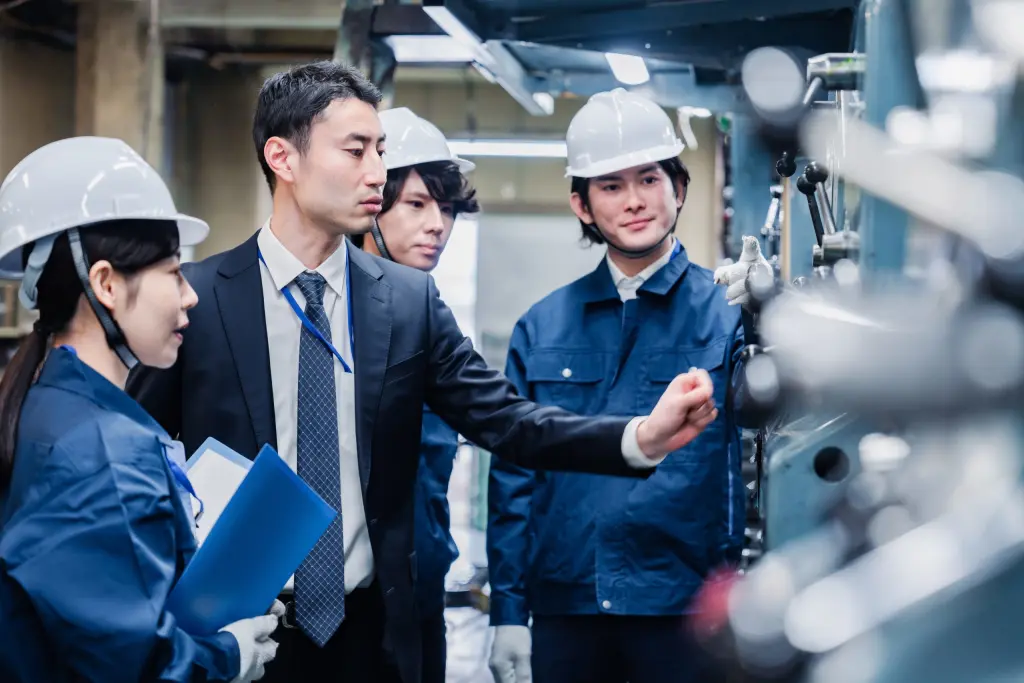
Photo credit: Shutterstock
Each market’s culture can manifest in many forms. For example, Maru jokes that many of the Malaysians he’s worked with have a sweet tooth. So taking note of something like this – and offering sweets or chocolates when meeting up, which he often does – can go a long way.
MEIF’s Minefuji agrees. “This not only fosters mutual respect but also establishes a strong foundation for partnerships and meaningful relationships.”
He adds: “Ultimately, Japanese companies shouldn’t just try to export their playbook wholesale to Southeast Asia. Instead, they should identify opportunities to co-create with local businesses.”
Launching point
With all these points in mind, both Leave a Nest and MEIF are looking to strengthen their foothold and encourage other Japanese companies to venture into Southeast Asia.
In particular, Maru plans to turn the region into an expansion hub for Leave a Nest, allowing the firm to enter new markets. He also sees how collaborating with startups in Southeast Asia can be a “teaching moment”: Companies like his can learn how to work with overseas firms and then use that experience in other markets.
As for Minefuji, the manager says MEIF is actively seeking opportunities for investment in Southeast Asian startups.
“What we’re selling is synergy for corporate endeavors. We do not make ‘fire and forget’ or ‘spray and pray’ bets,” he stresses.
“Instead, what we’re really honing in on is strategic investments to co-create and innovate.”
ME Innovation Fund, Mitsubishi Electric’s corporate venture capital fund, was launched in 2022 to help create a vibrant and sustainable society through continuous technological innovation and creativity. Find out what MEIF is all about on its website.
This content was produced by Tech in Asia Studios, which connects brands with Asia’s tech community. Learn more about partnering with Tech in Asia Studios.
Stay updated on the go with our mobile app.
Get latest insights with smoother, more personalized experience through TIA mobile app.
Recommended reads
 AI hiring heats up in Singapore
 Mesh Bio to expand healthcare platform’s SEA reach with new capital (update)
 Singtel partners with Nvidia, others for AI initiatives
 Octopus co-founder steps down for ‘personal reasons’
 Seek, Jobstreet, Jobsdb merge into single platform
 Modalku co-founder steps down after 8 years of service
 East Ventures co-launches emissions calculator for Indonesian companies
 PropertyGuru lays off 79 employees amid strategic shift
 This profitable SG firm combines mercenary approach with Amazon-like infrastructure
 ASEAN Foundation, Microsoft partner for AI upskilling project





Editing by Winston Zhang and Eileen C. Ang
(And yes, we’re serious about ethics and transparency. More information here.)



📅 Upcoming Events
22 October 2026
Payoneer x CSPN Summit 2026