 Josh Horwitz · · 4 min read
Quixey CEO Tomer Kagan on the company’s close relationship with Alibaba
On Friday, while Asia was sleeping, Mountain View-based startup Quixey announced it closed a US$60 million funding round led by Alibaba, with participation from Softbank, Goldman Sachs, GGV Capital, and others. Re/code first reported the then-upcoming round back in February, so Quixey’s announcement marks the company’s official confirmation.
To many, Quixey might seem like a confusing company. When Alibaba announced its first investment in the company, its only visible product was a “search engine for apps,” wherein users inputted queries like “food delivery” and received results like Postmates or Food Panda. Its leadership team also has an affinity for jargon, spouting phrases like “ontology of apps” and “naive taxonomy” to describe its nascent technology.
Jargon aside, Quixey is a company to watch – partly for its vision, and partly for its close relationship with Alibaba.
For about a year, Quixey has been open about its plans to develop what it calls “deep search.” Put simply, deep search lets users retrieve information buried inside of apps. If one inputs “Thai food” in a hypothetical Quixey-powered app, one’s screen might show a card with Yelp listings for three top-rated Thai restaurants, a card with an OpenTable listing for the Thai joint you ate at last week, and a card with your Thai recipes folder in Evernote.
Of course, this premise gets complicated quickly. Quixey and its competitors not only need to collect data on how users search, they also must encourage developers to build their apps so they are crawlable. It’s hard to imagine what this might look like – What will I see if I Quixey-search “ride to Jameson Street?” Is Candy Crush crawlable? Tinder? A browser?
Right now, most consumers can only get a glimpse of Quixey’s deep search if the company hooks them up with Chow, a members-only Quixey app that crawls other apps for food-related information. But if you live in China and own a phone powered by YunOS, Alibaba’s Android-fork mobile operating system, you can test out Quixey. Searching for “sushi group deals,” for example, conjures up offers pulled from group-buying apps.
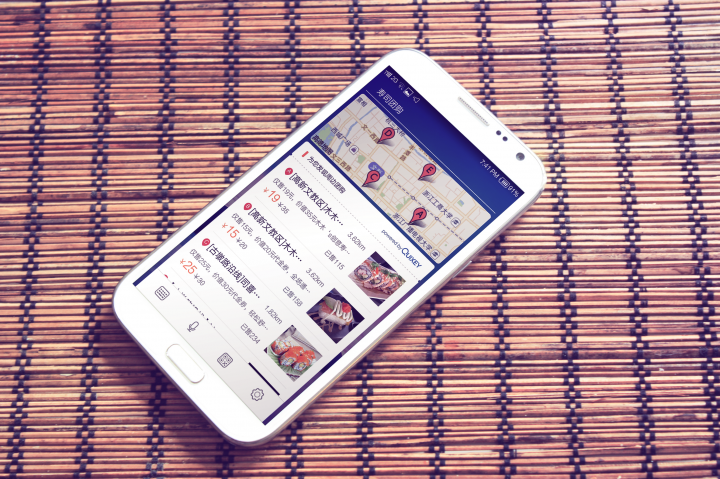
Kagan says the team is using food as a starting point, but ultimately wants to crawl every app for everything.
“We did food because we had to build a whole system of crawling and collecting the app structure, indexing it correctly, handling search queries, and rendering properly. That was three years of work,” says Kagan. “What we’re putting out in the next stage is hopefully a hundred apps in about 1,000 states, and then 1,000 apps with a million states,” he adds.
While fundraising for its series C round in 2013, Quixey approached a number of OEMs and global internet giants to discuss potential partnerships. But it ultimately chose Alibaba because it promised Quixey the right amount of access for what Quixey could offer, which was minimal at the time.
“All of the partners we talked with kept saying something like ‘We want global support. Give me 26 languages.’ Search doesn’t work that way. Alibaba said, ‘just give us Chinese support,” says Kagan.
For Alibaba, partnering with Quixey provides several benefits. In the short term, Quixey might help the YunOS devices differentiate themselves and thereby generate sales – which will then increase Alibaba’s access to Chinese end users.





Stay updated on the go with our mobile app.
Get latest insights with smoother, more personalized experience through TIA mobile app.









