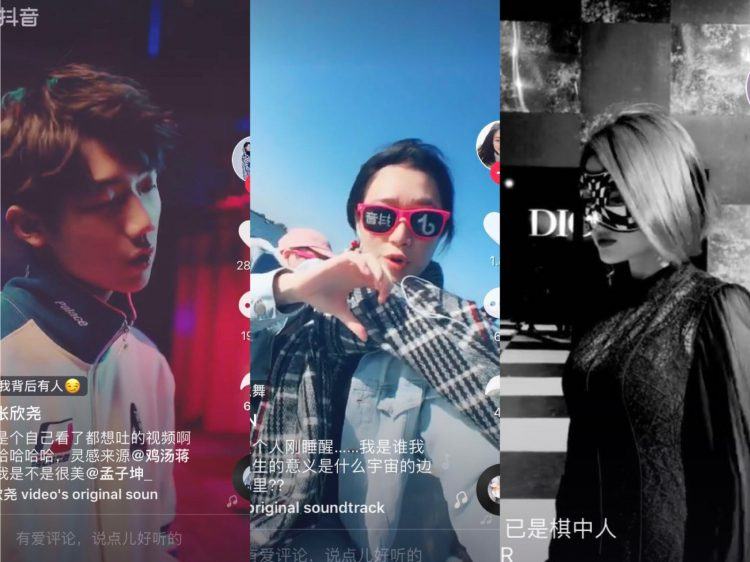
Some of Douyin’s top influencers / Image credit: Zhang Xinyao, Erin Huang, Wu Jiayu
If you’re on Chinese social media, you’ve probably stumbled upon a 15-second video of your twenty-something friend that goes like this:
Such videos are produced on Douyin, a social network app that’s regarded as a clone of its US counterpart, Musical.ly. Launched in September 2016, Douyin lets users choose a song, record themselves miming and dancing to the tune, add various filters and speed options like time lapse and slow motion, and then share the final work on the app or to other social platforms.
“I don’t take selfies anymore, I just make a Douyin video because Douyin is cool,” says Erin Huang, a Shenzhen-raised, Singapore-educated 21-year-old who’s one of the earliest influencers on the platform.
The app’s also available worldwide as Tik Tok.
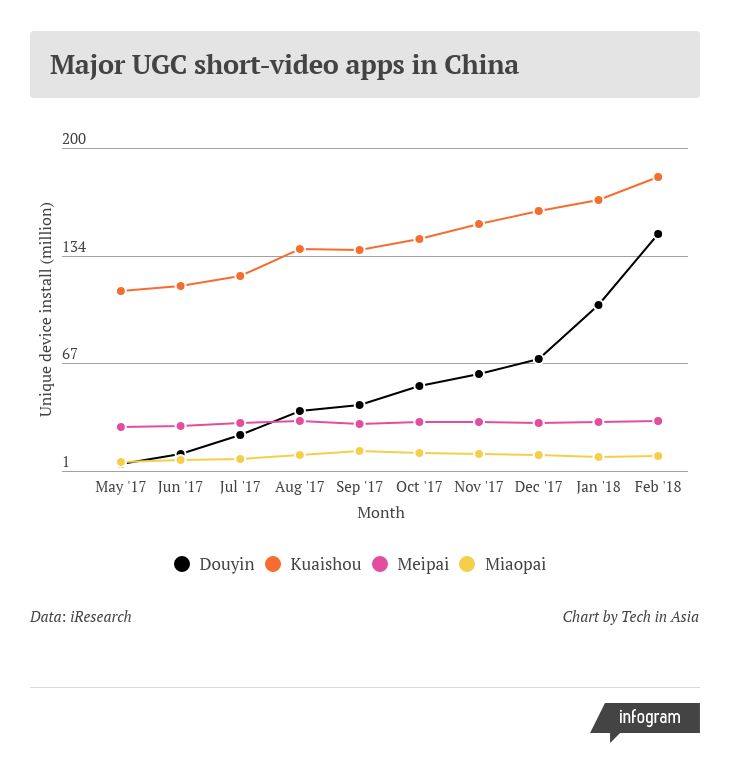
Made by parent Bytedance – which acquired Musical.ly last year – Douyin has climbed to become China’s second-largest short-video app focused on user-generated content (UGC) in terms of unique downloads. It trails behind Tencent-backed Kuaishou and beats the likes of Meitu’s Meipai and Weibo-backed Miaopai. Douyin now has 32.5 million users and was adding an average of 1 million users per day during the last six months, according to big data company Jiguang.
A proven app idea
When Douyin rolled out, China’s mobile users already had a dozen short-video apps to toy with. People were creating and consuming more micro videos via their phones than ever, thanks to cheaper data charges and rising demand for bite-size content. Between 2013 and 2016, the market saw a 302 percent jump to reach 153 million users. That’s about one in every 10 Chinese.
I don’t take selfies anymore, I just make a Douyin video because Douyin is cool.
These short-form video apps all have their own edge. Some stream professionally generated clips, like Bytedance’s other video platform Xigua. Others focus on UGC, like Douyin, Meipai, and Kuaishou.
While Kuaishou’s easy-to-use interface attracts mostly male, smaller city dwellers who indulge in making funny sketches, Douyin started out by eyeing the same user group as Meipai’s: mostly young, urban females.
However, instead of offering eye-enlarging and face-slimming tools – features you’d find on the Meipai app – Douyin chose to adopt something that Musical.ly has proven to be popular among young US users. The lip-sync and dance videos that people create on Douyin, according to Huang, are not like the throwaway clips on other video platforms. They require a level of body coordination and musical talent to turn out well, and they can make nobodies feel like stars.
Attracting effective influencers
Advertising tactics
From a cool kids club to the public square





Stay updated on the go with our mobile app.
Get latest insights with smoother, more personalized experience through TIA mobile app.













📅 Upcoming Events
22 October 2026
Payoneer x CSPN Summit 2026