
Earlier this year, Taiwan hosted its Taiwan Innotech Expo at the Taipei World Trade Center. The annual event features a host of innovative technologies across different industries and verticals. One of its key focuses this year was the application of 5G, a prominent technology that has seen rapid development and implementation in recent years.
5G has experienced an impressive rollout in Taiwan so far. Currently, the island ranks third in the world for fastest download speeds using 5G, and by the end of this year, it is expected to reach an overall 5G penetration rate of 30%.
However, getting to this point was no mean feat.
Overcoming 5G’s slow start
The density of hardware required in each 5G tower is 3x higher than that of 4G, and the range of these towers is over 98% shorter.
This means that in order to provide enough coverage, more technicians will be needed for installation works in each tower and more locations will need to be rented out to build these infrastructures, says C.H. Wu, chief enterprise business officer of telecommunications firm Taiwan Mobile. This could lead to a 60% increase in network-related capital expenditure.
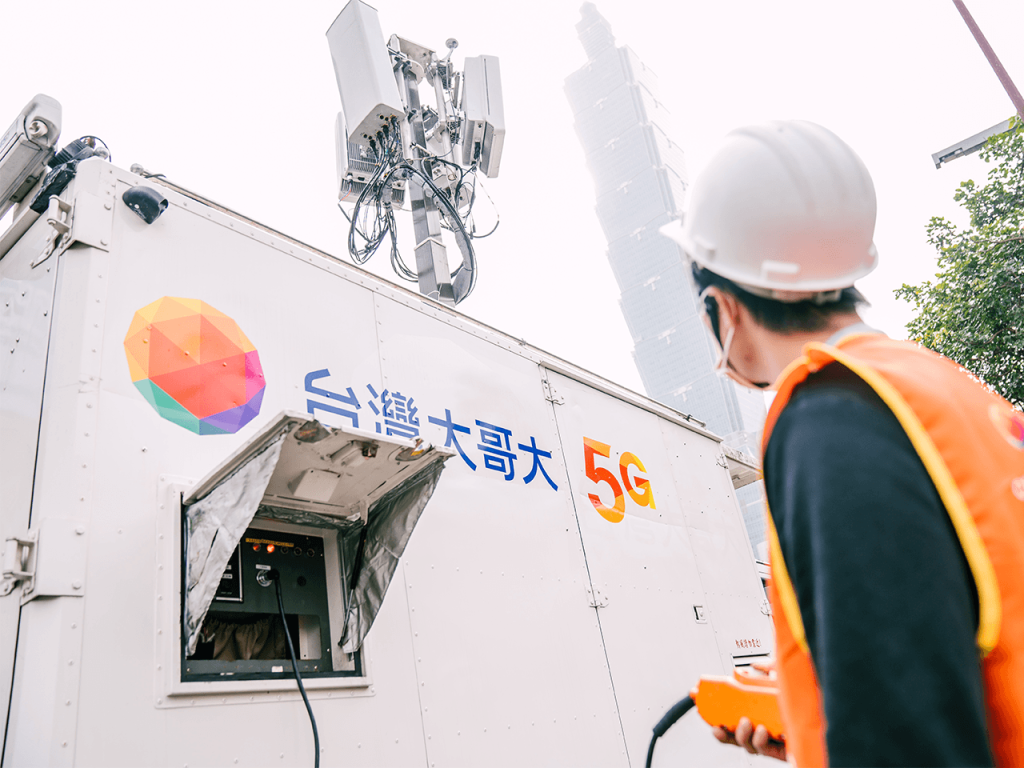
One of Taiwan Mobile’s 5G towers / Photo credit: Taiwan Mobile
To support telecommunications operators, the Taiwanese government has allocated US$650 million, which will be distributed between 2019 to 2022, to subsidize installation works.
Another challenge for 5G development in Taiwan is adopting it for enterprise use.
Most 5G tools and solutions on the market prioritize consumers, as this segment has already demonstrated enthusiasm for 5G, says Wu. Indeed, roughly a third of respondents in a survey by PwC indicated that consumers were willing to pay more for faster internet speeds.

C.H. Wu, chief enterprise business officer of Taiwan Mobile / Photo credit: Taiwan Mobile
In this regard, telcos can help plug the gap by providing solutions and hardware for businesses.
Taiwan Mobile, for its part, developed a communications-platform-as-a-service product known as Cloud PBX.
Launched in 2019, the platform uses 5G to provide the firm’s clients with capabilities such as a virtual switchboard, which alerts up to three devices at once whenever a call is received. This would allow businesses like customer service companies, cram schools, and telemarketing agencies to respond to customer inquiries more quickly.
While the platform uses 5G technology, it is not limited to 5G applications and can be applied to serve as a communications tool for a business’ internet-based services, such as customer outreach, as well.
Apart from this, the telco also recently partnered with systems integration company Smartlink Technologies and cybersecurity startup PacketX Technology to develop a private 5G network for enterprises. With Taiwan Mobile providing the 5G cell tower infrastructure, enterprises can cut back on the initial investment and maintenance costs to acquire such hardware.
Exploring new possibilities
If businesses overcome these challenges in adoption, 5G could prove useful in improving operational efficiency.
One way this can happen is by portioning and distributing the physical 5G network to meet the needs of different individual applications. For example, factories can use one portion of the 5G network to control automated machinery, while the rest of the bandwidth can be used for data retrieval.
Such advancements could reduce capital expenditure and operational costs by 49% and 36%, respectively.
The technology could also give rise to new applications such as self-driving vehicles, which have an estimated value contribution of more than US$100 billion by 2035.
Taiwan Mobile, for example, unveiled two autonomous vehicles, which started their first tranche of trials in 2020, and debuted a self-driving food delivery cart earlier this year.
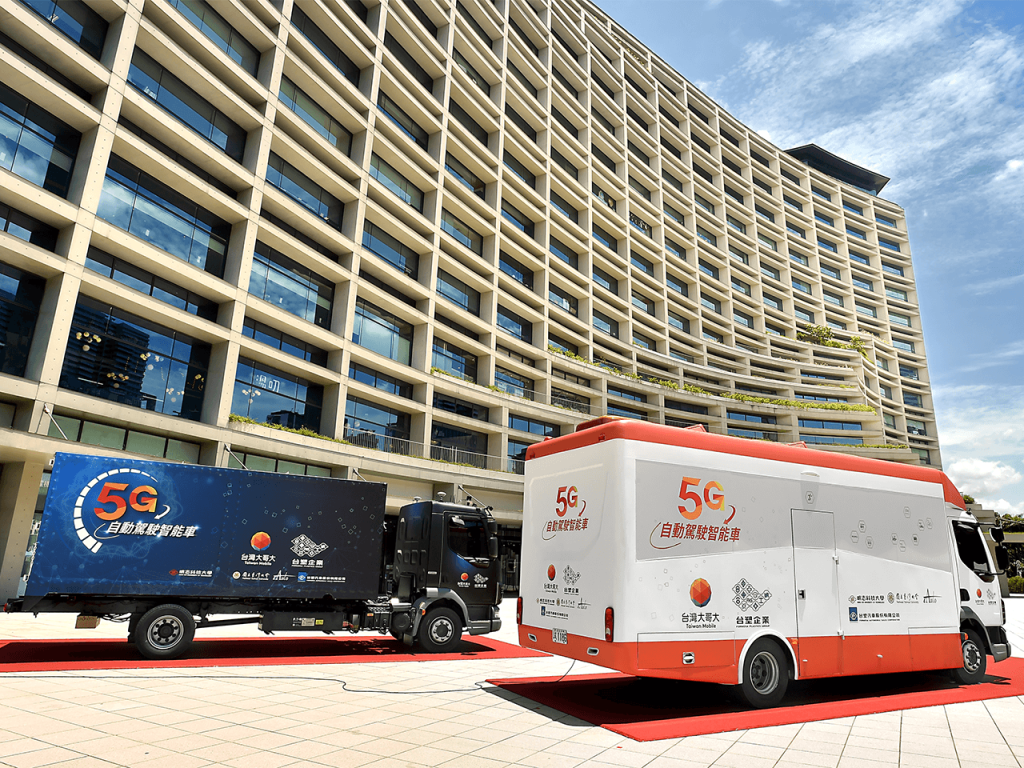
Taiwan Mobile’s autonomous vehicles / Photo credit: Taiwan Mobile
Having 5G capabilities is critical in this field. While on-the-fly decisions would still be made through onboard computing capabilities, the cutting-edge technology is needed to constantly update these autonomous vehicles with information on positioning and roadside conditions, both of which are key aspects to improving driving safety, Wu explains.
Implementing 5G, which is significantly faster than 4G, means that information – such as sudden traffic congestion or heavy rains and flooding – can be fed to the vehicle almost instantaneously.
Autonomous vehicles also rely heavily on AI models to make decisions while driving, and these models need to be kept up to date. 5G allows the data collected by the vehicle to be quickly sent to the cloud and fed to the AI for training, a process which would be much slower with 4G and make day-to-day use of such vehicles more cumbersome. Once AI models are updated, they can be easily downloaded in just a few minutes.
Signaling the future
Looking forward, 5G will continue to have a bright future in Taiwan. According to Wu, 70% of Taiwan Mobile’s enterprise clients have expressed interest in engaging the telco to use 5G as part of their digital transformation journey.
“They see that in the future, businesses must be equipped with 5G capabilities,” he says.
Indeed, industries such as entertainment, smart cities, and healthcare could all see breakthroughs with 5G tech in the coming years.
“Imagine every smartphone user being able to watch 4K or 8K videos or experience augmented and virtual reality applications,” he adds. “We believe that 5G and communication technologies will open up infinite possibilities for the world.”
Taiwan Mobile is a leading telecom operator providing mobile, fixed-line, cable TV, and broadband services. Since officially launching 5G services in July 2020, the company has expanded its offering of 5G solutions to include autonomous vehicles, a cloud-based CPaaS platform, and other business-to-business applications.
To find out more about Taiwan Mobile, visit its website.
This content was produced by Tech in Asia Studios, which connects brands with Asia’s tech community. Learn more about partnering with Tech in Asia Studios.
Stay updated on the go with our mobile app.
Get latest insights with smoother, more personalized experience through TIA mobile app.
Recommended reads
 Extracting battery tech from petroleum waste
 Cerebras builds gigantic AI chips. Can SEA get its hands on them?
 Singtel to launch Nvidia-powered cloud computing offering
 Watching the driver with AI
 South Korea launches $7b plan to boost AI chip production
 IBM, AI Singapore collaborate to improve Sea-Lion model
 Swapping hydrogen cylinders for on-site generation
 The hardware secret that gave OpenAI the edge on Anthropic
 AI bubble grows as bets rise
 Microsoft invests $2.9b in Japan to boost country’s AI capabilities





Editing by Nathaniel Fetalvero and Jaclyn Tiu
(And yes, we’re serious about ethics and transparency. More information here.)







📅 Upcoming Events
22 October 2026
Payoneer x CSPN Summit 2026