- Insights This article was written by a TIA community member. Insights pieces undergo the same rigorous editorial process that newsroom-produced articles have.
 Asaf Shalev · · 3 min read
Armed with military cred, this Israeli startup helps clients fight fake news
After years of leading digital influence campaigns in business and politics, a handful of Israeli entrepreneurs switched sides and founded Cyabra Strategy Ltd., a startup promising to help politicians and brands against digital attacks involving fake news and disinformation.
The startup’s employees come from cybersecurity and intelligence units of the Israeli military, as well as business intelligence companies that specialize in shaping activity on social media using fake profiles, avatars, and bots. This experience helped the company develop a deep learning and big data-based algorithm capable of recognizing when a disinformation attack is happening.
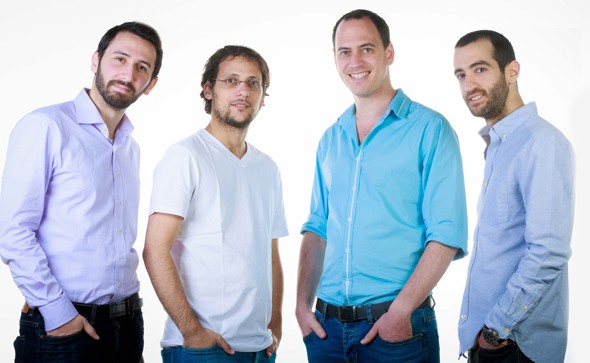
(L-R) Dan Brahmy, CEO; Yossef Daar, COO; Sendi Frangi, CMO; Ido Shraga, CTO / Photo credit: Yaniv Shmidt
Background
Founded in August 2017, Cyabra has raised about US$1 million and employs nine people, according to co-founder and CMO Sendi Frangi. Earlier this year, Coca-Cola selected the company as one of 12 startups for the inaugural class of its technology commercialization program called The Bridge.
“Cyabra was established at the right moment and answers a real need,” said Rami Ben-Barak, a former deputy director of the Mossad (Israel’s national intelligence agency) in a May interview with Calcalist. Ben-Barak, who had also served as the director general of the Ministry of Intelligence Services and the Ministry of Strategic Affairs, is a senior advisor to Cyabra.
“Fake news is a global phenomenon that negatively impacts the economic and the political domains,” Ben-Barak explained. “In my eyes, it is currently one of the greatest dangers to democracy and to the Western world. We are becoming aware that many significant global events are being influenced by groups and interested parties that employ fake identities to create a false reality,” he said.
Disinformation campaigns have been connected to several election campaigns in recent years, including the 2016 US elections. More recent privacy scandals, such as the one involving Cambridge Analytica, have also illustrated just how vulnerable social networks are to outside influence, begetting investigations in the US Congress and the European Parliament.
How it works
The startup’s technology works by searching for several factors that are characteristic of fake profiles, according to Frangi. The first is the date the profile was set up, as false ones are usually created a little before the launch of a campaign. The second is profile history—a three-day-old profile with 700 friends raises a red flag. The third is whether the profile has a wider digital fingerprint that’s characteristic of how real people use the internet.
“Anyone who is active online leaves traces that can be identified—be they a Google+ profile, a blog, or an email account,” Frangi explained. “A real person that is active online will be active in spaces other than their Facebook profile.”
Cyabra can determine the scope and outline of a disinformation attack within a day or two thanks to the help of its AI engine. “Twenty analysts earning top salaries will find out the same information, but it will take six days, and that’s too late,” Frangi said. Early detection is crucial for an effective response, as false information can tank a company’s stock or put a candidate out of the running if it gains enough traction, even if it is ultimately proven false, he added.
As an example, Frangi talked about PepsiCo CEO Indra Nooyi. In a November 2016 interview, she referred to the election of US President Donald Trump, saying many of her female, non-white, or LGBT employees were worried about the ramifications of his policies. Soon after, several websites claimed that she told Trump supporters to “take their business elsewhere.” This led to calls for a boycott and sent the company’s stock plummeting.
“The important thing is to change the narrative,” Frangi explained. “If PepsiCo’s CEO had understood in real time that she was under attack using fake news, she could’ve leveraged traditional media to counteract it. She could’ve gone on CNN or the papers and taken apart the campaign.”
This article is syndicated through Tech in Asia’s partnership with CTech. The original article can be found here.
Editing by Jaclyn Teng





Stay updated on the go with our mobile app.
Get latest insights with smoother, more personalized experience through TIA mobile app.











📅 Upcoming Events
22 October 2026
Payoneer x CSPN Summit 2026