Stefanie Yeo · · 5 min read
Meet the startup that wants to address Indonesia’s challenges with mental health care
When Christian Chonardo was three years into his undergraduate program at Princeton University, he dropped out.
“What I usually tell people is that I dropped out for health reasons,” he shares. “But I don’t tell them that it’s for mental health reasons because the stigma in Southeast Asia is definitely quite bad.”
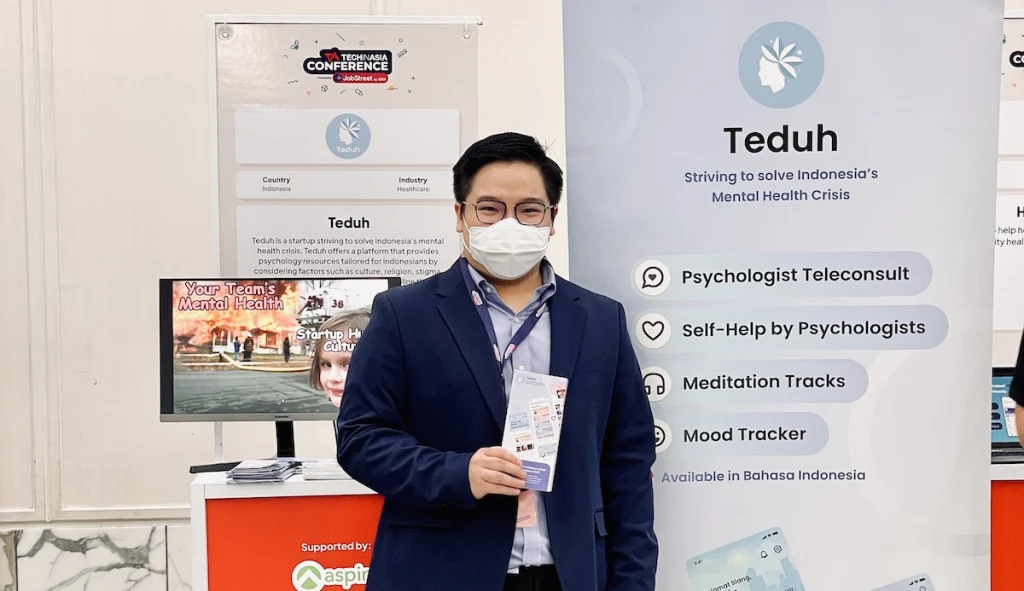
Christian Chonardo, co-founder of Teduh / Photo credit: Teduh
Chonardo was not alone in his struggle. Asia is facing a mental health crisis, with reports of burnout, depression, and anxiety on the rise.
Within Indonesia alone, some 9 million people suffer from depression, and the archipelago has an insufficient amount of psychiatrists to meet the needs of its population. This problem has been exacerbated by the Covid-19 pandemic, where long periods of isolation and uncertainty around health and livelihoods have only worsened the situation. Additionally, the country struggles with misinformation and misunderstandings around mental illnesses that create stigma.
Building for Indonesia
Driven by his own experiences and the stories of others, Chonardo teamed up with Adrianus Matthew and Nicco Parik to establish mental health startup Teduh.
The firm aims to be a one-stop platform for mental health in Indonesia. Through its app, users can access services such as teleconsultations with psychologists, mood trackers, meditation exercises, and self-help courses.
What differentiates Teduh from other mental health apps is that it is customized for the Indonesian landscape.
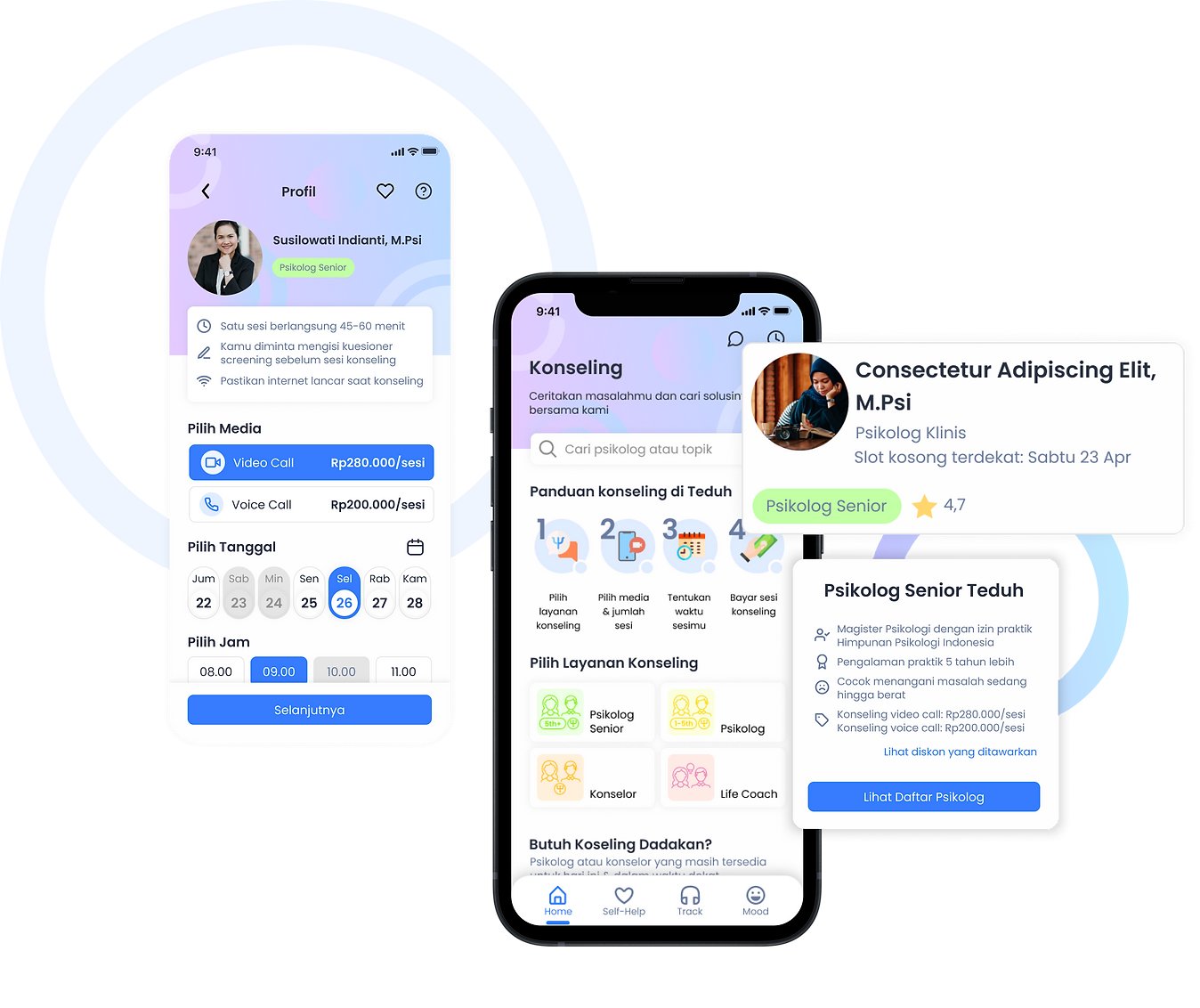
Teduh’s app / Photo credit: Teduh
“A lot of the existing mental health platforms just take Western solutions and try to adopt and translate them into Indonesia. But the country is quite different because there’s a difference in culture, religion, language, and ideology,” explains Chonardo.
For example, if someone is struggling with their gender or sexual identity, a mental health professional who doesn’t understand the local culture may provide support toward coming out and self-acceptance – something that might not work and may actually be dangerous in Indonesia.
“Whether or not that is the right approach is a separate matter,” explains Chonardo. “In Indonesia, where it’s very sensitive, we need to approach it in a different manner, especially because religion, ideology, and even the regulations are not supportive.”
The firm also offers the option for users to remain anonymous when consulting with psychologists on the platform as the stigma around mental health still prevents many from openly seeking help.
“The stigma in Indonesia is still that: hey, will my information leak? Will other people know that I’m depressed? Will they know that I’m seeing a psychologist?” shares Chonardo. “I don’t want that to stop people from seeking treatment.”
Starting simple
Teduh was launched in 2022 with a simple app as Chonardo and his team wanted to validate their ideas quickly before building anything more complex.
“Back in 2018, when I first had this idea, the timing wasn’t right,” he shares. “During Covid-19, I did another round of validation and realized that everyone’s attitudes toward mental health had changed, and we felt that the timing was really perfect.”
The first version of Teduh’s app was very bare – a true minimum viable product (MVP).

Chonardo and co-founder Nicco Parik / Photo credit: Teduh
“I’m actually quite embarrassed to show people [the first version of the app],” admits Chonardo. “For the mindfulness section, it was just a bunch of recordings that I paid a friend to do. I got a psychologist to write posts on anxiety and depression, and for the teleconsults, it was just a WhatsApp button to contact me, and I would manually schedule an appointment.”
The startup also employed a simple marketing strategy, spreading the word online through Facebook groups and Instagram posts. However, simple worked wonders for Teduh as it received an overwhelming response.
“People knew friends and family members who really wanted psychological help, who really struggled with depression, anxiety, and burnout. They wanted to give their friends and family support and also get treatment for themselves,” explains Chonardo. “We ended up having a few thousand individuals sign up within the first month of that MVP.”
Building off the MVP, the team conducted many user interviews in order to better refine and improve on its product, eventually launching the full app in late 2022.
Teduh currently operates on a freemium model. Services such as its mood tracker and meditation exercises are free for users, while teleconsults with psychiatrists are charged, with prices starting from about 120,000 rupiah (US$8) per session. It has also struck up partnerships with organizations such as the University of Indonesia’s Faculty of Economics and Business, making Teduh’s services available to staff, professors, and students.
“We’ve got some 6,000 users on our platform now in the few short months since our launch,” says Chonardo. “Traction is going great so far, both on the supply side, in terms of psychologists signing up, and on the demand side, in terms of users.”
Toward a better future
Teduh raised a pre-seed round from an angel investor at the end of 2022, and with the funding, Chonardo and his team have their sights set on improving the app and keeping up with the platform’s growth. One issue they hope to tackle is that of retention, a challenge faced by many healthtech startups.
“Retention is hard, but only if you have a subpar product,” says Chonardo. “What we’re trying to do is to iterate as much as possible to build habits for our users.”
This would involve doing A/B testing, setting up infrastructure to support more data-driven approaches, and gamifying features to get users to access the app more frequently.
The team also has its eyes set on expanding overseas.
“Once we’re able to penetrate the whole of Indonesia, we plan to expand to other regions around Southeast Asia to make sure that mental health care is affordable and available to all the people who need them in [the region],” Chonardo explains.
Above all, Teduh hopes to play a pivotal role in supporting Indonesians on their mental health journeys.
“Unlike physical health, where you go to the doctor, get medicine, and you’re done, mental health is about building habits that last, changing your thought patterns and your lifestyle,” Chonardo says. “We want to build products that support our users in their mental health journey, to change and develop better habits for better mental health in the long run.”
This content was produced by Tech in Asia Studios, which connects brands with Asia’s tech community. Learn more about partnering with Tech in Asia Studios.
Stay updated on the go with our mobile app.
Get latest insights with smoother, more personalized experience through TIA mobile app.
Recommended reads
 Asia’s AI divide: Creators vs. experimenters
 IBM on AGI: bad math, wrong science
 Sam Altman’s lesson from Google: Trust over ads
 Our CTO of the Year weighs in on tech, leadership, and innovation
 GitHub clocks record 1.7m users in SG as AI reshapes coding
 Rethinking Singapore’s biotech bet
 AI bubble grows as bets rise
 Coach Gemini is in session
 If AI eats the world, what’s for dessert?
 ASEAN Foundation, Microsoft partner for AI upskilling project





Editing by Jonathan Chew and Lorenzo Kyle Subido
(And yes, we’re serious about ethics and transparency. More information here.)