Nadine Freischlad · · 10 min read
Why motorcycle taxi drivers are ganging up against on-demand ride apps in Indonesia
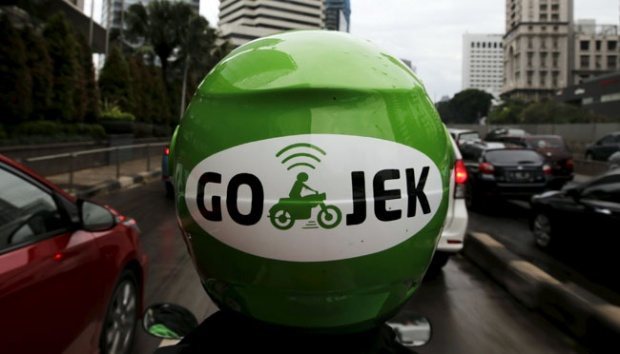
Drivers of motorcycle-taxi apps like Go-Jek are increasingly becomeing part of Jakarta’s cityscape (Image from Tempo.co)
All over the world, there have been protests against companies that use technology to disrupt traditional transportation. On-demand ride service Uber has been the most prominent target.
With Uber’s app, any car owner can become an impromptu taxi driver, pick up a passenger near them, and drive them to their destination for a fee. However, taxi drivers feel their business model is threatened by the presence of Uber. In France, cabbies have taken to the streets in violent protests against the company.
Indonesia has seen its own backlash against Uber. But in the past month, the heated conflict between motorcycle taxi booking apps like Go-Jek and GrabBike and traditional motorcycle taxi drivers has been far more prominent.
Independent motorcycle taxi drivers – locally referred to as ojek – are banding together, putting up banners and using intimidation tactics to keep Go-Jek and GrabBike from entering certain areas.
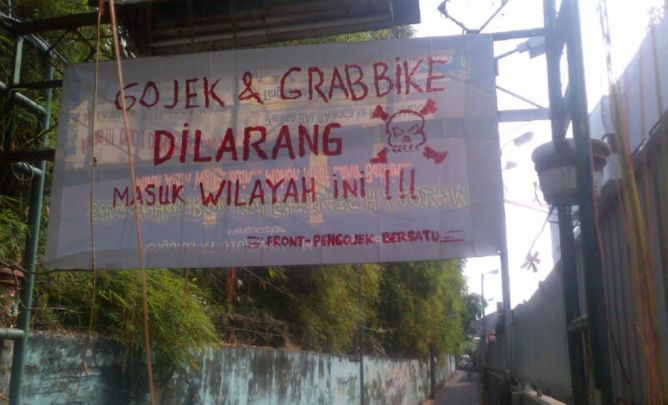
An anti Go-Jek and GrabBike banner in Jakarta’s Pancoran area. (Image from Metrotvnews)
Ojek as a form of transportation
Motorcycle taxis are an extremely widespread mode of transportation in Jakarta, a notoriously congested, pedestrian-unfriendly city. Informal motorcycle taxi hubs can be found on nearly every street corner. Ojek drivers do not undergo a vetting process, and are not registered anywhere. Payments are made in cash, and prices are a matter of negotiation. Ojek are deemed unsafe, and the helmets they provide unhygienic. The process of haggling for a price is annoying. Overall, ojeks are a mode of transportation Jakartans love to hate but depend on.
The local startup Go-Jek has actually been around for years, trying to improve ojek transportation by organizing a fleet of trusted drivers. But it was only in the beginning of this year that Go-Jek launched an app and got serious about expanding its network of drivers.
Through the app, users can order motorcycle taxis instead of picking one off the street. Drivers are rated after the experience. They register with Go-Jek, undergo a basic vetting process, and offer passengers clean helmets and face masks. In June, Malaysia’s GrabTaxi launched a similar service in Jakarta called GrabBike. However, with its head start, Go-Jek is the more prominent service so far, which is why it stands in the spotlight of the conflict.
By and large, Jakartans welcomed app-based motorcycle taxi services, since they make an informal but necessary mode of transportation more trustworthy. Drivers, too, have welcomed the opportunity: Go-Jek now claims to have signed up more than 2,500 drivers, and their trademark green helmets and jackets have become part of the cityscape.
I book a Go-Jek almost every day and habitually chat to the driver. All but one of them report an increase in income, since they no longer have to wait for passengers but can pick them up anywhere. The one who said his income was unchanged still found the app useful because it makes finding new passengers easier.
So why are these services met with resistance from some ojek drivers? Most Jakartans see their behavior as backward, and are starting to question the city’s readiness for technological innovation.
Backlash
Kalibata City, a massive apartment complex in South Jakarta, seems to be the backlash hotspot. Its thousands of inhabitants make it a lucrative hub, and each of the five major gates leading into the complex has its own street corner with ojek drivers in line, ready to take on passengers. Banners attached to trees and fences make it clear that Go-Jek and GrabBike are not welcome in this territory.
The heart of the problem
When joining Go-Jek is not an option
Spreading itself too thin?
After the honeymoon





Stay updated on the go with our mobile app.
Get latest insights with smoother, more personalized experience through TIA mobile app.