Dear readers,
Have you tried putting a child in front of a computer to watch an online class?
I have, and trust me when I say that it’s hard for them to pay attention. Granted, my kid was only three years old, but even as a college student, I would struggle to listen to a lecture with Facebook showing on my laptop screen.
Nothing beats having a teacher being physically present, and even the use of technology in a classroom isn’t a slam dunk, a McKinsey & Company study found. For some reason, using tablets led to worse outcomes compared to a laptop or desktop.
Education tech, of course, is all the rage among Asia’s startup community these days. In a two-parter, our analyst Simon Huang examined the unexploited opportunities and biggest challenges in Indonesia’s edtech sector.
We find that while a lot of players are focusing on the K-12 segment (5- to 18-year-olds), there are many startups carving out niches in adjacent areas.
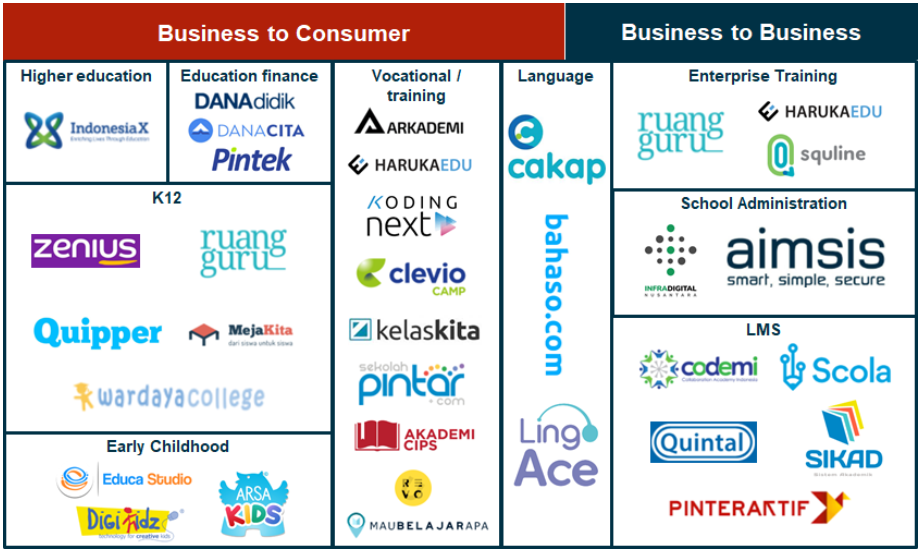
On whether technology improves education, there are two angles to consider. First, managing expectations. Tech was never meant to entirely replace old-fashioned teaching, though Covid-19 has forced our hand.
Second, edtech firms are constantly improving their methods and content. Simply recording a classroom lecture isn’t going to cut it.
Meishubao, a Tencent-backed art education startup in China, pairs an iPad with a snap-on mirror to make it easy for the teacher to view and give feedback to the student’s art piece in real-time. (You’re better off watching this video to see what I mean.)
Edtech firms also have a possible advantage in data, which enables them to understand each student’s behavior. As such, providers can customize their approaches based on users’ learning style and progress. That’s all in theory, of course – I’ve yet to see proof that such personalizations are effective, or maybe I’m just living under a rock.
Good teachers, of course, tweak their approach based on each student’s needs.
This brings me to my next point. In countries where good teachers are scarce and classroom sizes are large, edtech – even if unrefined – can perhaps make an impact.
It’s telling that Byju’s in India and Ruangguru in Indonesia have raised huge sums of money.They might thrive amid education systems that are not up to par.





Stay updated on the go with our mobile app.
Get latest insights with smoother, more personalized experience through TIA mobile app.











📅 Upcoming Events
22 October 2026
Payoneer x CSPN Summit 2026