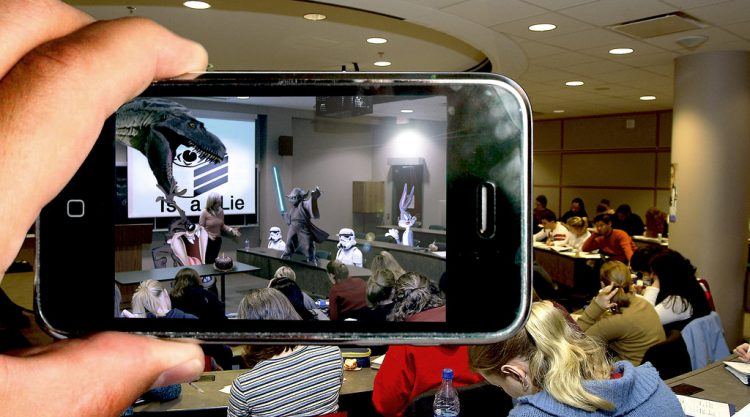
See a new world with augmented reality. Photo credit: Flickr.
Imagine calling up your friend in a land far away and instead of talking with a voice on the phone or screen, interacting with her hologram in real time, in your living room. Or wearing a lens over your eye that projects all you do with your phone on a virtual screen in front of your eyes, just like Iron Man’s Jarvis. That’s augmented reality (AR), in a nutshell, for you.
It’s a technology that overlays virtual elements on a real-world scenario, which you can then interact with in real time. It can be developed into apps and used on mobile devices. Microsoft’s Research team has already given us a glimpse of the technology that ports the hologram of a person, using a special rig of cameras and Microsoft HoloLens headset.
But augmented reality is not to be confused with virtual reality. While augmented reality enhances the real world setting with virtual interactive elements, virtual reality will recreate a different setting digitally in your living room, obliterating the real world setting.

Photo credit: Luke Wroblewski.
India’s perfect for AR
Virtual reality is at the moment just that – virtual. The hardware backing the technology is still far from mainstream and only a handful of content is available. What’s more, the VR devices available today do not have the capacity to run a video for more than 5 minutes or so.
The hardware ecosystem for augmented reality, on the other hand, is fledgling. Your smartphones, tablets, or even your laptops can be used to enable augmented reality. And that’s the reason industry experts feel AR will beat VR into early adoption. Tech in Asia met with prominent players in the AR/VR space on the sidelines of the Nasscom Game Developer Conference in Hyderabad to decode the assumption.
“The reason why VR has not picked up as yet, despite huge hype over it, is because of the hardware ecosystem for it. It is expensive and impractical. AR hardware is already there in our hands, our phones. It makes sense to develop AR content,” says Prakash Sayini, director at Deloitte.
Augmented reality mobile gaming apps are poised to reach 420 million downloads by 2019.
We have already seen a hit in the AR space with Pokemon Go. The mobile game developed by Niantic for iOS and Android devices and released in July garnered over 20 million active users. Now, Hyderabad-based gaming startup Empower Labs has also launched India’s first augmented reality game, Delta T, which is based on time travel.
Globally, Magic Leap, its investor Google, and Microsoft have been working in the area of AR with a virtual retina display, Project Tango, HoloLens, and Google Glass. Google attempted to bring AR to the masses by launching Google Glass in 2013, but the premium pricing of US$1,500 spelled doom for the device and failed to make an impact in the market.
“Even when new hardware is being developed and tested for AR as we speak, it’s not a worry if it takes another three to four years to hit the market. Because smartphones and tablets are available which can be used to bring consumers on board,” says Soumyajit Deb, senior staff engineer at Qualcomm’s corporate R&D center.
India’s thriving smartphone market has made it conducive for AR. The country is touted as the second-largest market for smartphones after China, overtaking the United States. The Indian smartphone market grew 23 percent in the first quarter of 2016. Subsequently, the Indian AR and VR market is projected to grow to US$90 billion by 2020, from US$1 billion currently, according to Deloitte. Augmented reality mobile games are poised to reach 420 million downloads by 2019, according to Juniper Research.
Appeal to the masses, find everyday utility
Room for improvement
Virtual trial rooms





Stay updated on the go with our mobile app.
Get latest insights with smoother, more personalized experience through TIA mobile app.









📅 Upcoming Events
22 October 2026
Payoneer x CSPN Summit 2026