How the matchmaking system works is probably one of the most important, yet difficult to understand things in Dota 2. Players often wonder what they did to deserve to be paired up with four unskilled players and be pitted against what seems to be a team of well-coordinated pro’s. The chance that you will encounter nine evenly skilled players looking for a serious competitive match is little to nil.
That’s all about to change, though, as the next major update will be including the Dota 2’s Ranked Matchmaking. A recent post on the Dota 2 blog gave a detailed explanation on how matchmaking works, but if you’re the type who would like to skip the hardcore details and numbers at the moment, we got you covered.
What is ranked matchmaking?
Ranked matchmaking works by finding ten different players to match up in a public game depending on their matchmaking rank (MMR). This reduces the chances of high-skilled players getting matched up with low-skilled players and increases the chances of having a better game compared to regular matchmaking public games.
Regular matchmaking also makes use of the same MMR system. The difference here is that in ranked matchmaking, a player’s MMR is made visible to give you a better idea of your current skill and progress. The MMR will only be visible to you and your friends after the calibration phase consisting of your first 10 games in ranked matchmaking.
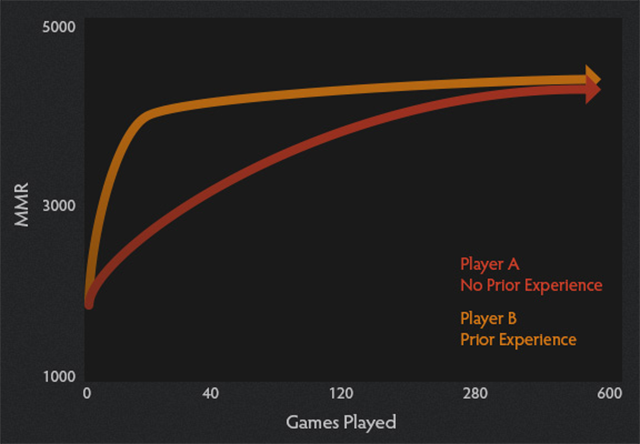
A graph illustrating the growth of a player with prior experience in Dota 2 and one without
This new feature is for players who seriously want to excel by competing with other experienced players, and is only available to players who have played at least 150 games. Players who queue in ranked matchmaking are expected to be more skilled and up for a challenge as opposed to those who use regular matchmaking. Players have a different MMR for regular matchmaking and for ranked matchmaking. Also, the MMR of one matchmaking system will not affect the other.
How is MMR determined?
There are a number of factors that determine your MMR. A player’s win-loss ratio greatly affects your matchmaking MMR. Wins make your MMR go up while losses make your MMR go down. However, aside from the win-loss ratio, Dota 2 also considers uncertainty, which measures the likelihood of your MMR being inaccurate due to any number of uncontrollable or undetermined factors. Having higher uncertainty means higher adjustments while a lower uncertainty means smaller adjustments. For example, players with new accounts as well as those who are new to ranked matchmaking have higher uncertainty. This way, it is still possible for your MMR to go up after a loss based on your individual skill.
How does the matchmaking system work?

Basically, the idea is to find ten different players within the same skill range while considering how many are playing in parties and the common language selected. With the aim to give both teams an equal shot at winning, the system will also consider the discrepancy of skill between teams. In this sense, the most skilled player for the Dire should be on par or within range of the most skilled player for the Radiant. The same goes with the least skilled players. However, not all of these requirements are satisfied 100% of the time. In such cases, the system makes a match with the best possible conditions with regards to these requirements.
Parties are a bit trickier since the skill level of players in a party can’t be controlled by the game. Because of this, the system determines the collective skill level of the party and uses that to find matches instead. This way, solo players will get matched with a party whose total average skill is close to theirs. This allows the players to be within everyone’s range of skill level.
No word yet as to when we’re getting this major update, but it’s possible we will see it later this week. According to Valve, the system is subjected to constant reevaluation and that it may change if deemed necessary based on performance data and feedback from the community. Although the ranked matchmaking doesn’t ensure a toxic-free environment, but for those looking to improve or go competitive, it is indeed a better way to find more serious players. A more detailed look on the matchmaking system is available on the Dota 2 official blog.





Stay updated on the go with our mobile app.
Get latest insights with smoother, more personalized experience through TIA mobile app.