 Rebecca Liew · · 6 min read
The evolving formula for building a successful and engaging online platform

Instagram, TikTok, and Facebook: What is it about these social media platforms that makes them so addictive to their 3.6 billion users worldwide? Beyond the fact that they whet our mostly visual appetites, their endless scroll function keeps users habitually checking back for fresh content and “likes” – and the teams behind these platforms know it.
With the online space brimming with more content than ever before, businesses are finding new and better ways to capture and retain users’ attention. Last year, 40 million people in Southeast Asia came online for the first time, underscoring the fact that internet users are at various stages of adoption and may have different needs – including requiring more time to familiarize themselves with a platform or an app.
For businesses, one solution to capturing these varied user segments and demographics starts with creating a seamless user experience (UX) to keep users returning.
The recipe for engagement
“When it comes to creating an engaging and easy-to-use app, there is a very simple measure of it, which is whether users revisit the app on a regular basis. This shows their genuine interest in it,” says Shailesh Nalawadi, head of product at Sendbird, a chat application programming interface (API) provider that helps businesses create user-friendly features more easily and quickly through its pre-built components.

Shailesh Nalawadi, head of product at Sendbird. / Photo credit: Sendbird
According to him, user engagement doesn’t just mean “likes” or interactions in a post. It might also look like a user making a purchase on an ecommerce app then returning to it a day later to check on the status of an order, or revisiting a dating app to check if any new messages have come in. Another instance is when someone gets momentarily distracted by a notification on their phone and is compelled to check it immediately.
The importance of creating an engaging app for users doesn’t come easy: It first requires understanding how users think, something that Nalawadi agrees is highly subjective.
“There are many frameworks for thinking about user engagement, and one framework that I’ve found very helpful is looking at the critical user journey,” he shares, referring to the paths that users may take to reach their goal when using a website. In the process of designing a website or an app, a company can rely on the user journey to plan the various ways that users can achieve their objective on the platform as seamlessly as possible.
“Let’s say I want to check if someone has responded to my Instagram post. I do so by launching the application, clicking on the ‘heart’ button, and checking for likes or comments. The critical user journey measures how easy it is to achieve this goal of checking on post interactions,” Nalawadi adds.
Understanding what users seek from a platform can help shape the features that software engineers and product managers develop for it. This, along with a seamless UX and building a strong community of users, are the ingredients that will keep users returning.
Reddit is one powerful example of how these elements can be successfully brought together. The social news platform boasts over 430 million members who voluntarily and actively create, join, and return to threaded conversations and discussions on smaller communities known as subreddits, as well as upvote, downvote, and share content.
“Customers like Reddit built and customized these experiences on their own using our earliest software development kit (SDK),” Nalawadi shares. “Reddit was an early adopter and had known what building blocks were missing for them. They were pretty clear about how [they wanted] to use our SDK to build their user engagement and conversational experiences by allowing users to interact with each other through chat.”
New conversational approaches
But these conversations don’t necessarily have to take place in their most basic form of user-to-user interaction or user-and-business interaction via a website’s chat tool.
“Conversational experiences aren’t just about chatbots and basic chat functions,” Nalawadi points out. “Today, every kind of interaction has been turned into a series of conversations. This happens even when an ecommerce system emails you to say that payment for a purchase has been received, and then sends another email saying the order is on its way.”
For instance, one of South Korea’s largest ecommerce businesses uses Sendbird’s chat API to create a live commerce experience for its users where they can engage in real-time chats during the livestreaming of product shows. Since its launch, the company has seen a manifold increase in its user base, and is driving higher conversions.
“Essentially, you can model a payment between two people as a chat,” the Sendbird product head adds. “So there are static communities and conversations, and then there are communities that come together for a moment in time.”
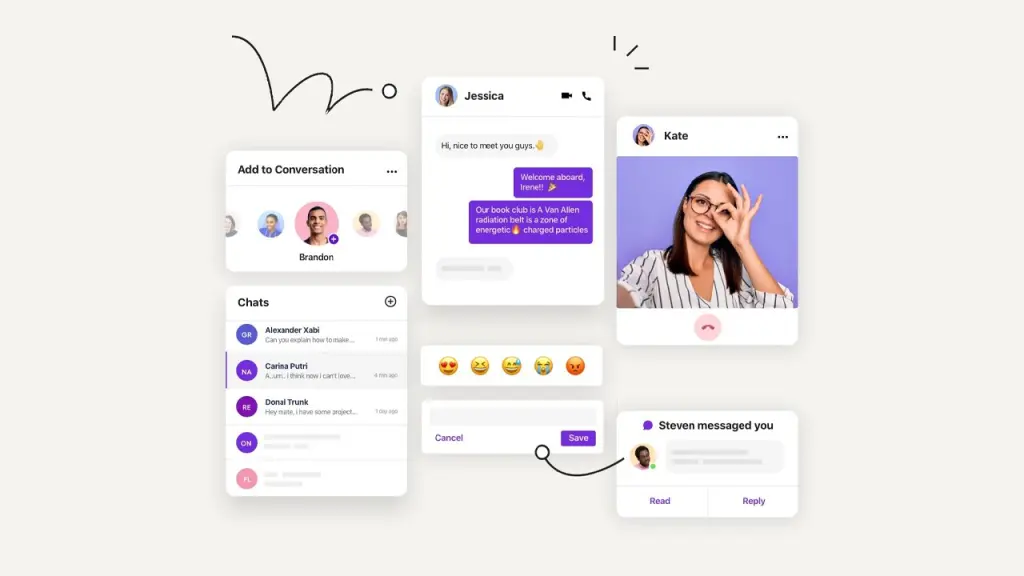
An instance of how businesses can easily build chat features using Sendbird. / Photo credit: Sendbird
Last year, consumers faced a dearth of physical events amid strict lockdown measures and social distancing rules, which has amplified the need for businesses to find alternative means of retaining users. This has led to the rise of shared livestreamed virtual experiences organized around influencer marketing and live commerce – a combination of the ecommerce experience with live video streaming by an influencer.
“It’s not as simple as a video and live chat on the site,” Nalawadi says. “Let’s say you have a livestreamed online concert with 10,000 participants. Can you imagine if every one of them is typing a message at the same time, and no one can read what’s going on?”
In response, Sendbird launched last year an application known as open channel dynamic partitioning – one that divides a large number of participants into smaller communities, allowing them to “have more intimate conversations while feeling like they’re part of a larger community of 10,000 people watching the [same] concert.”
Evolving with the times
This – helped in large part by the world’s largest messenger apps, among them Facebook’s Messenger, WhatsApp, and Telegram – has redefined the idea of community and conversational experiences altogether, as well as allowed consumers to become increasingly comfortable with having conversations in different settings, whether one-on-one, in a group, or with businesses.
“Over our years of building chat API experiences and working with some of the largest and most innovative customers, we’ve refined our solution and learned more about the cutting-edge innovations in chat,” shares Nalawadi. In 2020, the firm launched a user interface (UI) kit that allows customers to implement standard UI and UX components in a mobile application in a matter of days, from improving core chat and community features to tweaking color palettes.
As the traditional idea of what conversations could be continues to evolve, the product head says that maintaining or growing audience engagement goes back to assessing the critical user journey.
“This helps you decide what your north star is, what your KPIs are, and the kinds of conversations that could help your platform to stand out,” Nalawadi says.
Sendbird is a chat API provider with a client base of users from over 150 countries. Its chat, call, and desk solutions have serviced an extensive range of use cases across communities, marketplaces, and on-demand services, and in the sectors of gaming and ecommerce.
The company is hosting a code cafe workshop on March 30 (11 a.m. to 11:30 a.m. SGT), where Sendbird solutions engineer Alex Orr will address how to handle complex conversations with the use of Sendbird’s suite of moderation features. Register for it here.
This content was produced by Tech in Asia Studios, which connects brands with Asia’s tech community. Learn more about partnering with Tech in Asia Studios.
Stay updated on the go with our mobile app.
Get latest insights with smoother, more personalized experience through TIA mobile app.
Recommended reads
 Indonesian AI startup goes global
 Forrest Li on scaling Sea, building smarter bots, and founder grit
 An AI assistant that joins sales calls and scores team skills
 SGX’s CEO says it doesn’t need a unicorn to win
 SMEs want AI too, but not the kind Big Tech is selling
 Oatside’s alt-milk rise hits a profitable gear
 Alibaba’s financial health in 12 charts
 Asia’s telcos bundle AI into mobile plans. Will it pay off?
 M-Daq chases bigger clients as revenue falls, losses grow
 VC tracker: Accel raises US$3.5b, including US$550m for India





Editing by Nathaniel Fetalvero, Winston Zhang, and September Grace Mahino
(And yes, we’re serious about ethics and transparency. More information here.)




