Terence Lee · · 2 min read
CtrlWorks’ robots to assist doctors in S’pore hospital, gets featured on PopSci
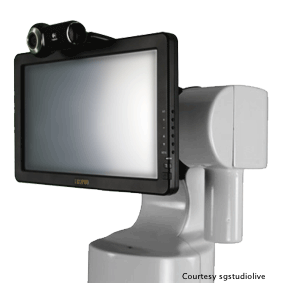 The first time we heard about CtrlWorks and their robots was at DEMO Asia 2012, where they unveiled their prototype. Called the Puppet, the telepresence robot allows a person to interact with a distant environment without being physically there.
The Singapore startup is now preparing for a trial at Khoo Teck Huat Hospital that will start this month. Junior doctors will learn how to operate the Puppet, which will enable them to accompany senior doctors from a remote location.
It is hoped that the robot will lessen the workload of junior doctors by helping them to scribble notes and input data into a medical database, freeing them up to work on other tasks.
The Puppet consists of a touchscreen LCD monitor with a camera, microphone and a speaker to enable two-way communication. The doctors can drive the robot, control the display and adjust its direction. More costly machines come with camera zoom, larger display, wifi and 3G/4G connectivity.
Controlling the robot doesn’t require specialized hardware; all that’s needed is a Windows PC, Mac, or Linux machine.
Beyond acting as a junior doctor, the Puppet could eventually operate alone to check on patients, with the operator controlling it from a different location. This saves traveling time and costs, making it useful for assisted home care and nursing homes.
The startup was recently featured on Popular Science and Singularity Hub. It supported by NTU Ventures and the Singapore government’s Interactive Digital Media Programme Office.
This is not the first time telepresence robots are being used in a medical setting. In Boston, United States, such devices are being used to check on post-operation patients in a children’s hospital.
Telepresence robots have other potential applications, of course. Google co-founder Sergey Brin once attended a conference using a robot that was connected to Skype.
In the future, instead of traveling physically by plane, we could be attending some of our meetings remotely. Freed from the constraints of a teleconferencing room, we could roam around a distant location and interact in ways that wasn’t possible before.





Stay updated on the go with our mobile app.
Get latest insights with smoother, more personalized experience through TIA mobile app.