 Josh Horwitz · · 9 min read
Storage wars: a look at Hong Kong’s storage startup scramble
In crowded Hong Kong, a startup race-to-the-bottom has begun, and the contestants have barely passed the starting line.
Within the past six months, five companies – Boxful, Spacebox, Klosit, StuffGenie, and GoNLive – have emerged to import a winning business model to a city strapped for space. Each company offers the same service: A person with too much stuff lying around will open an app and order a plastic box to be delivered to his apartment. After its arrival, the customer throws his or her junk box in the box (winter clothes or old photo albums, for example), which is then sent to a warehouse for storage. The customer is charged a minimal fee – usually about US$7 dollars per month – for each box in the facility.
These businesses leverage the internet to manage box booking, database technology to tackle warehousing, and tracking technology to oversee a box’s location. But their real technological innovation lies in a specific form factor – a reusable plastic box.
Traditional warehouse storage businesses typically require customers to take out leases on a large storage closet. They also have to pack up their belongings themselves and watch after the space. Often, units only get partially filled.
These on-demand businesses maximize efficiency by confining packages to a standard-unit size. It’s the sort of business model that could have existed in the seventies, but resonates particularly in today’s climate of “Uber for everything.”
Five firm scramble
Given the already generic nature of startups’ business models, it’s pointless to argue over which one arrived in Hong Kong before the rest.
“I’m keeping track of every single company that does this in the world, and by my count, it’s up to thirty,” says Mark Sims, founder of GNL Storage. “It’s really in the last three to four months that they’re popping up in Hong Kong. And they’re all claiming first mover advantage.”
Boxful, which Tech in Asia profiled in January, is founded by Norman Cheung and Carl Wu, two native Hong Kongers whose last venture was Zooq, a Chinese ecommerce company that sells women’s clothing. The two scored US$1.5 million in angel funding for Boxful, making it one of the better-backed storage startups in the city.
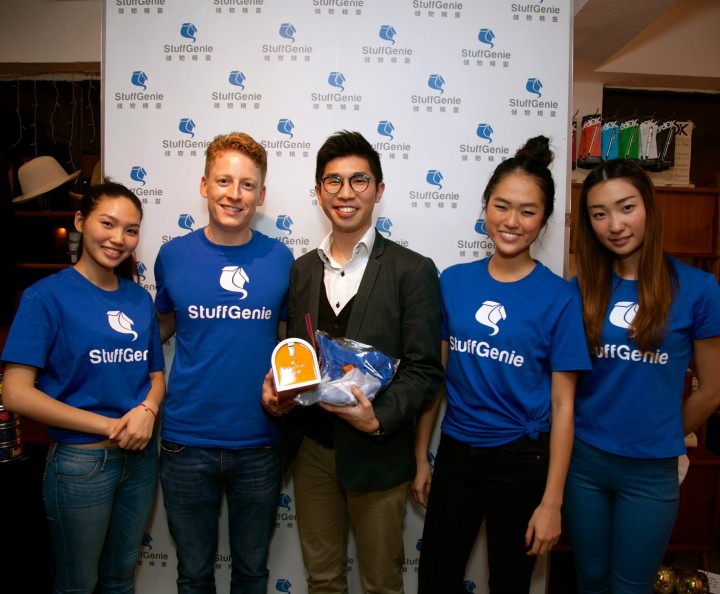
StuffGenie’s founding team also has roots in China’s fashion industry. Co-founder Miles Davison worked as general manager of Lifestyle Logistics in Shenzhen for two years, where he helped oversee a total of 60,000 square warehouse spaces that housed inventory for luxury brands. He teamed up with his brother Charlie, a web developer, to build StuffGenie.
“We know that this on-demand valet storage model is not new, but we felt we had an opportunity to do it better than other companies had been doing, particularly with respect to the customer experience,” says Miles.
Louis and Stuart Cerne of Spacebox are another sibling team looking to crack the market. While the two don’t have a logistics background, they co-founded Enecore, a climate mitigation consulting firm that they later sold to an investor. Unlike Boxful and StuffGenie, the Cerne brothers’ discovery of the box-on-demand model was somewhat accidental.
“We started out looking at made-to-measure furniture,” says Louis. “In Hong Kong, the problem is that apartments are weirdly laid out and furniture never quite fits. Through that process, the idea became to take storage out of the house.”
The Hong Kong no-brainer
Inside outsourcing
Winner take all?
Storage startups and the global logistics fabric





Stay updated on the go with our mobile app.
Get latest insights with smoother, more personalized experience through TIA mobile app.








📅 Upcoming Events
22 October 2026
Payoneer x CSPN Summit 2026