Terence Lee · · 5 min read
Cofounder of Kazaa and Skype, Niklas Zennström Speaks To Singapore Audience
 For a time, Niklas Zennström had to share an apartment with two people: His wife and business partner Janus Friis. The environment for technopreneurs was tough then, at the turn of the millenium. The dot-com bubble had burst, and investors were scared of putting money into Kazaa, a peer-to-peer file sharing software.
Good thing he had help. “My wife was super supportive and she had a good job at the telecommunications company where she had a good salary, so she could pay the rent and put food on the table,” he said at a talk organised by the Infocomm Development Authority of Singapore on 29th April.
As if there was not enough trouble already, Kazaa was fast becoming the next Napster, with record labels hounding them because users were sharing music using the software. Realising the trouble was not worth it, Niklas and Janus sold Kazaa to Sharman Networks at “essentially nothing”.
The idea for Skype came out of necessity. Since Niklas and Janus were bootstrapping, they had to find ways to save costs while making long distance calls. They soon realised that the peer-to-peer technology they had been developing at Kazaa and Joltid was the breakthrough they need to make Skype work.
The company, started in 2003, was sold to eBay for a cool 2.1 billion Euros in 2005 (roughly S$3.8 billion today). The success of the software could also be attributed to the fact that people were starting to use broadband Internet networks, which makes voice calls viable.
Today, Niklas is the founder and CEO of technology investment company Atomico, whose portfolio includes Technorati, Last.FM, Seesmic and Rovio (maker of Angry Birds).
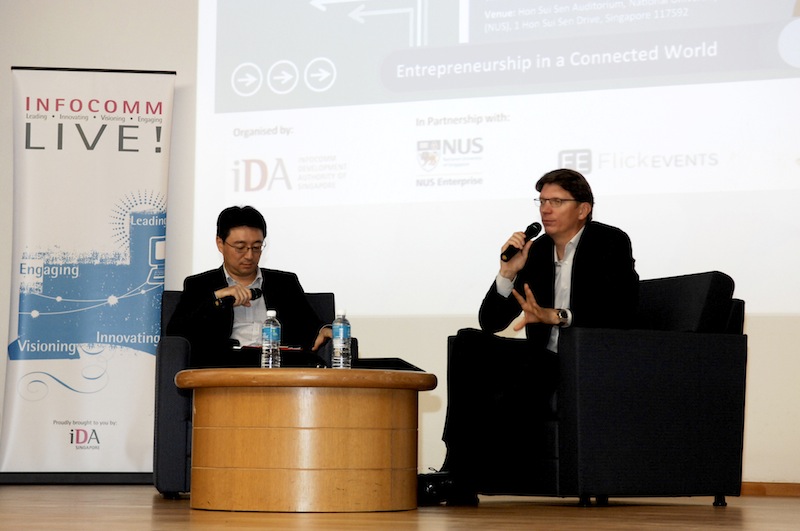
From left: Mr Robert Kim, (Director of Consumer Infocomm at IDA), Niklas of Skype and Atomico speaking in Singapore.
If I’m a student and I want to start a company, what should I do?
You need to finish your university degree. No investor will ever invest in someone (with very few exceptions) who’s a dropout from university; it’s a very bad track record. When you go to university, try to do extra curricular things that are entrepreneurial, like selling something.
There’s a great opportunity at university to team up with people from different disciplines. If you’re an engineering student, make sure you make friends with people from business school and behavioural science for example. People from cross-disciplines make a good combination.
What was different between now and 10 years ago?
The world is becoming much smaller, more of a global market. It may be harder to become a regional winner. Global winners tend to out-compete regional players before they can be protected by being the winner in their region. The financial upside of being a regional player is very limited too.
But the benefit of being in a small market like Sweden which has nine million people is that you will tend to think of the world as your market. It’s similar to Singapore which is a very small domestic market. Here people have to think about expansion and how to attract businesses here, and making businesses international. And that’s a good environment for being competitive.





Stay updated on the go with our mobile app.
Get latest insights with smoother, more personalized experience through TIA mobile app.