Chinese scientists have achieved a series of breakthroughs in stealth materials technology that they claim can make fighter jets and other weaponry lighter and cheaper to build and less vulnerable to radar detection.
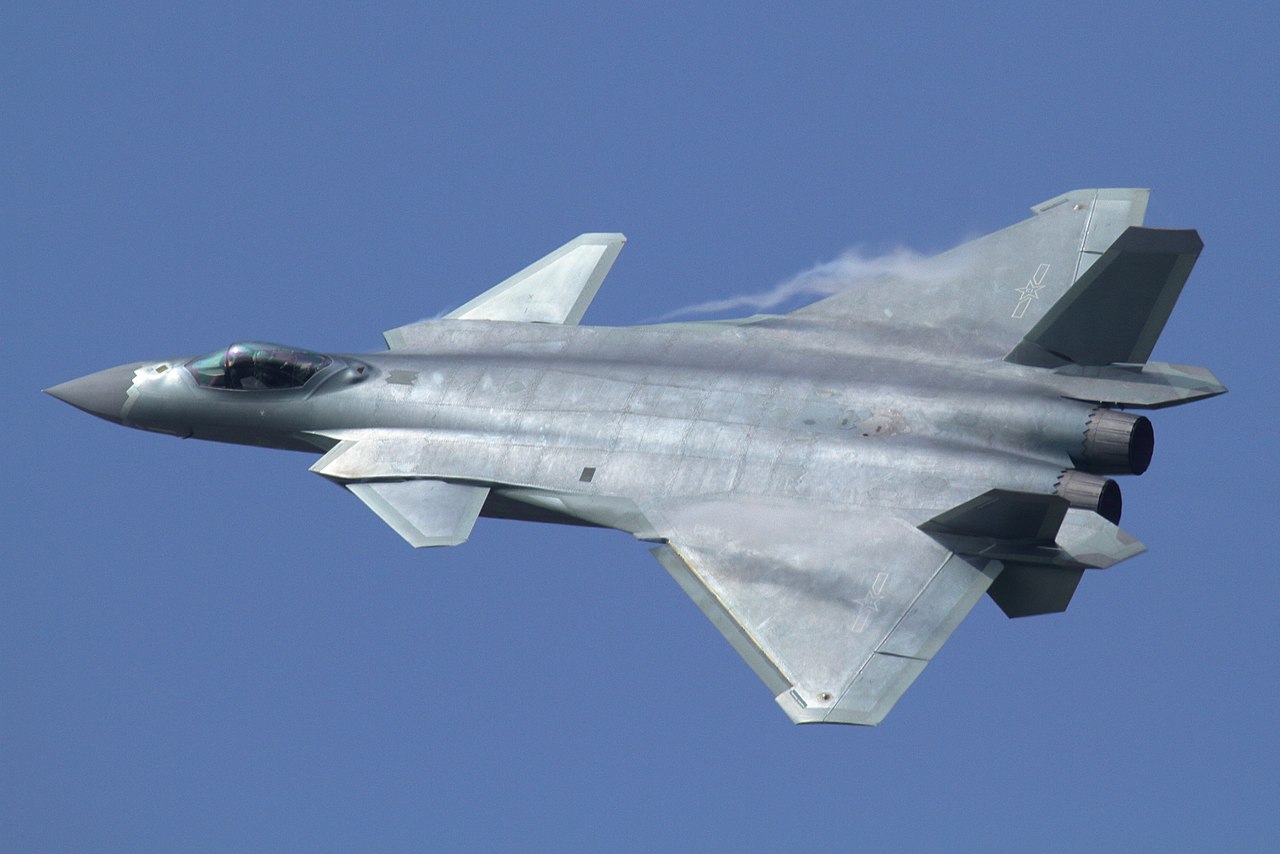
Flypast of the Chengdu J-20 during the opening of Airshow China in Zhuhai / Photo credit: Alert5
Professor Luo Xiangang and colleagues at the Institute of Optics and Electronics at the Chinese Academy of Sciences in Chengdu, Sichuan province said they had created the world’s first mathematical model to precisely describe the behavior of electromagnetic waves when they strike a piece of metal engraved with microscopic patterns, according to a statement posted on the academy’s website on Monday.
With their new model and breakthroughs in materials fabrication, they developed a membrane, known as a meta-surface, that can absorb radar waves in the widest spectrum yet reported.
At present, stealth aircraft mainly rely on special geometry – their body shape – to deflect radar signals, but those designs can affect aerodynamic performance. They also use radar-absorbing paint, which has a high density but only works against a limited frequency spectrum.
In one test, the new technology cut the strength of a reflected radar signal – measured in decibels – by between 10 and nearly 30 decibels in a frequency range of 0.3 to 40 gigahertz.
A stealth technologist from Fudan University in Shanghai, who was not involved in the work, said a fighter jet or warship using the new technology could feasibly fool all military radar systems in operation today.
“This detection range is incredible,” the researcher said. “I have never heard of anyone even coming close to this performance. At present, absorbing technology with an effective range of between 4 and 18 gigahertz is considered very, very good.”
The lower the signal frequency, the longer a radar’s detection range. But detailed information about a moving target can only be obtained with higher frequency radio waves. Militaries typically use a combination of radars working at different frequencies to establish lines of defense.
The Medium Extended Air Defense System, NATO’s early warning radar, operates at a frequency range of 0.3 to 1 gigahertz. The American Terminal High Altitude Area Defense system, the missile defense radar that caught Beijing’s attention when it was deployed in South Korea in 2017, operates at frequencies around 10 gigahertz.
Some airports use extremely short-range, high-frequency radars running at 20 gigahertz or above to monitor vehicle and plane movements on the ground, but even they might not be able to see a jet with the new stealth technology until it is overhead.
“Materials with meta-surface technology are already found on military hardware in China, although what they are and where they are used remains largely classified,” the Fudan researcher said.
Luo and his colleagues could not be reached for comment. But according to the academy’s statement and a paper the team published in the journal Advanced Science earlier this year, the stealth breakthroughs were based upon a discovery they made several years ago.
They found that the propagation pattern of radio waves – how they traveled – in extremely narrow metallic spaces was similar to a catenary curve, a shape similar to that assumed by chains suspended by two fixed points under their own weight.





Stay updated on the go with our mobile app.
Get latest insights with smoother, more personalized experience through TIA mobile app.












📅 Upcoming Events
22 October 2026
Payoneer x CSPN Summit 2026