 J.T. Quigley · · 3 min read
Japanese startup raises $15M to build satellites that are the size of your air conditioner
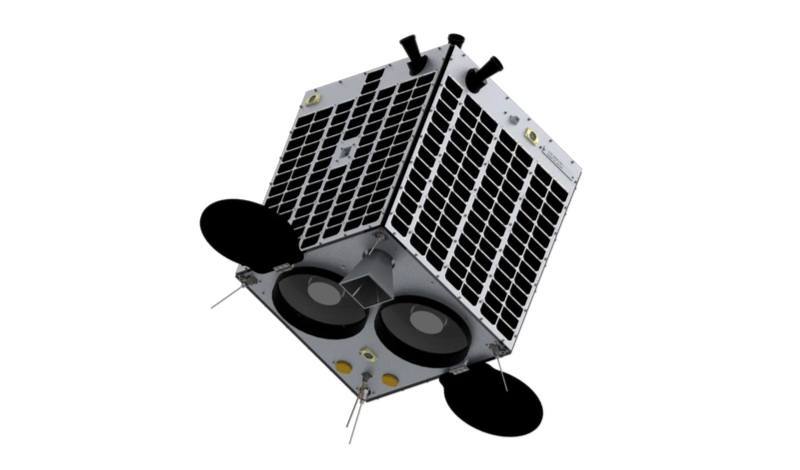
Japanese micro-satellite maker Axelspace today announced a JPY 1.8 billion (US$15 million) series A round led by Global Brain and joined by five other Japanese VCs. Mitsui & Co., one of Japan’s largest trading companies, and the Sky Perfect JSAT broadcasting company also contributed. Both Mitsui and Sky Perfect will also enter into business alliances with the startup.
Founded in 2008, Tokyo-based Axelspace will use the funding to develop three micro-satellites that are anticipated to launch in 2017. The satellites, dubbed “GRUS,” will allow Axelspace to enter the private satellite imaging and data service market. The startup envisions GRUS being utilized for agriculture, forestry, fisheries, and disaster monitoring. Data collection will, over time, allow users to make predictions about the areas they’re monitoring – i.e. differentiations in yield based on where certain crops are planted.
Each GRUS satellite weighs less than 80 kilograms with dimensions of 60 x 60 x 80 centimeters, roughly the size of an ottoman. For comparison’s sake, the Hubble Space Telescope is more than 13 meters long and weighs over 11,000 kilograms – about the size of a school bus.
GRUS is equipped with high-performance optical telescopes that enable it to capture images with a 2.5-meter ground resolution over a 50-kilometer area. Of course it has nothing on Hubble, or even Google Earth (which supplements its satellite imagery with close-up shots taken via airplane), but will be exponentially more affordable for third-party business partners. It will also be capable of updating images daily – Google Earth, on the other hand, is updated every one to three years.

A simulated satellite image based on GRUS’ 2.5-meter ground resolution.
“The weather is not our target application because the scale of the phenomena is much larger than the resolution: 1-kilometer to 1,000-kilometers [versus GRUS’ 2.5-meter resolution],” Yuya Nakamura, the startup’s CEO, tells Tech in Asia. “Furthermore, GPS systems are not for monitoring, but for positioning. Example applications for daily monitoring [range from] farming to business intelligence.”
“Aircraft and other big satellites take very high-resolution images, but the coverage and the availability are very limited,” he continues. “Our platform will be able to update very large areas everyday. The target time scale is completely different between our platform and something like Google Earth.”
After the initial launch of the first three GRUS, Axelspace hopes to eventually create a “constellation” of micro-satellites that can provide round-the-clock monitoring. With enough GRUS orbiting, there would be no blackout time when one goes out of range.
Axelspace successfully launched the world’s first commercial micro-satellite, the WNISAT-1, in 2013. It tracks icebergs in the Arctic Sea to help ships navigate more safely.
Fukuoka-based QPS, another micro-satellite startup that pitched at Tech in Asia’s Road to Tokyo Tour, is also racing for the stars. It hopes to launch even smaller satellites – only 50-square-centimeters and about 50-kilograms each – within two to three years.
Editing by Osman Husain
(And yes, we’re serious about ethics and transparency. More information here.)





Stay updated on the go with our mobile app.
Get latest insights with smoother, more personalized experience through TIA mobile app.








📅 Upcoming Events
22 October 2026
Payoneer x CSPN Summit 2026