C. Custer · · 3 min read
China will visit the dark side of the moon in 2018. Here’s why you should care.
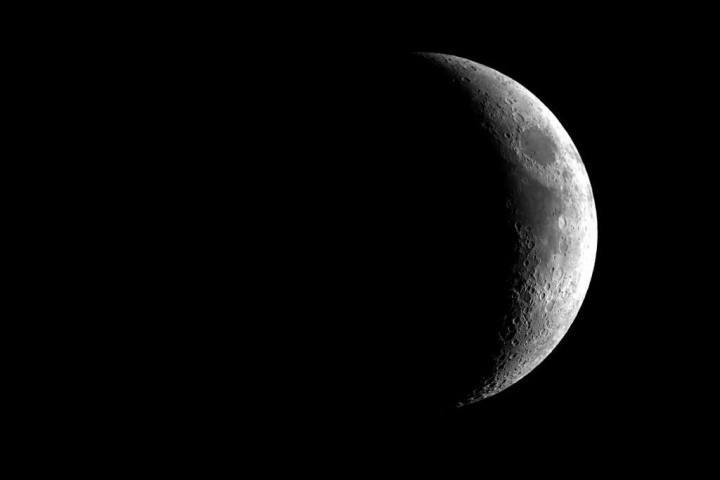
Photo by Chris Isherwood.
Last week, China announced its plan to put a lunar rover on the dark side of the moon in 2018. The new lunar probe, the Chang’E-4, is an updated version of the Chang’E-3, a probe China landed on the moon in 2013.
But China has put robots on the moon before. And the US landed humans on the moon half a century ago. Why should you care about Chang’E-4? Here are a few good reasons:
1. Nobody’s ever landed on the dark side before
For all of the lunar exploration humans have done, no human or robot has ever ventured onto the moon’s “dark” half. Calling it dark is actually misleading, of course – the moon’s “dark” side gets plenty of light, but we never see it because it’s always facing away from earth. Humans and probes have seen the dark side’s surface from orbit, but nobody has ever attempted to explore the surface before (although NASA has intentionally crashed a probe into the dark side).
2. It’s geologically different from the near side
The landscape of the far side of the moon is actually quite different from the near side. The near side (as we can see every night) is marked by large, smooth plains called maria. The far side, in contrast, is a lot rougher. Astronaut William Anders, who saw it from orbit, said it looked like “a sand pile my kids have played in for some time. It’s all beat up, no definition, just a lot of bumps and holes.” China’s probe will be the first ever to see this landscape up close.
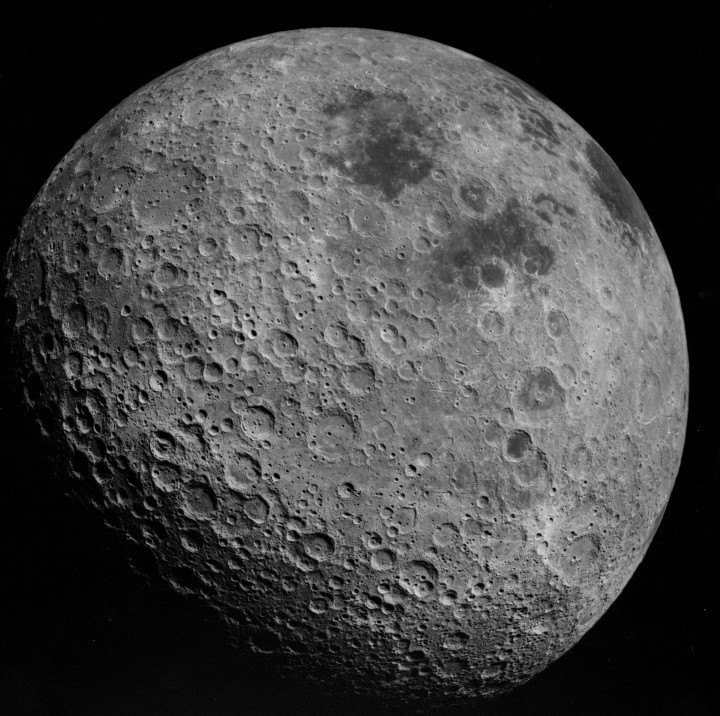
The far side of the moon, as photographed by NASA. Pretty smashed-up compared to the near side we can all see.
3. Exploring it could be a challenge
Aside from the more chopped-up terrain, part of the reason nobody’s landed probes or people on the far side of the moon is that communication with it is difficult. With the mass of the moon between the probe and earth, direct radio communication is out of the question, and previous far side landing plans have thus included a moon communications satellite that can connect the landing party to scientists on earth. But when it comes to space travel, every additional necessity (like a communications satellite) is a complication that makes it easier for things to go wrong. If China’s space program can pull off a successful landing and mission, it will be quite a coup.
4. It could teach us more about the moon
On the far side of the moon, there’s a massive impact crater from an asteroid that penetrated deep into the lunar surface. It’s not clear yet if China plans to land its probe near there, but investigation of this area could reveal more about the internal makeup of the moon.
5. The dark side could have immense value for mining
The far side of the moon is more exposed to solar winds, and as a result scientists expect it will have a higher concentration of Helium-3. Helium-3 has the potential to be used as a fuel for nuclear fusion, but unfortunately it’s extremely rare on earth. The far side of the moon may well contain enough Helium-3 that humans could begin to use it as a fuel source. For this reason, some have suggested that the far side of the moon would be the best site for a permanent moon base. China’s rover will be the first to scope this out, and may be able to determine whether the far side has as much Helium-3 as scientists expect.





Stay updated on the go with our mobile app.
Get latest insights with smoother, more personalized experience through TIA mobile app.