 Erik Crouch · · 6 min read
Smoking set to kill a third of young Chinese men. Vaping might save them

Earlier this month, the prestigious medical journal The Lancet sounded the alarm: smoking is set to kill one in three young Chinese men over the next few decades.
According to the study, two-thirds of young men in China pick up smoking – typically before age 20 – and around half of those are predicted to die as a result. Due to social norms, smokers in China are overwhelmingly male. Some studies put the proportion of smokers among women as low as 3 percent, and women whose deaths are directly attributable to smoking at below 1 percent.
Cigarettes in China are cheap: it’s easy to find a pack for less than RMB 10 (US$1.57), and they’re sold everywhere from street-side booths to train stations. Education on the health effects of smoking is lackluster, ID age checks are non existent, and various attempts at smoking ban legislation – while hyped up by the local press – are often unenforced.
Add to those the fact that 7 percent of the entire central government’s annual revenue comes from its monopolistic control of the tobacco manufacturing industry, and it may become clear why so many people are lighting up.
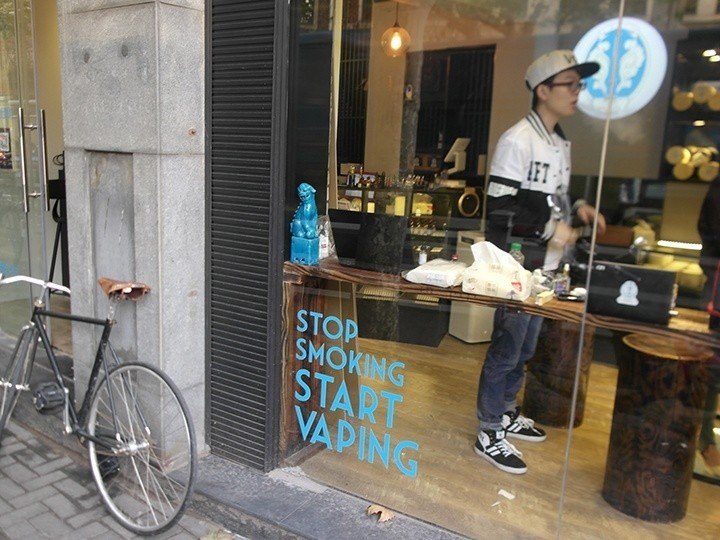
The Shanghai Vape storefront
Vape your way to health?
China’s vaping scene is still in its infancy. Despite the fact that nearly all of the world’s industrially produced e-cigarettes are assembled in the country, domestic use is far lower than in the west. Nevertheless, a fledgling market has developed, with both ecommerce retailers and brick-and-mortar shops getting in on the action.
“We don’t recommend anyone who doesn’t smoke to use our products,” says Sean Dickinson, founder and managing director of Shanghai Vape, one of the city’s first vaporizer stores. “Even the nicotine-free ones. Because why would you? The goal is to quit smoking.”
Sean started his business online, selling vaporizers, “juices” (the flavored liquids that are vaporized), and accessories. But the market in Shanghai – and China generally – is so new and inexperienced that a conventional shop became a necessity.
“Having a store is really good because people can come in, get some advice, and we can try to match the right device to the right person,” says Sean. “Unless someone can help you with the learning curve at the beginning, it’s tough to start – you don’t know what you’re doing, you buy the wrong stuff, it’s difficult.”
For now, the vape market in Shanghai is concentrated among two main groups: foreigners and upper-class Chinese. The foreign population is more likely to know about vaping – and maybe even already has the habit when they come to Shanghai. Wealthier Chinese consumers are a bit more in-tune with happenings around the world and have an appetite for the higher-end vaporizers and pricey artisanal juices on offer at Shanghai Vape.
“The interesting battle is going to be, can anyone make a mainstream e-cigarette which can target 90 percent of people who are smokers in China?” asks Sean. “Culturally, economically, it’s going to be very difficult.”
The downsides
A market that’s ready for disruption





Stay updated on the go with our mobile app.
Get latest insights with smoother, more personalized experience through TIA mobile app.











📅 Upcoming Events
22 October 2026
Payoneer x CSPN Summit 2026