
Late last week, an interesting piece ran in Bloomberg about China’s plans to eliminate foreign technology from government agencies and key industries by 2020, mostly for security reasons. China has already begun pushing in this direction – Windows 8 is banned from government computers, Qualcomm got slammed with a massive anti-trust fine, and Apple products like iPads have been removed from approved government procurement lists.
But can China really divest itself from foreign technology, at least in key areas? Not until it develops its own computer operating system. Most of China’s PC-based computing currently runs on Windows XP. Bloomberg reports that the government’s hopes for a new Chinese OS are based on NeoKylin, a so-called “homegrown” operating system that just underwent a successful test in the relatively small city of Siping. This, apparently, is China’s replacement for Windows.
To begin with, replacing one OS with another in a fairly small city is not quite the same thing as replacing the entire national computing infrastructure across government, banking, and state-owned organizations. These organizations have thousands of systems that work on Windows, and getting slow-moving SoEs (for example) to switch over to a totally new OS and rebuild all those systems is likely to take more than five years. Bureaucratic inertia is a powerful thing.
The bigger issue, though, is that NeoKylin isn’t really a homegrown OS at all. It is based on the Kylin OS that China’s government has been working on for nearly 15 years now, and Kylin has never been built from scratch. Early versions of the system were copied from an American OS called FreeBSD. Later, the government shifted to using Linux as the operating system’s base. The latest version of Kylin is based on Ubuntu and it has been developed for China by a British company called Canonical. In fact, Ubuntu Kylin is so not Chinese that as of very late 2014 parts of Kylin still hadn’t been translated into Chinese yet.
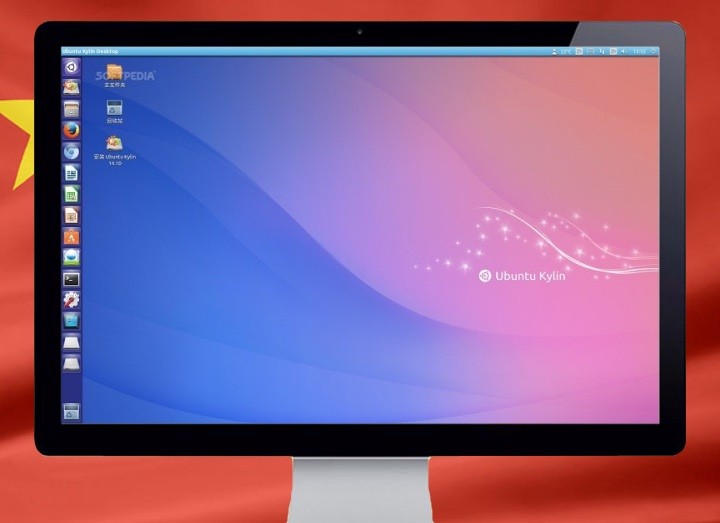
Ubuntu Kylin, China’s “homegrown” OS, was developed by a British company.
It’s not clear just how similar NeoKylin and Ubuntu Kylin are. Ubuntu Kylin is likely the newer software, as the NeoKylin name has been being used for a while. China Standard Software Company claims that it developed NeoKylin jointly with China’s National Defense Science and Technology University, with no mention of Canonical. But NeoKylin is still based on Linux, which means that at the end of the day even if it hasn’t borrowed from Canonical and Ubuntu Kylin, a lot of the operating system’s code was not developed in China. (And of course, it’s possible that the move to Kylin over the next five years will ultimately favor Ubuntu Kylin over NeoKylin anyway).
Setting aside the irony of using open-source software to close off your software systems from the world, the move from Windows to Linux does make sense from China’s perspective. Even if NeoKylin or Ubuntu Kylin or whatever Linux fork China’s government ends up using isn’t completely homegrown, it is certainly more homegrown than a wholly foreign-developed OS like Windows. And since China’s government has a hand in the development of these Linux-based operating systems, switching over to them will mean that China is no longer beholden to Microsoft to keep its operating systems up to date (which has been an issue since Microsoft ended support for China’s favorite OS, Windows XP). Kylin’s core may be foreign, but China still has much more control over it than the country ever had over Windows.
Still, the idea that China can replace all foreign technology in the next five years by switching to an operating system based on Linux – foreign-developed technology – is a little absurd. And PC operating systems won’t be the only area where China encounters issues if it wishes to entirely abandon foreign tech. China faces the same problem in the mobile space, for example, where virtually every successful Chinese-developed mobile OS is based on the foreign-developed Google Android OS.
More likely than a wholesale switch to domestically-developed tech is that China will push its foreign suppliers to submit to more thorough inspections and share more technology with their Chinese counterparts in return for being allowed to continue supplying the Middle Kingdom. And although some foreign tech firms may be loath to agree to this, many will. Making some concessions to China’s government will hurt less than abandoning one’s supply business in the country altogether. China’s isn’t ready to wholly replace foreign technology, but it doesn’t need to because the Chinese tech market is so appealing that it will increasingly be able to dictate strict terms to foreign companies wishing to do business there.
NeoKylin and Ubuntu Kylin are not wholly-Chinese-developed operating systems – this is true. But the move towards them still belies the end of an era for foreign tech firms like Microsoft, who until now have been able to release products like Windows without much need to consider the Chinese government’s security needs and requirements. In the future, any foreign company that wants to go after large and lucrative enterprise tech markets like Chinese SoEs, government departments, or Chinese banks will likely have to make major concessions, and including technological concessions that might bolster the foreign firm’s Chinese competitors.





Stay updated on the go with our mobile app.
Get latest insights with smoother, more personalized experience through TIA mobile app.














📅 Upcoming Events
22 October 2026
Payoneer x CSPN Summit 2026