Mary-Anne Lee · · 8 min read
How Asiasoft went from moving educational games to being one of SEA’s largest publishers
Asiasoft is a giant in its field. One of Southeast Asia’s most successful region-wide gaming companies, the online game publisher has hundreds of games in its portfolio and 120 million registered users. Its brand is synonymous with games like Audition, the wildly-successful Maplestory in Singapore and Malaysia, and Ragnarok Online in Thailand. Although Asiasoft’s mobile games portfolio hasn’t been as strong as its PC game catalog, it’s still a company that really understands what users want. But Asiasoft wasn’t started by a hardcore gamer or someone who had a dream for Southeast Asia’s gamers.
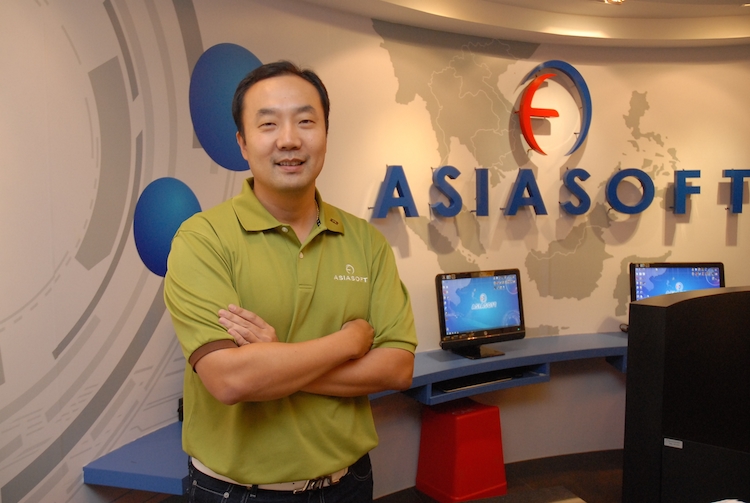
Pramoth Sudjitporn, Asiasoft CEO.
“We were just trying to make a living,” says Pramoth Sudjitporn, CEO and vice-chairman of Asiasoft, when asked why he and his two co-founders Sherman Tan and Lertchai Kanpai started a business centred around video games. Back in 1998, shortly after the 1997 economic crisis, no one was hiring. Companies were cutting costs and laying people off; some weren’t even paying salaries. Yet the trio founded a distributorship called BM Media, funded out of their own pockets. It was centred around the distribution of boxed educational games, because it was something that had market potential, yet remained untouched.
1998 was also a time when piracy was rife in Southeast Asian waters. No one wanted to deal with the sheer volume of additional work fighting piracy entailed. But Sudjitporn and his co-founders decided to take that chance. That was what started them off in the gaming business.
Their first solution, since prices that worked in the US and in markets like Singapore wouldn’t work in their native Thailand, was to bring down the price of these games by localizing products. There was a lot of local production done, including control measures to make sure the games didn’t leak out to other regions. By bringing the price down and bringing volumes up, BM Media was able to take advantage of the existing market potential.
But it was tiring to keep battling the pirates. And the world was changing. “Technology was shifting,” Sudjitporn says. “It was much more fun to play online […] where you have a massive amount of players together. There’s more communication, more community, more participation.”
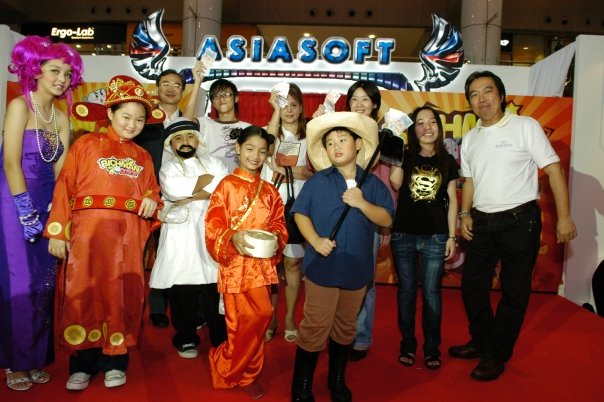
An early Asiasoft game carnival in Singapore, 2008.
It was that shift in technology that pushed Asiasoft into online gaming in 2001. Not only did online games show more potential for the business, they were also played on servers controlled by their service providers, making it easier to combat piracy. And they were boundless, which would allow the business to scale more easily in the future.
“When you look at online services and internet business, there are no boundaries, no territories, no physical location,” Sudjitporn explains. He and his co-founders believed that the Southeast Asian PC gaming market would grow soon enough.
However, Sudjitporn, being the savvy businessman he was, also realized that concentrating solely on online free-to-play was just too narrow-minded. So the company started talks with Blizzard Entertainment, bidding for rights to distribute World of Warcraft in the region. It was easy to reach out to Blizzard, since it was by then a subsidiary of Davidson & Associates, a corporation that had once been an education game giant – and a client of BM Media.
See: Why Blizzard needs a publisher for Hearthstone in Vietnam
Asiasoft eventually ended up distributing boxed Blizzard games. But at this point, the company was ready to scale and expand out of its native Thailand. Surprisingly, Sudjitporn says he wasn’t worried at all.
“The business is pretty much almost the same with other countries,” Sudjitporn said. “We believed we could duplicate [our] experience in Thailand in other countries.”
The future of online gaming
Asiasoft moving forward





Stay updated on the go with our mobile app.
Get latest insights with smoother, more personalized experience through TIA mobile app.