- Premium Content It takes our newsroom weeks - if not months - to investigate and produce stories for our premium content. You can’t find them anywhere else.
 Melissa Goh · · 11 min read
Could Bangladesh be the next Indonesia?
One country has been left out of Asia’s growth story in the last decade: Bangladesh.
Compared to Indonesia or Vietnam, little is known about the small country that flanks India’s eastern border, besides its core garment manufacturing and agriculture industries.
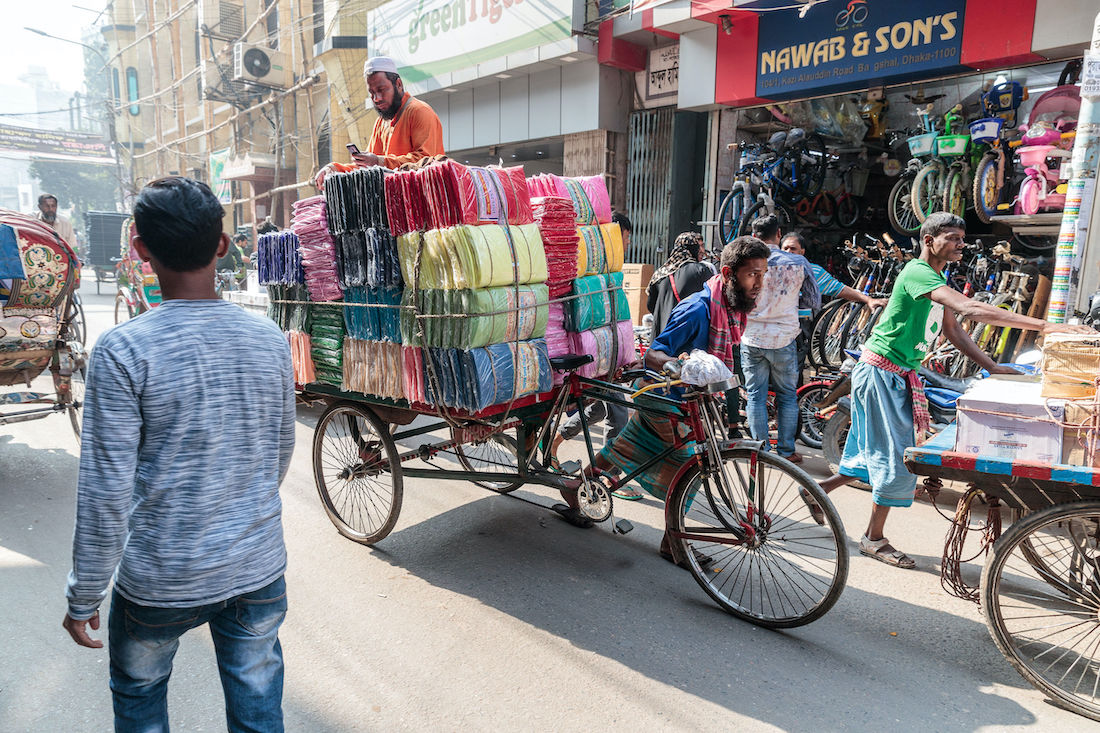
A man transporting fabrics through Dhaka / Photo credit: azeitler / 123RF
“Bangladesh geographically falls between the cracks – it’s not India, it’s not Southeast Asia,” says Sylvana Q. Sinha, founder and CEO of Dhaka-based healthtech startup Praava Health. “Investors don’t understand Bangladesh. It’s a new market for them, and it’s very unfamiliar,” she adds.
In a visit to the country years ago, the Bangladeshi American entrepreneur was struck by the lack of quality healthcare accessible to the masses. “It was eye-opening for me. I’d observed that anyone who could afford to leave the country for healthcare was doing so,” Sinha says.
It’s true that healthcare gaps exist and poverty is still widespread, as about 24 million or a sixth of Bangladeshis live below the poverty line. But several homegrown startup founders and investors Tech in Asia spoke to say some of the biggest misconceptions foreign investors have about the country, including safety concerns and a lack of infrastructure, are unfounded.
On the bright side, Bangladesh has a talented and tech-savvy workforce with a median age of 28 – one that’s hungry to consume new services, products, and content. With 164 million people, Bangladesh is the world’s eighth-most populous country and has a population size two-thirds that of Indonesia.
Its yearly gross domestic product (GDP) per capita growth is one of the highest in the world, outpacing China, India, Indonesia, and Vietnam last year.
At the same time, rising levels of mobile and internet penetration in the country present a huge opportunity for mobile-led tech startups, from ride-hailing and food delivery to healthtech to educational technology. Dhaka, its capital city, ranked second in the number of active Facebook users in all of Asia in 2017.
Bangladesh was doing 4,000 food delivery orders daily in 2016, says Kishwar Hashemee, co-founder and CEO of cloud kitchen Kludio, but now, it’s over 100,000 orders a day.” The Dhaka-based business, which Hashemee likens to a “digital food court,” launched in 2019 and competes alongside Pathao, Shohoz, Foodpanda, and UberEats in the food delivery space. Kludio operates its own food brands and handles its own orders and deliveries.
“People assume that because it’s a developing nation, it’s poor, and there are fears of extremism. But once people take the leap and visit, they see it’s a high-growth company with very good fundamentals,” says Ravid Chowdhury, chief financial officer of logistics startup Truck Lagbe.
US-raised Rahat Ahmed, founding partner and CEO of Anchorless Bangladesh, has watched the changes unfold since he first came to the Bangladeshi capital in September 2004. “I remember going back to New York, thinking there was nothing there [in Dhaka],” says the venture capitalist, whose firm focuses on early-stage startups.
Years later, Ahmed has become an investor in ride-hailing startup Pathao and is leading Anchorless’ efforts to woo startups in Bangladesh. The VC firm counts logistics startup Loop Freight and artificial intelligence company Gaze as part of its portfolio.
A funding gap
Bangladesh’s investors
The next Indonesia?
A digital Bangladesh
Stay ahead in Asia’s tech landscape
This is premium content. Subscribe to read the full story.
Local founders speak of a thriving tech scene, but what do investors think?
We know this is not ideal. ⌛ Sign up in 20 seconds. Cancel anytime.
Our subscriber community includes professionals from these companies:





Stay updated on the go with our mobile app.
Get latest insights with smoother, more personalized experience through TIA mobile app.







📅 Upcoming Events
22 October 2026
Payoneer x CSPN Summit 2026