 Samantha Cheh · · 5 min read
Buying AI tools is easy – getting real value is much harder

Summary:
- A successful AI pilot does not guarantee that it will work at scale. The real test comes when AI has to operate across live systems, teams, and business processes.
- Becoming AI-ready means creating the right conditions around the tech, defining ownership, governance, and business outcomes from the start.
- As AI becomes more widely available, competitive advantage will come less from adopting the tech first and more from deploying it reliably and proving business impact.
- Read HCLTech’s report on scaling enterprise AI in Singapore here.
“It usually breaks down outside the model,” says Sandeep Sarkar. The “it” in question is an AI pilot moving into production.
Sarkar, senior vice president for ASEAN at tech firm HCLTech, explains that a pilot can work within a small team, narrow dataset, and controlled environment. But once it moves into production, it has to contend with live data, legacy systems, security rules, audit needs, and real business workflows.

Sandeep Sarkar, senior vice president for ASEAN at HCLTech / Photo credit: HCLTech
As agentic AI becomes more commonplace, the gap between AI adoption and readiness is becoming more apparent. A recent study by Omdia commissioned by HCLTech shows that 70% of Singapore leaders expect all competitors to be using autonomous AI systems for mission-critical work within 12 months. But 49% of them cited insufficient processes for monitoring and auditing AI systems as a barrier to meaningful adoption.
“The real test isn’t interest in AI, but whether AI can run inside the business without creating new risks or extra manual work,” Sarkar observes.
Challenges to AI adoption at scale
The problem is often not AI itself but the environment around it. Businesses that are AI ready have the “basics” in place, Sarkar says.
This includes not just getting access to clean data and secure systems, but also having clear ownership and strong governance to ensure AI can be used safely and effectively throughout their operations. Crucially, businesses need a workforce with the skills to actually use AI.
Yet the reality is, many enterprises are grappling with long-standing organizational challenges that hinder their ability to deploy AI reliably at scale.
According to the Omdia study, 56% of Singapore respondents pointed to how coordination challenges across IT, data, cybersecurity, and business teams hamper AI execution, while 49% said they struggle to align their AI and business goals.
Best practices for AI readiness
A key starting point is to establish clear business outcomes for AI initiatives, Sarkar says.
Enterprises need to have a well-defined stance on how their AI investments are linked to business value and can demonstrate impact. This isn’t just about nailing down the ROI – by better aligning business and tech goals, leaders can also support workforce adoption and improve organizational buy-in.
He also highlights the need for good ownership and accountability protocols, so that responsibility for any AI initiative is not left with one team.
“The best AI work is shared across teams, with clear accountability,” Sarkar explains. “The business owns the outcome; IT owns integration and scale; data teams own data quality and access.”
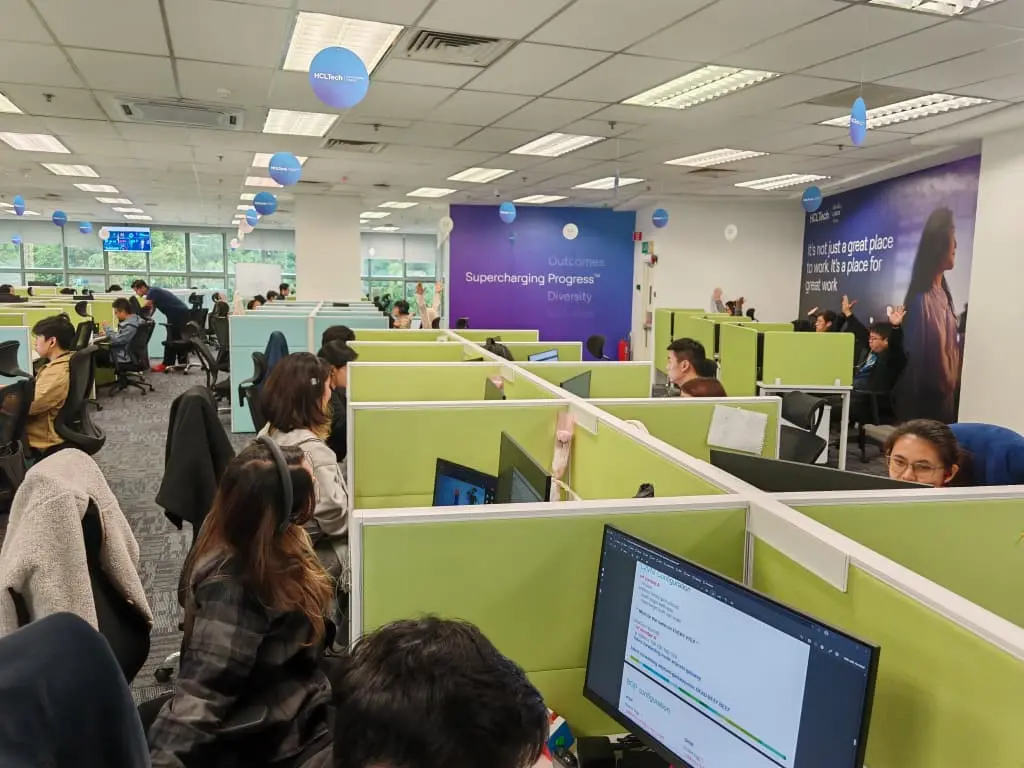
HCLTech’s global delivery center in Kuala Lumpur managing cross-border projects / Photo credit: HCLTech
Similarly, cyber and risk teams oversee the organization’s controls, privacy, and auditability, while operations teams are in charge of how work changes day to day.
Perhaps most important is the need for companies to embed governance frameworks and guardrails from the start, especially as AI gets involved in mission-critical work.
“It is too late to add privacy, audit or risk controls when an AI system is already inside a workflow,” says Sarkar. “If governance is added late, the business may move quickly, but there’s a risk they could lose control of how AI is being used.”
Finding the right AI partner
Enterprises are looking outside their organizations for help in establishing these crucial foundations.
Omdia’s survey found that 86% of companies have enlisted external consultants to bridge AI skills gaps and accelerate execution. Sarkar says partners can add the most value in more technical areas of delivery, such as AI engineering, integration, governance, and security.
Deeper partnerships are needed in areas including AI infrastructure and hardware, development and MLOps platforms, and AI monitoring and governance.
The role of a partner is to help businesses implement decisions, not take over and make those decisions for them. In Sarkar’s view, a good AI partner doesn’t just provide the technology but also shoulders “the harder delivery work,” enabling clients to choose the right use cases to begin roll-outs, set controls, train teams, and connect AI into workflows.
As he puts it: “Enterprises don’t need another tool. They need help with making AI work inside real systems and real business processes.”
In one such case, HCLTech helped a logistics company based in Australia and New Zealand with establishing governance and controls around its use of AI.

Photo credit: Chokniti-Studio / Shutterstock
The organization was already using unapproved public AI tools, creating potential data security and compliance risks. HCLTech worked closely with the internal team to design and implement a secure, enterprise-grade platform that could support AI use without compromising sensitive data or limiting innovation.
First is not always best
As agentic AI and other AI solutions become more widely available, access to the tech and being first to adopt it may not matter as much as implementing it in the right way.
The stakes go higher as AI systems take on more autonomous work, leaving organizations with less room to rely on manual checks or workarounds when ownership, governance or processes are unclear.
“There is a real opportunity here, but speed on its own will not deliver value,” concludes Sarkar. “The organizations that get ahead will be the ones that modernize their applications and data, strengthen governance, and make AI part of how the business runs every day, rather than treating it as a set of isolated pilots.”
A global technology leader in AI and digital transformation, HCLTech has spent the last three decades helping enterprises modernize their tech stacks. Today, the company is at the forefront of the agentic age, supporting companies as they adopt and scale AI solutions. To learn more about how Singapore businesses are navigating the challenges between AI ambition and execution, read HCLTech’s report on the realities of scaling enterprise AI.
This content was produced by Tech in Asia Studios, which connects brands with Asia’s tech community. Learn more about partnering with Tech in Asia Studios.
Stay updated on the go with our mobile app.
Get latest insights with smoother, more personalized experience through TIA mobile app.
Recommended reads
 SEA financials tracker: Moladin’s revenue rises 6% in 2025
 On‑demand services lift Line Man Wongnai’s 2025 revenue to $544m
 Flipkart’s costly late push into quick commerce and food delivery
 Inside Singapore’s government team that kills its own products
 Once an IPO hopeful, SCI Ecommerce nears collapse
 Who’s betting big on ChatGPT ads? Not Asian brands
 VC tracker: Granite Asia launches US$50 million fund
 GCash trims IPO ambitions to meet market realities
 Igloo CEO eyes global M&A: ‘We have an appetite to grow more’
 Why SBI paid a premium for Ajaib amid a tough market





Editing by Lilian Tang, Jonathan Chew, and Eileen C. Ang
(And yes, we’re serious about ethics and transparency. More information here.)




📅 Upcoming Events
22 October 2026
Payoneer x CSPN Summit 2026