Lilian Tang · · 5 min read
Building trust in agentic finance with AI-native security

Summary:
- AI is already widely used in financial services, but agentic AI goes further by planning and executing tasks rather than simply responding to prompts.
- As agents move across payments, accounts, FX, treasury, and other functions, businesses need connected systems that allow them to complete workflows from end to end.
- Greater autonomy also introduces new trust and security challenges. Ant International uses a two-layer security architecture that includes its KYA framework and AgentSafePay to establish identity, permissions, monitoring, and protection.
- Find out more about how Ant International is building AI-native financial infrastructure for the agentic era here.
Who hasn’t argued with a chatbot?
In the AI era, this has become commonplace. If users aren’t scolding a chatbot for misunderstanding prompts, they’re taking it to task for still not getting it right after the nth round of correction.
While these inconveniences are annoying, the consequences usually stop there.
Now imagine that same AI could make payments, manage foreign exchange, or move company funds on your behalf. Calling the mistakes made in those scenarios “annoying” would be an understatement.

Photo credit: Andrey_Popov / Shutterstock
That is the reality facing businesses as AI moves from assisting with financial tasks to executing them. Businesses need to know who is behind the agent, what it can access, and what it is allowed to do.
AI agents in finance
AI has already made its mark on financial services, supporting areas such as risk management, compliance, and electronic know-your-customer (KYC) checks. In a recent study by financial software firm Finastra, just 2% of the surveyed financial institutions reported no AI use at all.
“Agents will become the common language spoken across finance,” says Tianyi Zhang, chief trust and security officer at fintech firm Ant International.
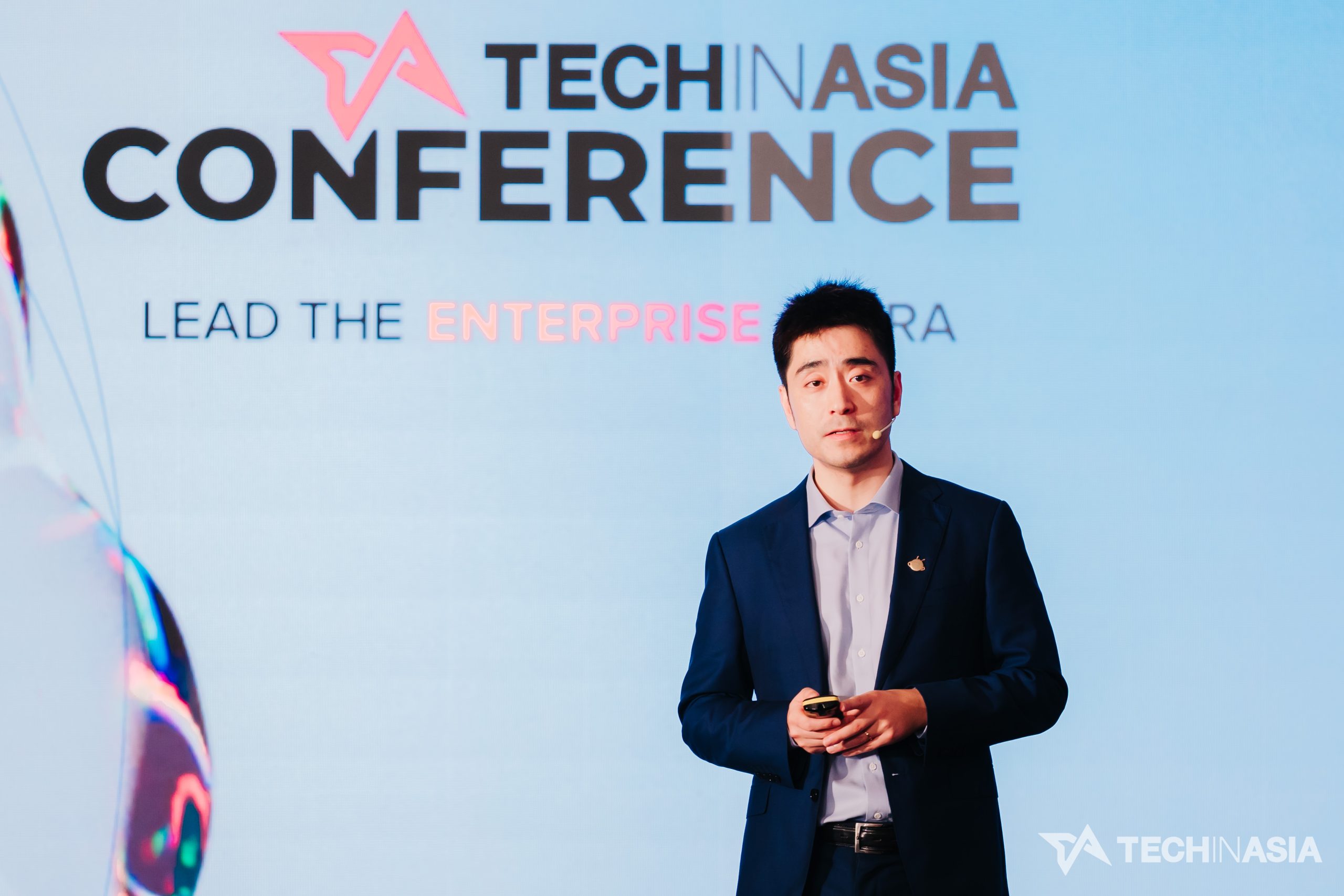
Tianyi Zhang, chief trust and security officer at Ant International / Photo credit: Tech in Asia
Unlike a traditional chatbot, an agent is given an objective, plans across the tools and systems needed to reach it, and – subject to the guardrails built around it – executes, he explains.
Broader adoption is already evident on Antom, Ant International’s merchant payment services platform, where about nine in 10 merchants have adopted its AI-powered solutions. Antom’s AI smart dispute agent, for example, has helped merchants resolve more than three times as many chargeback dispute cases.
Zhang expects agentic adoption to initially emerge in areas where tasks are structured and the returns are clear, such as B2B purchasing and operations.
Consider procurement. An agent could check a supplier invoice against previous patterns, verify the purchase order and authorized budget, initiate settlement, and file the reconciliation record without needing to be prompted by a human at every step. But the workflow is not complete until the transaction itself is carried out.
“The ability to complete payments is what allows agents to autonomously finish these tasks,” says Zhang.
Operating across the financial chain
That procurement example, however, is only one part of a much larger financial puzzle, especially for global businesses.
Payments feed into accounting, while cash positions affect treasury decisions. Throw a cross-border supplier into the mix, and the same purchase can involve currency conversion, liquidity, and settlement.
This is where individual point solutions can become limiting.
“Financial operations do not operate in silos. Neither should the agents,” Zhang observes. As businesses automate more of their workflows, he argues that the systems agents rely on need to be similarly connected and interoperable.
These functions often sit in separate systems and have access to different information and processes. This fragmentation makes it difficult for an agent to move from one step to the next as it tries to complete one business outcome.
“Payment providers must now be full-stack enablers, blending payments, accounts, FX, treasury and growth into one connected package,” Zhang says.
Ant International’s AI-native approach brings together all these capabilities, supported by open protocols such as Agentic Mobile Protocol (AMP) for agent-led mobile payments and infrastructure like WhaleRTP for wholesale settlement, treasury, and liquidity management.
Security risks of agentic AI
The convenience of interconnected agents, however, comes with a trade-off: The more systems an agent can access, the more vulnerable they become to a mistake or an attack.
“AI has fundamentally altered the economics of cybercrime,” Zhang adds. Thanks to widely available generative AI tools, it’s becoming cheaper and easier to create convincing fake identities and personalized fraud at scale. AI agents introduce new security demands in the face of risks such as hallucinations, tool-call errors, prompt injection, and adversarial exploitation.
Ant International’s two-layer security architecture is designed to address these challenges.

Zhang speaking about trust and security in agentic commerce at the recent Tech in Asia Conference / Photo credit: Tech in Asia
The first layer is aimed at defending against existing threats amplified by AI, such as fraud, scams, and abuse. The Antom 3-in-1 Transformer is a payment foundation model that analyzes behavior over time, structured records, and relationships among users, entities, and devices. The model learns and understands payment behaviors, and can be adapted to a range of security tasks.
The second focuses on AI agents. As traditional KYC checks help financial institutions verify who a customer is, a parallel question emerges with agents: Who is this agent, and what is it allowed to do?
Ant International’s know-your-agent (KYA) framework establishes an agent’s identity, traces the developers, users, and operators behind it, and defines what it can do.
“No anonymous agents, no ghost operators,” Zhang says.
These permissions can include time limits and revocation conditions, while checks continue even after an agent starts operating. To protect merchants, KYA is paired with AgentSafePay, an industry-first security and fund protection feature that provides a 100% fund guarantee against losses from agent-specific risks.
“An agent that’s safe at launch is not necessarily safe at execution,” Zhang says. “Trust is continuously earned rather than granted in a one-off review.”
Is agent trust portable?
Knowing an agent within one ecosystem only goes so far if it has to prove itself every time it enters another. If agents are to transact across merchants, banks, wallets, and payment networks, that trust needs to travel with them.
To address this, Ant International is working with Visa and Mastercard on an interoperable KYA framework that will create what Zhang calls a “common trust signal” across payment networks. The idea is that each network can retain its own verification and decision-making processes while sharing signals for identifying trusted agents rather than starting from scratch each time.
This will “cut duplication and integration complexity” for businesses and “let the space scale,” he notes.
As agents take on more buying tasks, Zhang expects merchants themselves to adapt to machines acting on customers’ behalf. Product catalogues could be made readable by agents, while merchants could find ways to accept agent-led payments securely across existing channels.
“Merchants have to become AI-native to be ready for the agentic economy,” Zhang says.
Ant International provides AI-native solutions across payments, account, FX, treasury, and growth operations for global businesses.
Explore the full stack here.
This content was produced by Tech in Asia Studios, which connects brands with Asia’s tech community. Learn more about partnering with Tech in Asia Studios.
Editing by Stefanie Yeo and Eileen C. Ang
(And yes, we’re serious about ethics and transparency. More information here.)