 Nadine Freischlad · · 4 min read
Want to break into Indonesia’s crowded mobile messaging market? Here’s how

Indonesia is a famously chat-happy nation. According to Inmobi’s report “State of mobile messaging in Indonesia,” 97 percent of mobile users in Indonesia access messaging apps multiple times in a day, and have an average of 3.6 different messaging apps installed on their phone.
The market is crowded, with most big messaging apps, both Asian and Western, enjoying popularity in the archipelago. Is there any chance for a newcomer to get a foot in the door?
Let’s look at which apps are most popular now with Indonesians.
1. BBM is king
The ongoing popularity of Blackberry Messenger (BBM) was evident in a Nielsen study from mid-2014. Now Jana, the company that created mCent, an app advertizing channel, published a new ranking of Indonesia’s most popular chat apps. Jana gathers real-time information from its users and knows which other apps they installs and use:
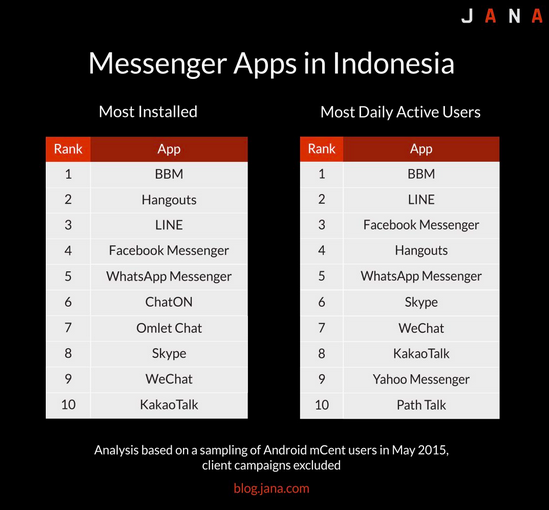
It’s interesting to see that, even one year on, BBM still holds a steady reign over Indonesia.
2. Several apps side-by-side
Blackberry devices used to be hugely popular in the archipelago, at a time when there were fewer choices available. Blackberry’s messaging system was pre-installed on those phones, leaving users no choice but to get used to it. Now, Indonesians are habitual to Blackberry Messenger and use it on their Samsung devices, because this is where everyone else is. To vast parts of the population, especially those outside of big cities, messaging is synonymous with BBM.
But the fact that Indonesians don’t mind having several chat apps installed plays in favor of the newcomers in this field. So even if people are still used to Blackberry Messenger and like to have it around, it doesn’t mean they would not also use a different app, given a significant share of their colleagues, family and friends are already using it.
3. Preloading is not as relevant as one might think
Jana’s data reveals another interesting fact: pre-installed apps don’t do better than the others. For example, most Samsung phones will come with Samsung’s own ChatOn pre-installed. The same goes for Omlet Chat which comes pre-installed on Asus’ Zenfone product line. But despite the ubiquity of these apps on users’ devices, they don’t appear anywhere in the top 10 message apps by usage. Just because it’s there doesn’t mean it’s popular.
Results from the InMobi report mentioned above confirm this behavior, showing that users are very comfortable with browsing the app store, listening to friends’ recommendations, and directing their own installs according to their preferences. In the survey, 46 percent of respondents said they discovered new apps mostly by browsing the app store, while 42 percent said they got new apps through word-of-mouth.
If you are a messaging app newcomer thinking of a pre-loading partnership as the holy grail that will gain you popularity with users, you should reconsider. Much more relevant than already being on a device is creating a recognizable brand that people will talk about and recommend.
4. The Line way
Cracking the network effect is hard, and this leads to the fact that messengers that are connected to other services containing a collection of contacts have a head start. Facebook Messenger and Google Hangouts fall into this category. WhatsApp managed to become popular by making it really easy for people to connect with friends who also have the app installed. Instead of having to add manually, other WhatsApp users simply show up in the contacts list.
5. Social data package deals





Stay updated on the go with our mobile app.
Get latest insights with smoother, more personalized experience through TIA mobile app.










📅 Upcoming Events
22 October 2026
Payoneer x CSPN Summit 2026