J.T. Quigley · · 2 min read
Ahead of 2020 Tokyo Olympics, NTT Docomo to offer translation app for 10 languages

Planning on heading to Japan for the 2020 Tokyo summer Olympics but worried about the language barrier? Fret not, as the country’s largest mobile carrier today announced that it will release a spoken translation app to ensure smooth communication with the locals.
NTT Docomo will offer its Jspeak app starting November 10, currently exclusive to the Google Play store – and not locked down to Docomo subscribers only. As long as you’ve got an Android-powered smartphone or tablet (running 4.0 Ice Cream Sandwich or later), you’ll have access to the paid service, which will be available for US$.99 a day or US$2.99 per week.
“We are providing the application for Android first, as currently most of [Japan’s] inbound travelers are from Asian countries where Android is popular,” a Docomo spokesperson tells Tech in Asia. “We will positively consider offering the application for iOS in the future.”
Jspeak utilizes existing Docomo technology – Hanashite Hon’yaku – to convert spoken phrases in 10 different languages to Japanese. Developed in 2012, it won first place at the 2013 CITA E-Tech Awards in the mobile app category, but was a Docomo exclusive and geared toward Japanese going overseas rather than the reverse.
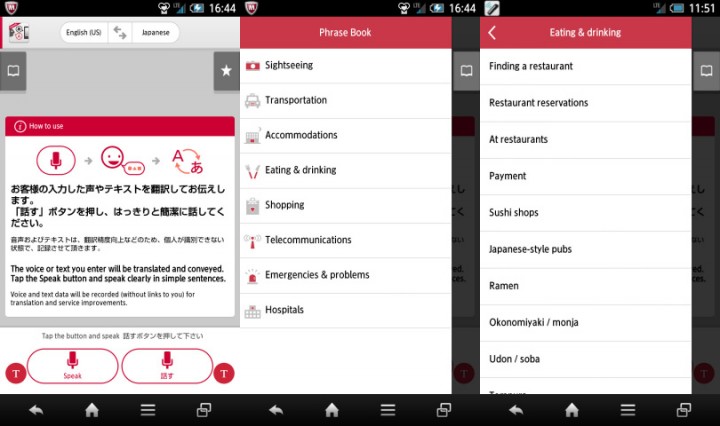
At launch, the app will support Chinese, English, French, German, Indonesian, Italian, Korean, Portuguese, Spanish and Thai. It comes with more than 700 pre-installed phrases for daily-life situations, such as using public transportation or ordering food at a restaurant. Users can also create lists of their most commonly-used or favorite expressions for quick access – though it’s unclear if the typical Japanese pickup line of “Can I get your Line ID?” is supported.
Docomo says that the app can recognize the difference between American, British, and Australian English accents. If an incorrect word is picked up while speaking, users can touch to edit the on-screen text that the app generates. Rather than focusing on adding additional languages, the telco explains that its top priority is improving the translation accuracy for existing languages.
Even if potential users aren’t looking as far ahead as 2020, the app is sure to come in handy for the tourists – last year, thanks in large part to a steadily weakening yen, Japan set a record for inbound tourism with 10 million visiting from overseas.
Those who wish to forego a phrasebook can try rival (mostly free) options like Voice Translator, iTranslate, and Jibbigo. Travelers on a budget can also lean on Google Now’s speech translation function – or good old text in a Google Translate box.
Editing by Terence Lee
(And yes, we’re serious about ethics and transparency. More information here.)





Stay updated on the go with our mobile app.
Get latest insights with smoother, more personalized experience through TIA mobile app.