Paul Bischoff · · 2 min read
Baidu’s new interactive map predicts the spread of influenza, hepatitis, and STIs all across China
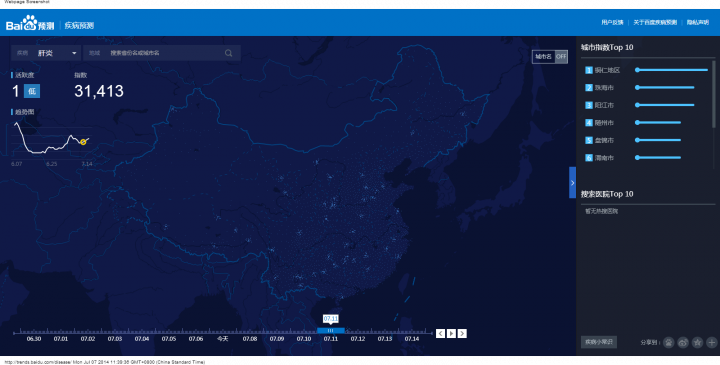
Baidu Trends, China’s nearest equivalent to Google Trends, has launched an interactive nationwide map that predicts the spread of disease (hat-tip to 36kr).
The hypochondriac’s nightmare combines Baidu users’ searches and location-based data to show where and when people are looking up information on influenza, hepatitis, tuberculosis, and sexual transmitted infections. China’s Center for Disease Control and Prevention also contributes some surveillance data.
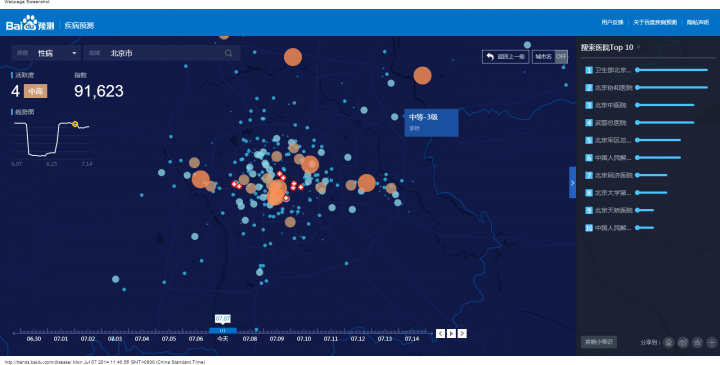
Local epidemics are shown as color-coded dots, each with a rating of one (low activity) through five (high activity). Baidu provides the past 30 days of data, and claims it can make reasonable predictions for the next seven days. You can zoom in on any major city to see where breakouts are happening and where the nearest hospitals are.
Here in central Beijing, for example, influenza and tuberculosis both seem to be on an uptick in July, but not to a threatening level. Venereal disease, however remains high at a steady level-four rating.
Besides user data, Baidu also looks at temperature changes, environmental indices, population movements, historical data, and other factors to make its forecasts. A Baidu spokesperson explains:
The search query and other Baidu user data gets sent to the Center for Disease Control which they then cross-check against their own data, and they provide us with the data you actually see.
Baidu has done some similar projects in the past, including a heat map that tracked travelers during the annual Chinese New Year migration. It’s also created a World Cup forecaster, which has correctly predicted 40 out of 60 matches as of press time.
See: How Crowdsourcing Can Stop False Medical Ads from Killing Chinese Grandparents
Hopefully, citizens, doctors, and government officials can all take advantage of big data projects like these to more efficiently distribute medicine, curb the spread of disease, and cut healthcare costs. Google likewise flexed its data analysis muscles in the past for projects that tracked influenza and dengue fever, although some scientists found its projections to be inaccurate.





Stay updated on the go with our mobile app.
Get latest insights with smoother, more personalized experience through TIA mobile app.