 Sumit Chakraberty · · 5 min read
Ask not what Techstars will do for India, ask what India will do for the accelerator
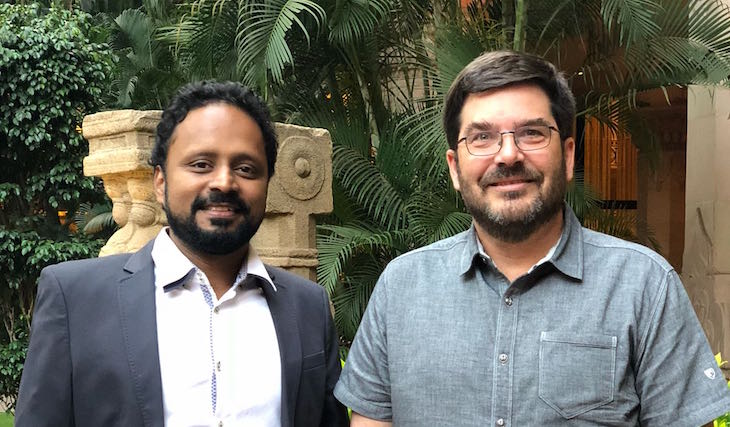
Techstars India president Bala Girisaballa and Techstars co-founder David Brown in Bangalore / Photo credit: Techstars
Seven months after choosing Bangalore as its first Asian outpost, Techstars today named its India president and announced accelerator and corporate innovation partnership programs. These are in line what the global accelerator does in other countries.
But in a first for Techstars, it also set up an “R&D center” in India. The center will have a pool of engineers, developers, designers, and quality assurance staff that Techstars’ global portfolio of over 1,300 startups can tap from around the world when required.
“Techstars quarterly reviews have shown that one of the top three needs of these startups is finding the right talent fast,” says Techstars India president Bala Girisaballa. Newly appointed to this role, Girisaballa earlier ran Microsoft’s accelerator in Bangalore for the last couple of years.
Techstars co-founder David Brown gives the example of its 2009 batch startup SendGrid. Back then, the Colorado-based startup struggled to find engineers and then set up an R&D center in Los Angeles. “Had this [tech talent pool] existed then, they could’ve hired engineers in India,” says Brown. “Now they’re a large company [which had an IPO a few months ago], and could be a candidate to run a GIC (global in-house center) in India. So we see that as a possibility for all our startups – get some early engineers in India through Techstars and grow to having GICs based here.”
Techstars has partnered with Ansr to run its programs in India. Lalit Ahuja, who was the country head for retailing giant Target in India, founded Ansr in 2003 to help global corporations set up development centers in India. Today, there are over 1,000 GICs in India, and they have been evolving into more value-added services than the traditional offshore IT back office work that the country is known for.
“Large companies coming and leveraging India is done – either by themselves via GICs or with partners like [IT service giants] Wipro or Infosys,” says Girisaballa. “But it’s hard for startups trying to do that at a smaller scale where they need five to 10 developers.” And at the same time, their need is more acute.
“If you’re in Spain, for instance, hiring big data or cloud capability engineers is difficult,” adds Girisaballa. Even in the US, startups based in places like Colorado, Iowa, or Kansas city have to move to the Valley or Seattle to find the right talent, and that becomes expensive and time-consuming at an early stage.
Techstars is rolling this out by eating its own dog food, hiring full-stack engineers in India for its global tech team who will become a part of the talent pool. “We get updates from our 1,300 portfolio companies. They’re emails but structured with an ask section, and the number one request we get is to find engineers,” says Brown. “We’ve had engineering positions open for six months ourselves, with a backlog of projects which aren’t getting attention.”
Girisaballa points out a couple of benefits for Indian techies in this model. “There’s limited downside, and more of an upside. Even if a startup shuts down, for instance, we can just move them to another project,” he says. “Secondly, it builds a talent capability oriented towards global startups and that could foster future entrepreneurs here.”
“We’ll start small by hiring a few dozen engineers this year, but eventually it could grow to thousands of engineers depending on how valuable the model proves to be,” says Brown. “To me, this is a startup within Techstars,” adds Girisaballa.
See: How Indiez offers an alternative model for hiring tech talent
Portfolio startups in the US and Europe have already expressed interest and the program will start in a couple of months. “Our business model is that we’re invested in our 1,300 portfolio companies, with equity, and if we can solve the talent constraint on their growth, that will be huge for Techstars,” says Brown. To modify former US president John F. Kennedy’s famous quote, ask not only what Techstars can do for India, ask what India can do for Techstars to evolve and grow.
The hardest part for most of its portfolio startups, says Brown, will be to understand cultural differences in India. “The biggest thing we have to learn is overcoming our biases. Many Americans may think of Indians as being inexpensive, low-quality developers. I don’t believe that to be true, so we have to learn and teach our portfolio companies to treat a team member in India as one of them, and not a surge resource for which I’m going to pay a lower number of dollars to do a job that nobody will do in the US. That learning is going to take some time.”
Matchmaking





Stay updated on the go with our mobile app.
Get latest insights with smoother, more personalized experience through TIA mobile app.










📅 Upcoming Events
22 October 2026
Payoneer x CSPN Summit 2026