 Rick Martin · · 11 min read
Happy Birdday! Rovio's Mighty Eagle Eyes A Billion Fans as Angry Birds Turns Two
In today’s changing gaming landscape few characters are as iconic as Angry Birds. And while publisher Rovio is modest about the comparison, Angry Birds is perhaps the first franchise to ride the smartphone wave to approach heights only occupied by Mario, Zelda, Sonic, and Pac-man. And yet the brand is still in its infancy.
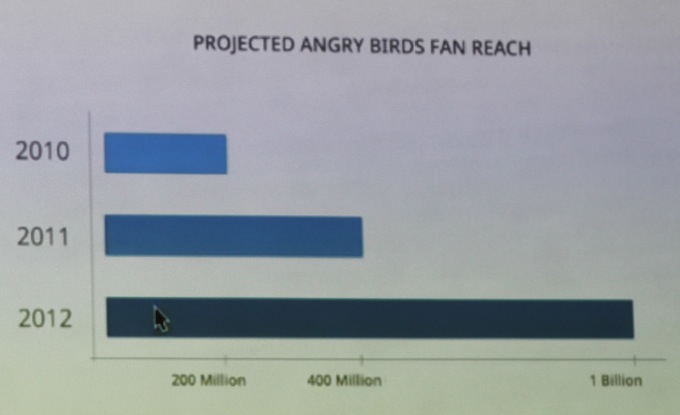
Today in Tokyo, Rovio celebrated the second birthday of Angry Birds with an event at the Ginza Apple Store. Rovio’s ‘Mighty Eagle’ Peter Vesterbacka was on hand, as was Antii Sonninen who is the company’s representative in Japan. Peter looked back on Rovio’s journey so far, and the conditions and circumstances that came together for Angry Birds to take flight as they did. As Peter notes, Rovio is only just getting started, explaining that the company’s trajectory over the next year will bring many more games than we saw in 2011. He lays out a roadmap that looks to rocket the Angry Birds brand to a billion fans, with more than a few unlikely stops along the way. You can read Peter’s two-year retrospective below, including some new announcements, and the vision for the future — which is about to include Japan. [1]
How Rovio was hatched #
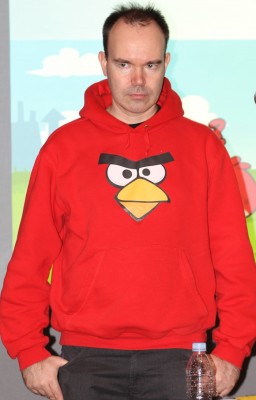
Rovio's 'Mighty Eagle' Peter Vesterbacka has eyes set on a billion fans
Rovio is not new to games, and it has now been two years since Angry Birds – but we have been making games since 2003. There were 51 games before Angry Birds. It’s important to keep in mind that success stories like these don’t happen overnight. Angry Birds is an overnight success story that took a few years to make.
If you look at Rovio, it started out of a competition I organized while at HP at Helsinki in Finland. After Niklas Hed and two student friends were making mobile multi-player games (him and two friends won the competition) they asked what should we do now? I said why not start a company? And so Rovio got started.
Angry Birds was the 52nd game. Some other games were also good, primarily games we did for others. Bounce was on 220 million Nokia phones. We made Burnout and Need for Speed for EA. Lots of work for higher projects. It’s important to note that the market was tough for a small startup like Rovio. You used to need to be friends with handset and mobile operators for distribution; it was very tough to get distributed. It’s appropriate that we’re celebrating here at the Apple Store in Tokyo, because what really changed the market was the iPhone and even more the App Store. It’s much easier for small developers to distribute games now. We have Apple and the App Store to thank for that.
If you look at Angry Birds, we’re about two years into the experience, not such a long time. On December 11, 2009 Angry Birds came out. Development started in spring of 2009, and the process took eight months. We thought we knew good games, but distribution was hard. We looked at the iPhone and the App Store, and analyzed many games out there to see what it took to make a hit game. And our strategy was to keep making games until we had a hit an then take it to all screens – like a Tetris strategy – make an iPhone hit and then take it everywhere. And on December 11 2009 we released Angry Birds.
It took eight months to develop and we used a very analytical process to create the game. We tried to eliminate luck, but of of course you need a little luck as well. Every Friday we have an internal pitching of ideas, and one of our games designers Jaakko Iisalo had a design that was very different from the current design, but it had the birds characters. And everyone fell in love with the characters. And we knew we had to make a game around the birds.
Developing character #
Being here in Japan you have many successful character-based businesses; many stories created around characters in Japan. We’re very much driven by character based entertainment. Then we needed a story. And the Angry Birds story is very simple. You have an island with two species: birds and green pigs. The pigs are not evil, but very, very hungry. The biggest pig is the king, and there’s not really a lot to eat on this island. Only one thing is very nutritious, and that happens to be the eggs – and so the pigs steal them. But the eggs are very important for the birds, and you all know what happens next – the birds get very, very angry.
It’s a very simple story and it’s an epic battle that has no end. Pigs steal and birds get angry, and it goes on and on. It took eight months because it was a project in between our work for hire projects. There were only 12 people at the company at the time. Some things [happened] during the development process, for example, a very late addition was the slingshot. But now when you pick it up, everyone knows how to play it – from young kids to grandparents. Angry Birds is easy to pick up, and very difficult to put down.





Stay updated on the go with our mobile app.
Get latest insights with smoother, more personalized experience through TIA mobile app.









📅 Upcoming Events
22 October 2026
Payoneer x CSPN Summit 2026