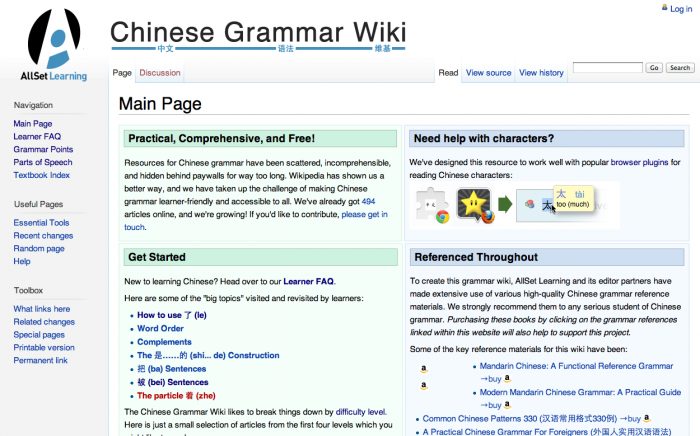
AllSet Learning is an educational consultancy startup based in Shanghai, China. Today, AllSet has entered the tech realm by launching a Chinese grammar wiki. The wiki, which contains explanations and examples of Chinese grammar points organized by level of difficulty, is licensed with a Creative Commons license, which means that although it was created by AllSet, it can be used and shared by anyone interested in learning Chinese. AllSet Founder John Pasden told us:
I’m really hoping that learners all over the world will find it useful, and that some of them will even want to give back to the project by serving as an editor.
Indeed, it seems like the sort of thing entrepreneurs and investors looking to better understand the Chinese market by learning Chinese could definitely make good use of. To be sure, I took a look around the wiki to see what it had to offer. As a longtime student of Chinese and also a former Chinese teacher, I must say I was pretty pleased with what I found.
Grammar points are broken down by difficulty, from basic all the way up through advanced. In many cases, the grammar points are also linked to sections in popular Chinese textbooks like Integrated Chinese and New Practical Chinese Reader so that students can find relevant exercises and more in-depth textbook explanations easily.
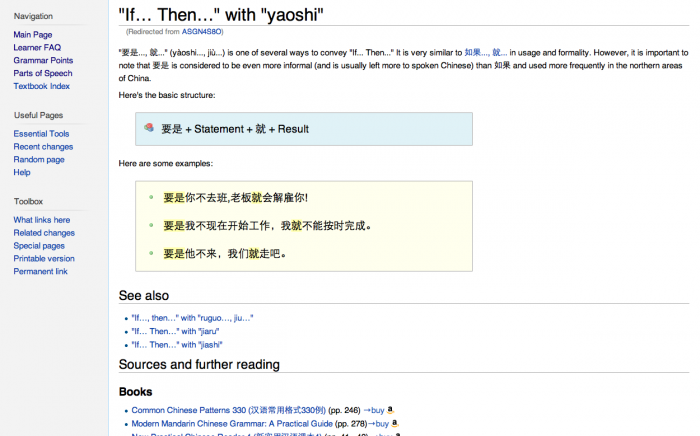
An entry on the Chinese grammar wiki about a certain type of if...then... grammatical construction
As of when I looked at the wiki — a few days ago — some pages were more in-depth than others, and a few pieces of the puzzle were still missing. Obviously, though, this is a project that AllSet intends to expand and grow as time goes on. All in all though, I found the explanations to be clear, concise, and thorough. Most impressively, the wiki includes some very recent grammar usages that you’d never find in a textbook, but that are nevertheless important for understanding what people are really saying (for example, this use of bei).
Entries are also thoroughly cited (generally to popular textbooks so that students can look up the citations easily) and, where available, additional resources like podcast links and other online resources have also been appended to the end of each article. It’s the sort of thing I wish I’d had when I was learning about le (for example), and it’s a pretty useful reference even for fluent speakers who want to brush up or double-check that they’re using something correctly.
I tested the search function a bit, and searches in Chinese characters and in pinyin both seemed to work pretty well, leading me directly to the pages I was looking for. Searches in English were a bit more hit-or-miss, but still not too bad. A search for “negating”, for example, turned up a bunch of results, but the page I was looking for on the main words used to negate things in Chinese still appeared on the first page of results, albeit closer to the end than the beginning.
One thing that may irk some students of Chinese is that there’s very little pinyin romanization on the site, it’s almost all characters. However, the wiki is designed to work well with browser plugins that provide the pinyin for a character on mouseover, and if students don’t know where to find those plugins, there’s a wiki entry for that, too. I have a feeling some students may still be annoyed by this, but it’s probably a good thing — it forces students to look at the characters at least for a second, and it helps the wiki look clean and inviting. (Generally speaking, having characters, pinyin romanization, and English translation all in one place looks like a garbled mess, and rendering pinyin fonts is an extra pain in some browsers).
All in all, the Chinese grammar wiki is a pretty impressive resource for students and I’m looking forward to watching as it expands. I’m also happy to see educational companies in Asia entering the tech space with strong offerings like this, especially when they’re nice enough to use Creative Commons licenses to make sharing easy and legal.





Stay updated on the go with our mobile app.
Get latest insights with smoother, more personalized experience through TIA mobile app.