Stefanie Yeo · · 5 min read
How PasarPolis is making insurance accessible in Indonesia and beyond

When you buy a smartphone on Shopee Indonesia, you might be served with an option to add-on some gadget insurance for your purchase at checkout. It doesn’t cost much, with prices starting from as low as 1,750 rupiah (roughly US$0.12), and can be added to your cart with a tap of a button.
This microinsurance service is just one of the many products Indonesian insurtech firm PasarPolis offers. Founded in 2015, PasarPolis was launched as a licensed online insurance marketplace, selling one-size-fits-all policies from insurers for health, cars, and travel.
However, founder and CEO Cleosent Randing had different ambitions for his startup, especially in the face of Indonesia’s low insurance penetration rates, which stood at just 2.7% at the time.

Cleosent Randing, founder and CEO of PasarPolis / Photo credit: PasarPolis
“We wanted to really revolutionize the insurance market in Indonesia and across Southeast Asia,” he explains. “If we want to increase the penetration of insurance, we cannot do it the same way as before – we need to really provide easy, affordable, and accessible insurance to everyone.”
Driven by this desire, PasarPolis evolved into a tech platform that also works with insurers and business partners to offer affordable insurance products to address the challenges that Randing and his team saw in Indonesia’s insurance scene.
Challenges with the insurance experience
According to Randing, Indonesia has two major issues regarding insurance: access and the availability of products that really meet the needs of consumers.
Indonesia’s insurance industry is dominated by banks – a format commonly known as “bancassurance” – and offline agent networks. For a large part of the country’s population, especially those outside Tier 1 cities, traditional insurance has been mostly inaccessible. Getting an insurance policy would often require a lot of paperwork, complex and time-consuming processes, and high premiums that most could not afford.
Plus, applying for and claiming insurance has historically been a cumbersome process, with claims taking months to process and even longer to be paid out.
From Randing’s perspective, this hampers the entire experience, particularly given that residents outside major cities may be reliant on day-to-day work for income and might not have the necessary savings to tide them over such long processing times.
Additionally, traditional insurers have not been able to meet the needs of Indonesia’s increasingly tech-savvy population, which is seeing new forms of risk emerge as a result of new technologies.
“Technology definitely helps ease the way people deal with the ongoing risks they have to face every day, especially with the new digital services emerging,” shares Daniel Tedja, senior vice president of corporate finance at PasarPolis. “Ride-hailing, e-wallets, ecommerce, microfinance – the list goes on – and insurance comes in as an important player in this landscape providing protections against these new kinds of risk.”
Bridging the gaps
In the face of these challenges, PasarPolis decided to expand its offerings to bridge the gaps.
Besides its online platform, where consumers can purchase insurance directly, the firm has also struck up partnerships with many major tech companies to embed insurance into their products. This has created more opportunities for Indonesians to access insurance easily and affordably.
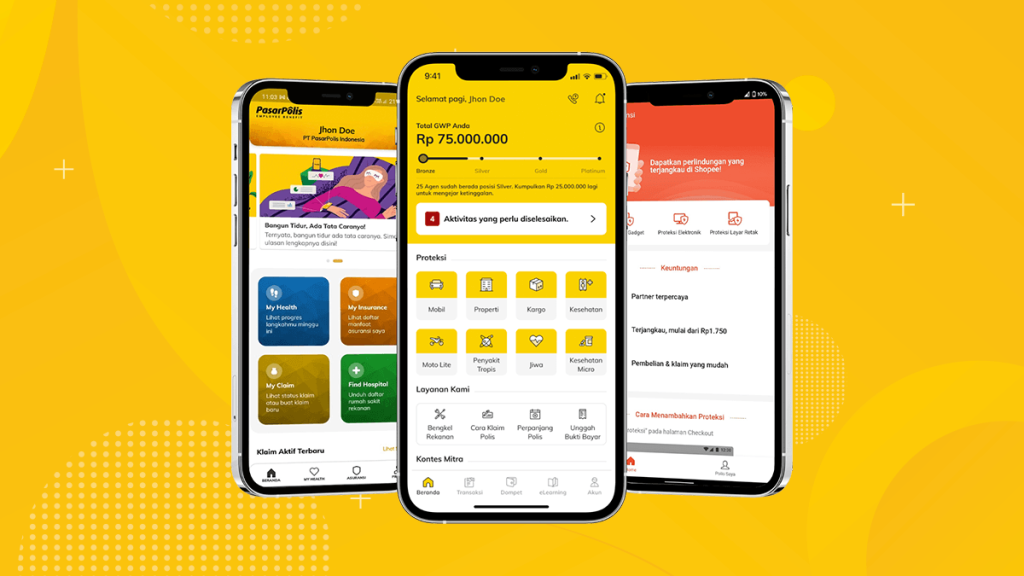
Photo credit: PasarPolis
The firm has worked with companies like Gojek to provide health and life insurance for its drivers and riders, meeting a new need that has risen along with the digital economy.
It also collaborates with ecommerce firms like Shopee and Tokopedia, as well as electronics companies such as Xiaomi, to offer gadget insurance on items like smartphones and laptops that are bought on the platforms. Among its other offerings, PasarPolis allows consumers to buy travel insurance, plane tickets, and hotel bookings from companies like Traveloka.
“In this way, we make insurance frictionless and a part of the transaction,” says Adi Darmaputra, PasarPolis’ director of partnerships. “Insurance [used to be] difficult to buy. What we have done is to embed it in every activity and work with ecosystem partners to make it easy and accessible.”
PasarPolis also operates a “mitra” model, where offline agents – such as mom and pop shop owners – can facilitate insurance product purchases on the firm’s digital platform. This makes PasarPolis’ offerings accessible even to Indonesians who don’t have easy access to the digital economy.
“Offline-to-online remains a dominant well-known distribution channel for insurance products,” shares Randing. “With this, we can ensure buying insurance is frictionless and easy for all levels of internet users.”
The firm has also made the effort to make sure that the process of buying insurance, making a claim, and receiving a payout is streamlined through its platform.
“We have instant policy issuance, and we can pay out claims within a day,” Randing says. For example, if a user encounters a flight delay, PasarPolis can access real-time information and verify and process claims through its connections to airline watchtowers and flight trackers.
To Indonesia and beyond
PasarPolis’ approach has served it well. The firm has expanded its operations into Thailand and Vietnam and has issued nearly 370 million policies. In 2021 alone, the company insured over 80 million consumers across the three markets it is active in.
“The truth is that much of Southeast Asia faces the same problems with insurance as Indonesia,” says Randing. “The use of digital platforms and partnerships with digital services has helped make insurance more accessible to people in these emerging economies as well.”
On the road ahead, PasarPolis aims to continue to make insurance accessible to consumers around Southeast Asia.
In particular, the firm is hoping to leverage new technologies such as AI and machine learning to develop customized and personalized products for each customer, while remaining accessible and affordable. It has also brought in a new CTO to drive these efforts.
“We really want insurance to be 10 times more delightful, more affordable, and more behaviorally precise,” shares Randing. “And therefore, insurance can better meet the needs of users, allowing us to be more socially impactful and revolutionary.”
PasarPolis aims to solve the pain points involved with insurance, creating worry-free lives for individuals and families through technology.
Learn more about PasarPolis on its website.
This content was produced by Tech in Asia Studios, which connects brands with Asia’s tech community. Learn more about partnering with Tech in Asia Studios.
Stay updated on the go with our mobile app.
Get latest insights with smoother, more personalized experience through TIA mobile app.
Recommended reads
 FPT, Nvidia join forces for $200m AI factory project in Vietnam
 Vietnam’s F88 secures $60m loan, eyes IPO by 2024
 Tesla to build Indian EV factory
 China’s Nio expects to sell less EVs amid Covid-19 crisis
 Grab to phase out GrabPay Card services in June
 Hex Trust wins license for virtual asset services in Dubai
 Grab scouts for engineers in Malaysia
 Bolt seeks country manager for Malaysia launch
 Shein trials B2B ecommerce service in Brazil
 Meituan eyes HK expansion amid local slowdown





Editing by Nathaniel Fetalvero and Jaclyn Tiu
(And yes, we’re serious about ethics and transparency. More information here.)