- Premium Content It takes our newsroom weeks - if not months - to investigate and produce stories for our premium content. You can’t find them anywhere else.
 Samreen Ahmad · · 9 min read
Skyroot’s frugal rocket formula and why it won’t follow SpaceX
Skyroot Aerospace is currently one of the hottest names in India. The Hyderabad-based spacetech unicorn successfully launched Vikram 1 last month, making history as the country’s first privately built orbital rocket.
The achievement has propelled India into the league of China and the US. More than that, Skyroot is challenging the notion that blazing through cash is a prerequisite for growth, even showing that it can do more with less.
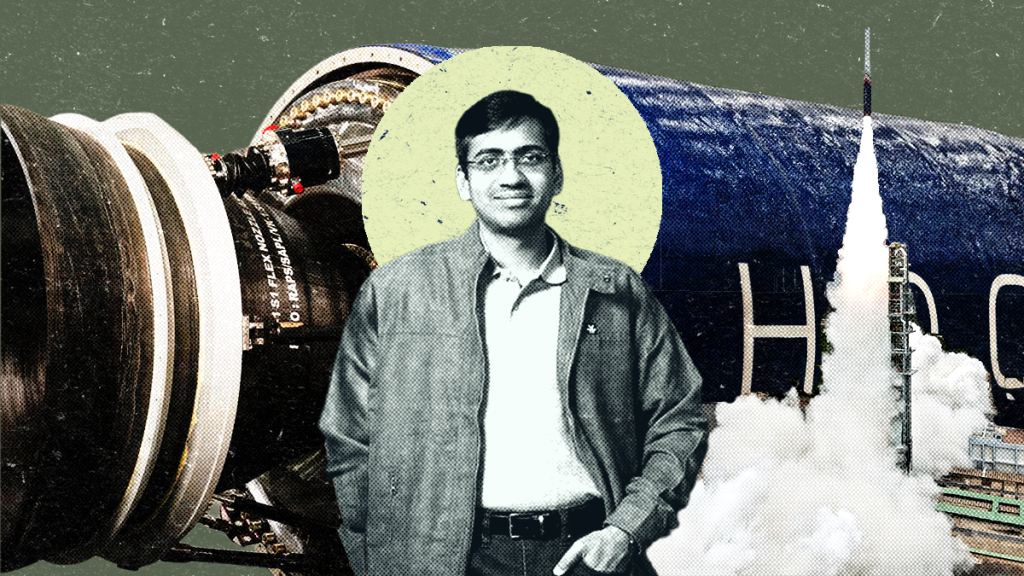
Digital collage by Ulla, photos courtesy of Skyroot
The startup, whose backers include Singapore sovereign wealth fund GIC, Temasek, and BlackRock, has raised only US$150 million since its founding in 2018. But it has built what it says is one of the world’s lowest-cost rockets that can carry payloads of up to 350 kilograms. For reference, SpaceX’s Starship is designed to carry over 100,000 kilograms.
In this wide-ranging interview with Tech in Asia, cofounder and CEO Pawan Kumar Chandana explains Skyroot’s frugal approach and the technology decisions behind the rocket it named after Vikram Sarabhai, a pioneer of India’s space program.
Amid reports that the company is raising as much as US$200 million in new capital and taking bids from investors, Chandana says it is “not really looking to raise much capital” and that it is “well-capitalized” enough to continue growing.
He talks us through why he believes India has all the components needed to produce world-class deeptech companies that can achieve “extremely difficult milestones.” He also shares his hopes that Skyroot’s success can create a ripple effect across India’s tech ecosystem.
This interview has been edited for clarity and brevity.
What was your initial reaction to the successful launch?
I was in the highest spirits after the launch was successful because I was not expecting it. As an engineer, I knew there were so many things that could go wrong, and none of the first launches for a completely new launch vehicle had ever succeeded globally.
The statistics were against the odds of success. It was a great validation and gave me relief that we are doing something world-class from India.
What made you leave your job at Indian Space Research Organisation (ISRO) to launch Skyroot back in 2018?
I’ve wanted to be an entrepreneur since childhood. I was really fascinated by the impact entrepreneurs have on society. They create employment, build infrastructure, and generate wealth.
I felt that, within a limited time, you can make much more impact if you’re an entrepreneur. I was also drawn to the independence that entrepreneurship offers.
Stay ahead in Asia’s tech landscape
This is premium content. Subscribe to read the full story.
India’s first spacetech unicorn made history with a successful orbital rocket launch. Facing bigger tests, its CEO looks back and ahead.
We know this is not ideal. ⌛ Sign up in 20 seconds. Cancel anytime.
Our subscriber community includes professionals from these companies:





Stay updated on the go with our mobile app.
Get latest insights with smoother, more personalized experience through TIA mobile app.