- Premium Content It takes our newsroom weeks - if not months - to investigate and produce stories for our premium content. You can’t find them anywhere else.
 Samreen Ahmad · · 7 min read
Can AI mash more value out of the potato?
Most potato farmers don’t give a chip about AI. They’re focused on whether the harvest is healthy, the crops are watered, and the produce is getting to market.
But a growing number of firms across Asia are taking a fresh look at how the lowly spud is farmed and how to make it more predictable – and profitable.
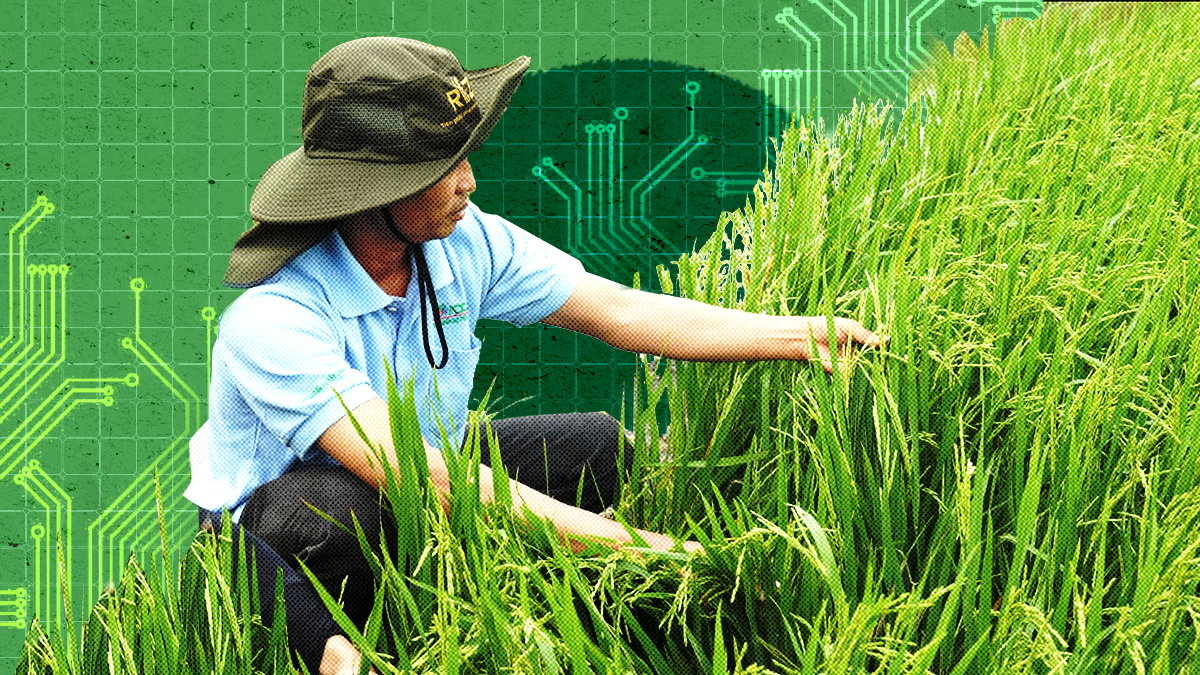
Digital collage by Ulla, photo courtesy of Rize Farm
Krishna Kumar, founder of Indian agritech company Cropin, says the entire agricultural supply chain – not just farmers – needs a clear economic incentive to make AI a viable addition to farming. The Google-backed company is hoping to give the sector that incentive by using AI in a way that goes beyond making farm management software more efficient.
Founded in 2010, Cropin provides AI-powered farm management and predictive intelligence software to agribusinesses. It has around 700 million crop records across 103 countries, 400 crops, and 10,000 varieties. That data is used to train models that can predict how crops could perform in the future.
For instance, Cropin is working with potato growers and research organizations in Europe to examine how farming practices affect water use and crop quality. The company uses AI to test whether different farming practices can increase the solid content – as opposed to water content – of potatoes.
Those with higher solid content can yield more finished products, such as chips, during processing, potentially making them more valuable to food manufacturers.
Conventional potato farming often relies on fixed irrigation schedules, leading to overwatering and lower tuber quality. Cropin combines regenerative soil practices with satellite data, soil moisture analysis, and rainfall forecasts to guide farmers on when and how much to irrigate.
The company shares that in one regenerative agriculture program supported by European organization EIT Food, water use fell 5% while potato solid content increased 1.5%.
See also: VN startup banks on co-ops to defy agritech skeptics
That does not automatically mean a 1.5% increase in the farmer’s income, as the financial benefit depends on how potatoes are graded and priced. But it can lead to a more favorable setup: The farmer could earn more for producing a better-quality crop, while the processor gets better yields and more consistent output.
Because of this, farmers may not be the ones who pay for the technology. Cropin largely offers its models to businesses and governments rather than individual farmers.
AI in the field
Agritech companies have been using satellite imagery, weather data, and machine learning to monitor crops and predict yields since the 1990s. Generative AI is making that information easier to access, allowing farmers and agribusinesses to get up-to-date information through conversational interfaces, such as asking when to irrigate, how much fertilizer to use, or when to intervene against disease.
Cropin offers Orbit AI, a multiagent system with different “personas” for growers, agronomists, and sourcing managers. Instead of opening a dashboard and downloading reports, a sourcing manager can ask which farms need to be visited and get a list of farms that need field visits based on factors such as water stress or disease risk.
Linking up the farms
The harder question
The holy grail
Stay ahead in Asia’s tech landscape
This is premium content. Subscribe to read the full story.
The AI boom has reached the farm, where rice and potato growers are testing whether better predictions mean better economics.
We know this is not ideal. ⌛ Sign up in 20 seconds. Cancel anytime.
Our subscriber community includes professionals from these companies:








📅 Upcoming Events
30-31 March 2027
Upskill Fest