- Premium Content It takes our newsroom weeks - if not months - to investigate and produce stories for our premium content. You can’t find them anywhere else.
 Ye Yuan · · 7 min read
The Chinese neurotech startups chipping away at Neuralink’s lead
Tiger Tao once ran China’s top research institute for information technology. But he would eventually leave the security of a state job to go all in on brain-computer interfaces (BCI).
In 2021, he founded NeuroXess, one of the most ambitious neurotech companies in the country. Tao, who is also chief scientist at his startup, is confident in the market potential of BCI, which records and translates brain activity into computer commands via an external device.
Speaking to Tech in Asia from his Shanghai office, Tao says that he shares Elon Musk’s vision for brain chips.
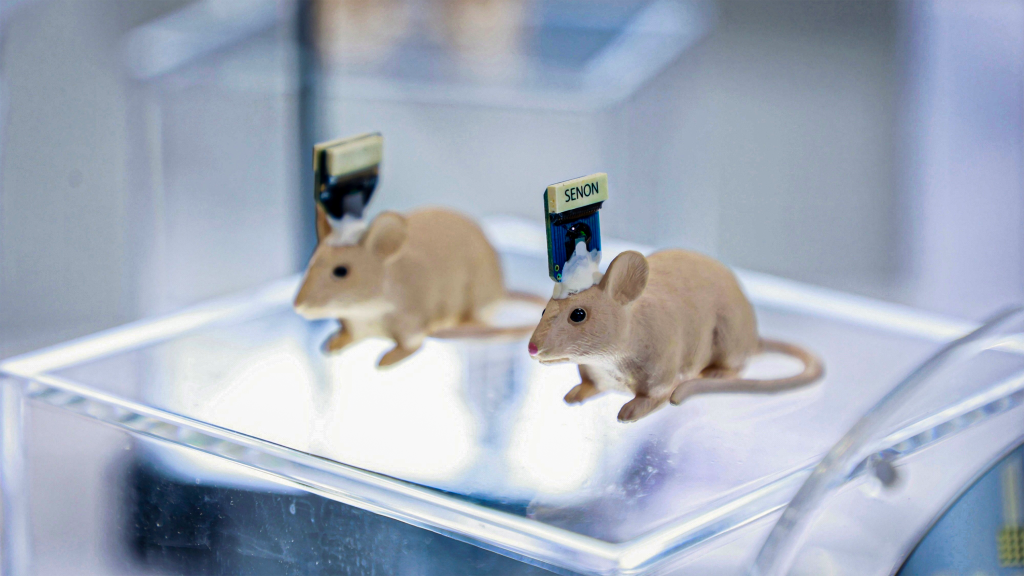
Experimental brain-computer interface implants on display by Chinese startup NeuroXess. / Photo credit: NeuroXess
Musk-founded Neuralink is making the biggest splash, popularizing what was once just science fiction and launching its first-in-human trial in 2024. But safety concerns have long clouded its path to commercialization.
Invasive implants carry the risk of infection. For brain chips, the most significant concerns are bleeding and brain tissue damage as electrodes go deeper into the brain to capture signals.
According to Tao, NeuroXess takes a different approach. While its probes also target the brain, they require only minimal open-skull surgery to be implanted on the cortex. That’s thanks to the company’s self-developed patent, which he claims makes the procedure less invasive.
“Although our electrodes are placed on the cerebral cortex, they deliver performance on par with electrodes implanted deep within the brain,” says Tao, who returned to China in 2014 after completing his postdoctoral training in biomedical engineering at Tufts University.
In January, NeuroXess became the first Chinese startup to achieve real-time decoding of both motor and language functions in human trials. Tao says the technology allows recipients to speak Mandarin at 300 words per minute. For comparison, the average is 150 words per minute for healthy individuals.
See also: Chips don’t lie: Did China’s latest AI just beat the US?
Early backers include Shanda, a private investment group founded by tycoon Chen Tianqiao, and HongShan, a firm spun out of Sequoia Capital’s China arm after its 2023 split.
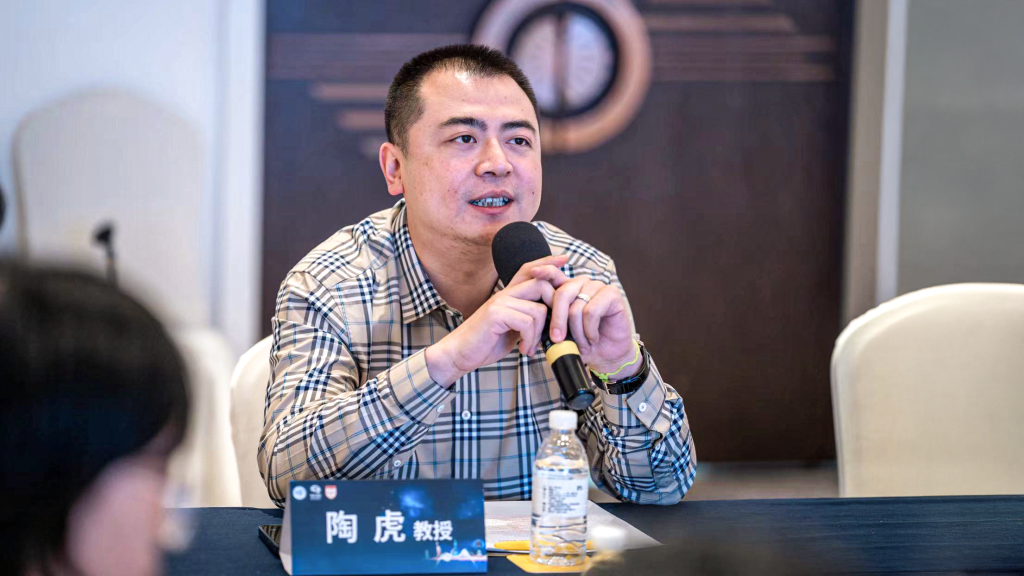
NeuroXess founder Tiger Tao / Photo credit: NeuroXess
NeuroXess plans to seek product approval for its wireless brain implant system in two years, Tao says. It is also set to close a series B round from Chinese funds soon.
Aiming for China’s first certified brain implant
Will China move faster than the US?
Stay ahead in Asia’s tech landscape
This is premium content. Subscribe to read the full story.
One such startup is NeuroXess, whose trials show that patients with brain chips can already play games and scroll social feeds with their thoughts.
We know this is not ideal. ⌛ Sign up in 20 seconds. Cancel anytime.
Our subscriber community includes professionals from these companies:





Stay updated on the go with our mobile app.
Get latest insights with smoother, more personalized experience through TIA mobile app.