
Wi-Fi, as we know it today, was standardized in 1997 by the Institute of Electrical and Electronics Engineers. Wi-Fi 1 only had a speed of 11 megabits per second and a bandwidth of 2.4 gigahertz, ludicrously inadequate for current needs.
Fast forward to today: Wi-Fi 7 has hit the market and blown past previous speed records to touch 5.8 gigabits per second.

Photo credit: Shutterstock
“The question now is: what else is Wi-Fi 7 bringing to the table?” says Yeo Siok Been, a product lead at network infrastructure company HPE Aruba Networking. “What new capabilities will help everyday users and businesses dramatically improve their internet experience?”
Faster and more stable connections
Wi-Fi 7 comes at a time when businesses are looking for better networking solutions amid the confluence of several industry trends, such as growing IoT usage and hybrid working arrangements.
While the internet may seemingly be made up of infinite space, in actuality, how much connectivity a user has access to is limited by bandwidth.
“Think of Wi-Fi bandwidth like a road system,” says Yeo. “You could have the fastest car ever, but if there are many other vehicles on the road, you’ll hit congestion.”
Wi-Fi 7 technology doubles channel bandwidth from 160 megahertz to 320 megahertz. Broader channels mean “you’re getting users in and out of your highways at a much faster rate, so your overall capacity and performance is better,” explains Yeo.
Moreover, Wi-Fi 7 improves user experiences by using 4K QAM, which increases the amount of data that can be sent in a single instance, thereby boosting overall transmission speeds.
This makes Wi-Fi 7 ideal for supporting large offices or co-working spaces, where people need fast, reliable connections for video conferencing and cloud computing.

Photo credit: Shutterstock
However, Yeo admits that there are downsides to 4K QAM), saying that “those high speeds require you to be close to the access point in order to reduce how much noise there is around you.”
That said, most enterprises will likely only need 1K-QAM. While it has slower speeds than 4K-QAM, it lets employees work further from the access point while already giving them wider Wi-Fi coverage.
Another aspect of Wi-Fi 7 that supports modern-day office work is its use of distinct multi-link operations, which allows devices to work across multiple radio bands for data transmission. This provides additional channels in cases of unexpectedly high congestion, such as when remote teams come together to work in the office.
Foundations of the smart factory
Aside from boosting bandwidth, Wi-Fi 7 – like Wi-Fi 6 and Wi-Fi 6E before it – improves transmission efficiency by building on the foundations laid by orthogonal frequency-division multiple access technology. Prior to this tech, whole channels could be taken by a single device, which can lead to the connection being easily congested and slowing down speeds.
“We were essentially using a lorry to deliver a single data package, regardless if it was big or small, which is very inefficient,” explains Yeo.
Through a feature called multiple resource units, Wi-Fi 7 allows any available channel to be shared by different users. This enhances efficiency and lowers latencies by roughly 25%, increasing reliability and reducing Wi-Fi congestion.
Wi-Fi 7 access points are also effective at managing IoT devices, as they simplify connectivity and improve security. A report by GSMA Intelligence estimates that by 2030, there could be more than 38 billion IoT connections, cutting across smart buildings as well as healthcare and manufacturing facilities.
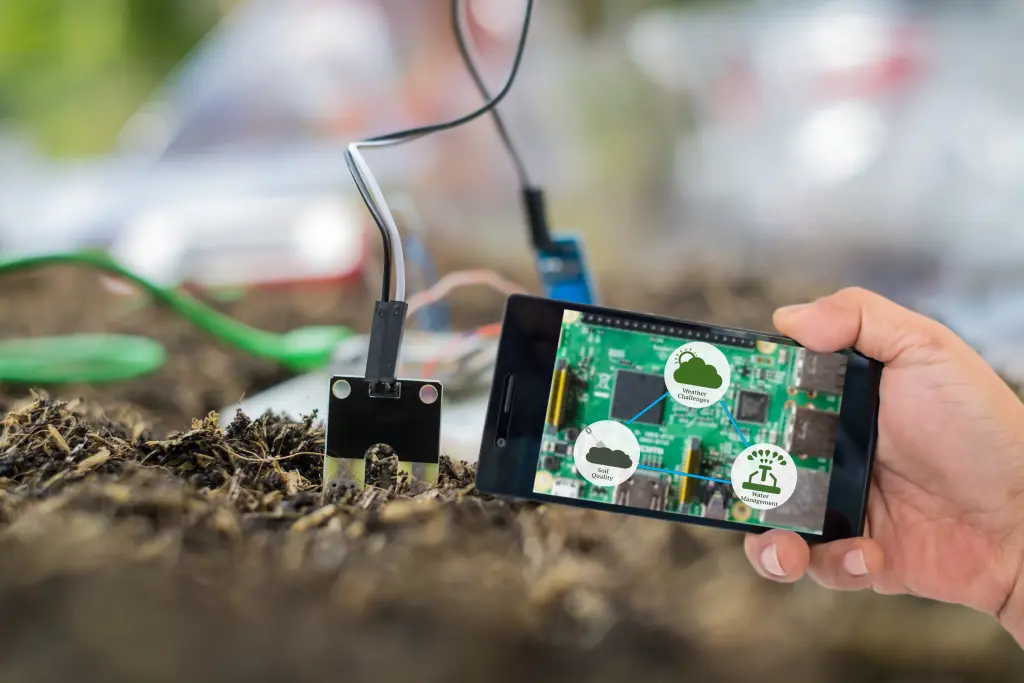
Photo credit: Shutterstock
Improved and reliable connections are essential as “people want more interconnected, smart networks, so they’re installing lots of IoT devices everywhere,” Yeo says. “In hotels, for example, you’re now using your phone to unlock doors.”
In particular, factories will have much to gain from integrating Wi-Fi 7 into their operations. Powering smart manufacturing requires an intricate ecosystem of IoT sensors, robots, and automated monitoring systems that are constantly and rapidly transmitting data.
“The low latency in Wi-Fi 7 ensures precise synchronization and control of robots, autonomous guided vehicles, and drones,” she explains. “Wi-Fi 7 also enables seamless transmission of high-resolution video streams for industrial cameras, which can be used for real-time decision making and AI-driven detection of defects.”
Security and sustainability for Wi-Fi
There will be a wide variety of use cases for Wi-Fi 7, but solutions will require strong sustainability and security capabilities to meet the demands of modern users.
With the widespread uptake of remote work, Yeo says that workers are more vulnerable to hackers because they’re using open Wi-Fi networks in locations that are less secure than an office setting.
It’s also important that in the age of remote work, security teams are aware of who is connecting to their systems, as IoT devices can open the door to hacking. Case in point: In 2017, hackers exploited a fish tank sensor to steal data from a casino in Macau.
The latest generation of Wi-Fi has seen improvements in security protocols such as WPA3, which was certified in 2018 and provides better protection of data and users. At HPE Networking, Yeo says that the company is “doubling down” on producing hardware that supports strong and secure IoT connections.
“Let’s say you see a sudden spike in activity from an IoT device. Our devices proactively monitor your sensors so you get that information instantly to quickly investigate and quarantine the problem before something goes wrong,” she says.
HPE Networking’s access points also support MACsec, a higher level of encryption that extends data protection from wired connections to the access points themselves.

An access point developed by HPE Aruba Networking / Photo credit: HPE Aruba Networking
Yeo adds that sustainability is also a growing issue when it comes to Wi-Fi 7, as “access points will increase your power consumption because you’re running through radio and have a lot more features.” Network infrastructure companies are exploring how they can minimize power consumption and improve their products’ energy efficiency.
For HPE Networking, its Wi-Fi access points have a sleep mode function, which saves energy when they aren’t in use. “That cuts down power consumption by a lot, especially during weekends when no one is in the office,” adds Yeo.
What will the future look like?
As Wi-Fi technology continues to develop, it will eventually require government clearance in certain areas to reach its full potential.
In Singapore, only a certain portion of transmission channels are available for enterprise Wi-Fi 7 uses. “Think of it as having a highway with four lanes, but you’re only allowed to use two,” says Yeo.
However, if all the possible channels become available for use, the improvements for enterprises using Wi-Fi 7 technology, and possibly Wi-Fi 8 in the future, could be game-changing.
“When all channels are open for use, you’re looking at potentially double your existing performance,” adds Yeo.
HPE Aruba Networking provides secure, AI-powered networking solutions. To learn more about how its Wi-Fi 7 solutions – in partnership with VSTECS – can supercharge your business, click here.
This content was produced by Tech in Asia Studios, which connects brands with Asia’s tech community. Learn more about partnering with Tech in Asia Studios.
Stay updated on the go with our mobile app.
Get latest insights with smoother, more personalized experience through TIA mobile app.
Recommended reads
 Forrest Li on scaling Sea, building smarter bots, and founder grit
 SGX’s CEO says it doesn’t need a unicorn to win
 SMEs want AI too, but not the kind Big Tech is selling
 Oatside’s alt-milk rise hits a profitable gear
 Alibaba’s financial health in 12 charts
 Asia’s telcos bundle AI into mobile plans. Will it pay off?
 M-Daq chases bigger clients as revenue falls, losses grow
 VC tracker: Accel raises US$3.5b, including US$550m for India
 Graas buys Temasek-backed Trustana in agentic commerce push
 Doctor Anywhere posts healthier operations in 2025





Editing by Jonathan Chew, Winston Zhang, and Lorenzo Kyle Subido
(And yes, we’re serious about ethics and transparency. More information here.)





