- Premium Content It takes our newsroom weeks - if not months - to investigate and produce stories for our premium content. You can’t find them anywhere else.
 Samreen Ahmad · · 6 min read
Will India’s trade tensions spill over to OpenAI, Anthropic?
Global AI giants like OpenAI and Anthropic are setting up offices in India, but their arrival intersects with a delicate geopolitical moment.
Rising trade frictions between the US and India, from tariff disputes to tighter H-1B visa quotas, have reignited debate over how much access India should grant to US tech firms in critical digital sectors.
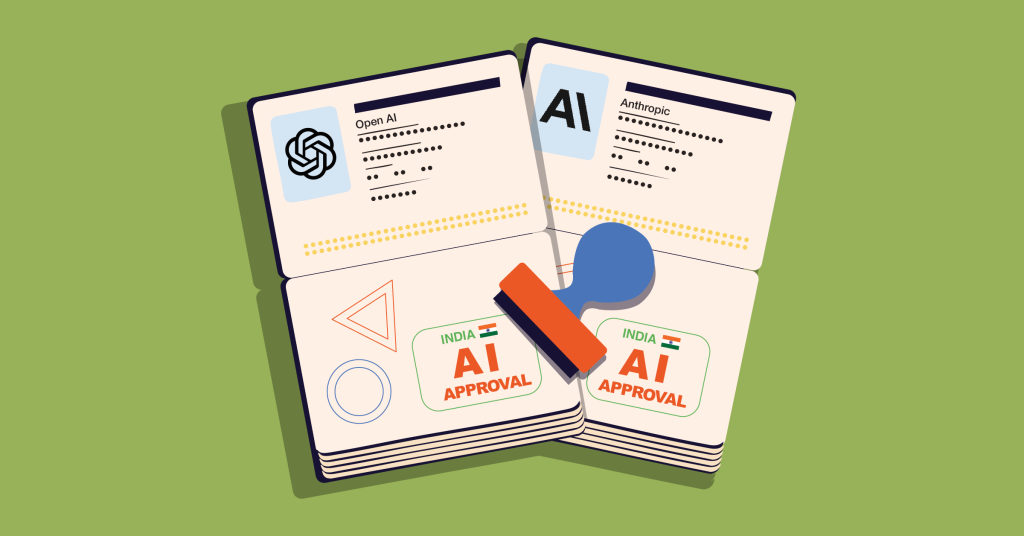
Image credit: Arsal Ysfin
India recently scrapped its 6% equalization levy on digital ads, known as the “Google Tax,” effective April 1. The move is widely seen as a gesture to ease trade friction with the US.
At the same time, Tech in Asia has learned that the Indian government is currently assessing how much market access it should allow AI players from the US.
An official from the Ministry of Electronics and Information Technology declined to comment on Tech in Asia’s queries, while OpenAI and Anthropic did not respond to emails seeking comment.
Generative AI has become a frontier technology with both economic and strategic implications. Greater access for OpenAI and Anthropic in India could drive innovation, but it also raises risks over who controls the country’s digital future.
“Every technology or market we open up must now be viewed through the lens of national security,” Abhishek Goyal, co-founder of data firm Tracxn, tells Tech in Asia.
“We have seen how digital systems can be weaponized during conflicts. India needs to ensure that what is built here cannot be turned off or used against us.”
Recent history supports this caution. In 1999, during the Kargil War, the US limited GPS access, which showed how dependence on foreign tech can leave India exposed.
If access to key AI tools or cloud can be restricted during a geopolitical crisis, “that is an unacceptable vulnerability,” Goyal says.
Every technology or market we open up must now be viewed through the lens of national security
The government has so far taken a measured stance. According to Ashish Aggarwal, head of public policy at Nasscom, the entry of global AI players is “a natural outcome of India’s market growth,” and “not a result of any specific geopolitical or policy nudge from anybody.”
But the broader context, including tariff controls and the Trump administration’s tightening of skilled-worker visas, makes the situation more complex. In an environment where technology itself is strategic, India’s decisions about market access, data, and infrastructure are bound to carry political weight.
The Toyota test
Avoiding the Google, Meta moments
Stay ahead in Asia’s tech landscape
This is premium content. Subscribe to read the full story.
India’s tech insiders call for AI tariffs and a check on foreign dominance in the space.
We know this is not ideal. ⌛ Sign up in 20 seconds. Cancel anytime.
Our subscriber community includes professionals from these companies:





Stay updated on the go with our mobile app.
Get latest insights with smoother, more personalized experience through TIA mobile app.








📅 Upcoming Events
22 October 2026
Payoneer x CSPN Summit 2026