Meghna Rao · · 5 min read
The digital revolution is leaving the blind behind, but she’s here to change that
Photo credit: Dboybaker.
The danger with opening up the internet floodgates is that not everyone can access the information that comes out. Those who can’t are falling behind faster than ever – can you imagine how hard it is today for a blind person to keep up with someone who can see?
Surabhi Srivastava, the co-founder of Innovision, explains that blind literacy rates have dropped from fifty percent to less than ten percent over the past thirty years, with developing countries like India scraping the bottom with less than two to three percent. There are plenty of factors to explain away those dismal numbers – an increase in literacy standards, or maybe the first time real data has been collected – but they provide a striking look at who we consider important when we talk about development.
While there are machines that convert digital text into braille, they’re expensive, and alternatives that use voice technology don’t hit the mark in terms of literacy. Surabhi explains that there’s not much that can compare to the knowledge gained from text-based learning, and that means that those who can read are still leaps and bounds ahead of those who can not.
Thats why even today, most blind people are stuck reading from paper, which she says has never been a great option. “A book from the Harry Potter series is 1,000 pages and costs US$17,” Surabhi says. “One for the blind is 11 volumes long and costs eight times as much.”
Her startup, Innovision has produced a solution for this problem: the BrailleMe. It’s a machine that plugs into mobile phones and computers to help the visually impaired access the internet and other digital content. It’s equipped with a tool to let people write in braille and have it appear in digital text, as well as one that converts digital text into raised bumps for readable braille. Every time a person finishes reading a line, they can press a handy little “next” button to move to the next one.
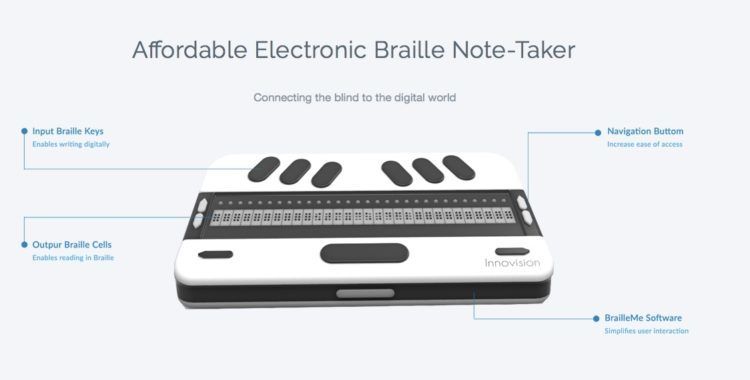
It can be used for everything from surfing the web to checking Facebook to mapping out GPS directions. “Let’s say you plug into a phone and have a client you want to email,” Surabhi says. “You can use the navigation buttons to get to the Gmail icon and type out a response.”
The machine supports bluetooth connectivity and has an SD card port, so people can access just about any file they have stored. It costs just under US$300, making it much cheaper than existing text-to-braille devices that cost around US$2,500.
Surabhi is 25, and just graduated last year from IIT Bombay. When I spoke to her last week, she and her cofounder and classmate Shyam Shah were getting ready to board a fully-compensated flight to Silicon Valley.
“We started this in our last year of school,” she says. “We’re both engineers and wanted to create great tech solutions for the people that needed them the most.”
Business talk

Photo credit: Abhijit Kar Gupta.
Getting the price down





Stay updated on the go with our mobile app.
Get latest insights with smoother, more personalized experience through TIA mobile app.