 Jack Ellis · · 4 min read
Almost 30% of Go-Jek, 5% of Grab e-hails in Indonesia are fraudulent, study claims
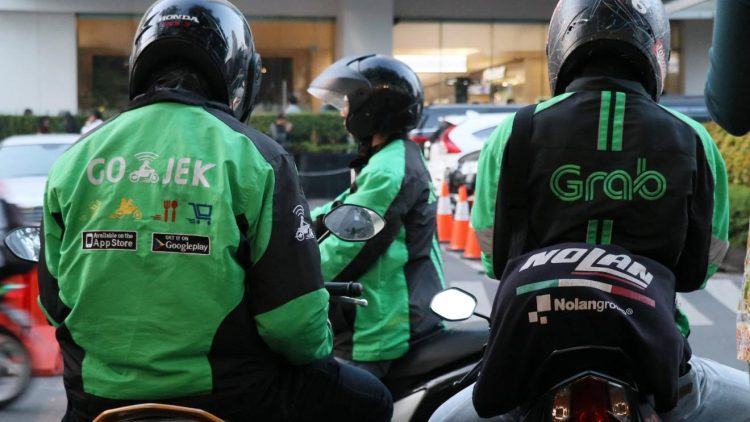
Photo credit: Tech in Asia
Almost a third of e-hails made through Go-Jek’s app in Indonesia may be fraudulent, while 5 percent of Grab orders in the country could also be false, a new study claims.
However, Grab told Tech in Asia that it has reduced fraud rates to under one percent of total orders.
The new research was conducted by Spire Research & Consulting, a market research firm that’s part of Tokyo-based Yamada Consulting Group.
Spire told Tech in Asia that it adopted “a qualitative research approach to get deeper insight on how the fraud is conducted and what types of fraud are the most common.”
Without revealing too much about its methodology, the firm said that it collected data through a survey of 40 ride-hailing drivers and 280 consumers selected from across Indonesia, as well as from “internal and external industry sources” and face-to-face interviews with drivers.
Interviewed drivers had mostly worked with both apps, and all were members of driver communities – allowing them to “share qualitatively as key opinion leaders of other drivers,” the Spire spokesperson added.
They said that Spire didn’t conduct the survey or interviews online, but that responses were “anonymous […] from a mixture of vendors, company contacts, and industry sources.”
Go-Jek is questioning Spire’s research. “We take reports of incidents of fraud on our platform seriously. Based on what little has been revealed of the methodology employed for this study, we strongly question whether a statistical conclusion can be drawn that accurately represents our driver population and the volume of orders on our platform,” said Go-Jek in a statement to Tech in Asia.
Having a fraud-free platform means our GMV is cleaner.
Ride-hailing fraud is a major problem in Indonesia. The Jakarta-based Institute for Development of Economics and Finance found last year that 61 percent of ride-hailing drivers know fellow drivers who have conducted fraud, while over 80 percent reported receiving fake orders at least once a week – and over 30 percent once a day.
While some drivers are seeking to profit from sham orders, others suffer, since their bonuses are based on completion rates and keeping cancellations low. Unsolicited fake e-hails harm these performance metrics.
Spire estimates that 30 percent of e-hails made through the Go-Jek app in Indonesia can be considered as “fraud.”
It puts the proportion of similarly fraudulent e-hails on the Grab platform at 5 percent. According to the research, respondents indicated this was because it’s easier to exploit loopholes in the Go-Jek app that allow fraudsters to modify their location in the system.
No clear winner in Indonesia





Stay updated on the go with our mobile app.
Get latest insights with smoother, more personalized experience through TIA mobile app.












📅 Upcoming Events
22 October 2026
Payoneer x CSPN Summit 2026