 Meghna Rao · · 7 min read
These entrepreneurs aren’t afraid of India’s rural edtech beast
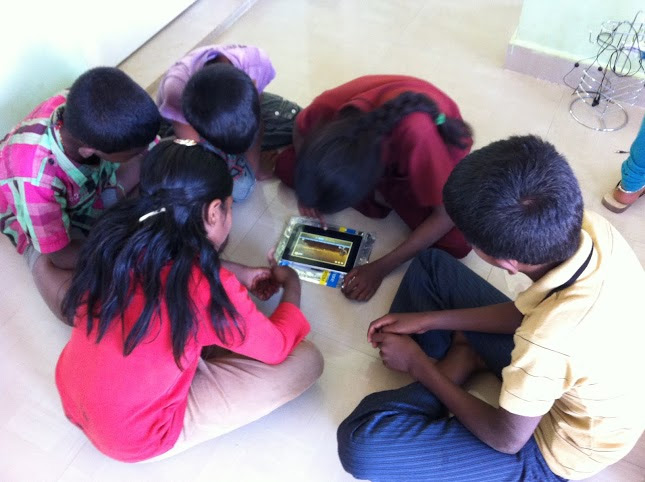
Students using CoBELS.
Right off a central road in the small town of Mangalore, Karnataka, is the barebones office of Callystro, a startup that makes educational tech games. It has won national awards, gotten recognition from large-scale organizations for its financial literacy games, and is even in talks with partners that want to help it expand to Japan and New Zealand – but there’s still something that worries the founder.
They only charge US$0.15 a month for each student that signs on with its services, which means that it’s tough to make money, and even tougher to attract investors.
“We want to impact rural India, but the customer base is a difficult one,” co-founder Rajeev Gopalakrishnan explains. “If we price any higher, we won’t be tapping into the customers we want,” he says, recounting an experience in another city in Karnataka, where even the extra fee of US$0.15 was too much.
That’s the type of battle that’s always there when you work with India’s millions of low-income customers. Until you figure out what makes them tick, it’s hard to get them to buy your services. But in other ways, it’s also a battle particular to edtech startups that work in non-urban India. Whether it’s government policies, unconfident investors, or customers that are almost too diverse, these startups are met with challenges wherever they look – and aren’t offered much support.
Rajeev has been leaping through these hoops for a while now, but he doesn’t get too dismal about it – he seems to be focused on the light at the end of the edtech tunnel. “We just need to establish our presence, and then it’s large scale for us,” he says.
Hit the ground running

Photo credit: J P Davidson.
Rajeev worked at Infosys for a long time, and that’s where he met his soon-to-be co-founders Sampath Shetty and Sampath Menon. The two decided to quit their jobs and launch Sparkling Minds, an edtech product for young children. While working in the education sector, the trio met Sabina Jain. That’s when they decided to launch Callystro with their own funds. “We knew we had to do it,” says Rajeev.
The first iteration of the product took them nearly three years to build, and they didn’t market their product until it was complete. “We couldn’t just sell partially to one age group,” Rajeev says. “We needed it to be end-to-end so we could hit the ground running.”
And hit the ground running it did.
Callystro’s main app – conceived by Sabina – is CoBELS, which Rajeev claims is the only edtech app to map out and pair with the entire student curriculum from the 1st to the 9th grade. That’s made up of nearly 300 different classes, neatly packaged in individual apps.
It’s also released a financial literacy game that lets students level up as they learn more about how to use their money wisely. It’s currently showcased at the Rashtrapathi Bhavan, the national house of the Indian president.
Distribution’s tough
Shark tank





Stay updated on the go with our mobile app.
Get latest insights with smoother, more personalized experience through TIA mobile app.












📅 Upcoming Events
22 October 2026
Payoneer x CSPN Summit 2026