Guest Contributor · · 10 min read
Why Singapore needs a public policy framework for 3D printing technology
By Yap Shiwen. A version of this article was first published on The Online Citizen. Republished with author’s permission.
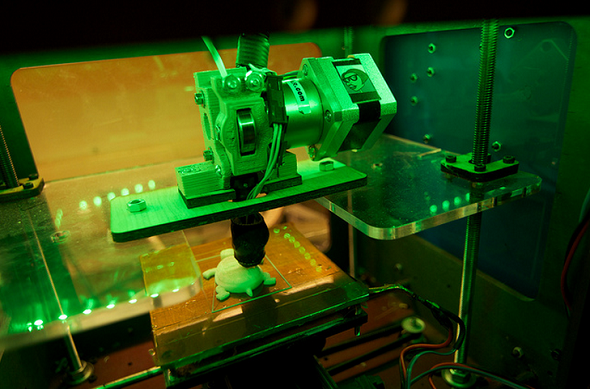
3D printer at work. Image: Keith Kissel
3D Printing or 3DP, an additive manufacturing technology that translates digital designs into physical objects, has emerged as the latest technology trend in the news, given its status as a groundbreaking innovation. It has the potential to disrupt established supply chains, logistics, the manufacturing industry and intellectual property rights.
One Singapore startup, Pirate 3D, aims to become a prominent producer of 3D printers and a distributor of digital designs. It has been active in marketing itself across different media platforms and has articulated a long-term goal of facilitating a post-scarcity economy via the creation of a low-cost 3D printer.
3DP holds great promise, with applications ranging from tissue engineering and organ production to its established use in rapid prototyping and design, and even the production of household goods such as furniture. Affected by this technology are designers, both artistic and industrial, engineers, software programmers, 3D artists and technicians.
But what is its relevance to Singapore? Given the current state of the world economy, as well as advances in robotics, computing and 3D printing, Singapore needs to look at ways in which the technology can be harnessed and capitalised, as doing so soon would grant a significant first mover advantage to the country and develop its status as a center for 3d printing technologies.
More significantly, 3D printing disrupts supply chains by potentially allowing for local customised production of parts through on-demand production, more efficient material usage with less wastage and diseconomies of scale compared to traditional mass production methods.
It also allows for more compact infrastructure and equipment, granting space savings compared to traditional manufacturing equipment which is often bulky. Finally, it enables digital designs to be brought to life as physical products anywhere around the world.
Singapore needs a policy framework to address the multiple challenges that 3DP poses in both a local and global context. These areas need to be addressed:
- Intellectual property
- Legal Responsibility
- Industry Standards
- Infrastructure
- Security
Intellectual Property (IP)
The basis of most 3DP lies in the software: the use of the STL (Standard Tesselation Language) format. It enables people to download designs off the Internet and translate them into physical objects. This is much like Napster, which enabled the digital distribution and reproduction of music through the use of the MP3 file format.
This challenges not only the established business models of mass production manufacturing, but creates an issue with regards to potential losses faced by designers, engineers and other IP holders. Much like Napster, the manufacturing industry will have to respond to this issue sooner rather than later.
At this current time though, 3DP isn’t developed enough to challenge traditional manufacturing businesses. 3DP business models are still evolving, with a combination of proprietary and open-source designs available through community portals such as Thingiverse, owned by Makerbot Industries. Another digital marketplace with the same concept but with a more commercially-oriented direction is Shapeways.
Given the rapid pace of development, measures need to be put in place to respond to these coming challenges. IP issues and patent conflicts could inhibit development of the industry and technology, as well as compromise consumer and investor confidence.





Stay updated on the go with our mobile app.
Get latest insights with smoother, more personalized experience through TIA mobile app.