- Insights This article was written by a TIA community member. Insights pieces undergo the same rigorous editorial process that newsroom-produced articles have.
 Kai Xin Thia · · 4 min read
Here are the most significant AI developments in 2018
2018 was an exciting year for machine learning and artificial intelligence. It yielded “smarter” AI, real-world applications, improvements in underlying algorithms, and greater discussions on AI’s impact on civilization.
Here are some highlights.
Smarter AI
Developed by Alphabet’s DeepMind, AlphaZero showcases the flexibility of deep reinforcement learning. It is now peer-reviewed and works across three different board games.
Experts have been building models to follow historical trends and make predictions based on past data. Now, there are machines that can observe the environment, learn the “unspoken rules” of the environment, and adapt their actions to explore and benefit from the environment like humans. Just don’t hold your breath yet for artificial general intelligence.
Real-world applications
AI in 2018 wasn’t just about games, given how it now has real-world applications. In healthcare, deep-learning models can perform as well as a human expert in analyzing electron microscopy or detecting eye diseases.
For environment and climate application, AI is helping to build better climate models, mapping millions of solar roofs in the US, monitoring ocean health, and animal conservation works. The open source community is also contributing to interesting projects.
The common theme across all these applications is the drastic improvements in computer vision and natural language processing (NLP).
Better algorithms
Deep learning has worked very well for the ImageNet classification challenge, where it improved from having 26.2 percent error rate with scale-invariant feature transform (SIFT) model (1990s) to 15.3 percent error rate on AlexNet (2012) and, recently, 2.25 percent with SE-ResNet (2017).
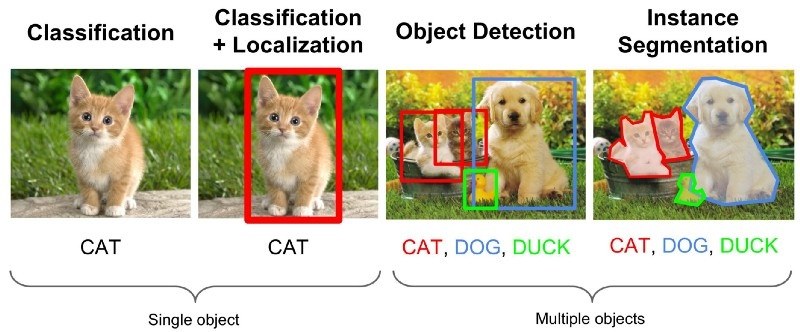
Object detection (see image above), which is a classic problem, can be handled in real time by the “you only look once” (YOLO) system and its derivative models or, more accurately, by single-shot detector (SSD).
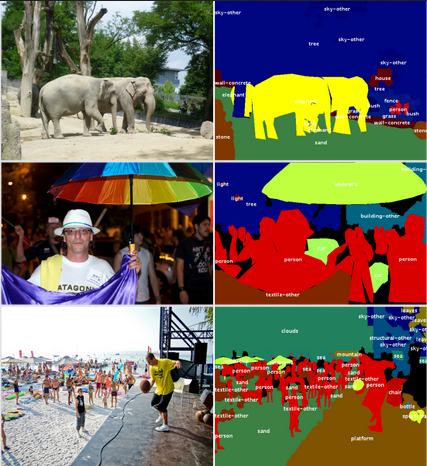
Image segmentation (see image below) used to be a challenging problem, especially for complex images where the boundaries of objects overlap. State-of-the-art deep learning models like path aggregation network (PANet) and context encoding network (EncNet) build on many previous ideas, with an improved feature extractor and context information.
Of course, BigGAN – which is like GAN but bigger and way better – should also be included. AI can now generate realistic fake faces and videos (“deep fakes”) and accurately catch a criminal among a crowd of 50,000 people in the middle of a concert.
Impact on civilization





Stay updated on the go with our mobile app.
Get latest insights with smoother, more personalized experience through TIA mobile app.