 C. Custer · · 2 min read
China will send a manned space mission to dock with a new space lab this year
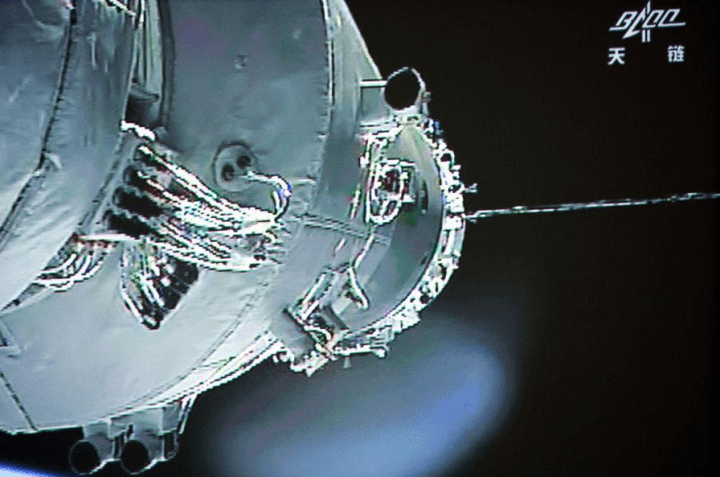
China’s astronauts are headed back into space this year, says the country’s Manned Space Agency. It has confirmed that it plans to launch a new space lab, Tiangong-2, into orbit in the third quarter of this year. Then, sometime in the fourth quarter, a manned two-person mission will be launched on the new Shenzhou 11 spacecraft to dock with Tiangong-2, test its systems, and (assuming everything’s working correctly) do some science experiments. China will also launch two new, unmanned Long March rockets this year.
The crew for the Shenzhou 11 mission has not yet been named, but China’s space agency has said that two astronauts are already receiving training for the launch. China’s previous two manned space missions have both included female crew members (Liu Yang and Wang Yaping, China’s first and second women in space, respectively), and it will be interesting to see if one of those women is named to this mission.
Chinese astronauts were last in space during June of 2013, when a crew of three docked the Shenzhou 10 spacecraft at China’s Tiangong-1 space station.
This year’s mission is part of a much larger goal: China’s plan to have a permanent, manned space station up and running by 2022. There will be no manned Shenzhou mission in 2017, but after that the plan is to launch a new Shenzhou every year until 2022, when Shenzhou 16 will dock with the completed, functional space station.
The station will include living quarters with support for three astronauts, as well as a science module for conducting experiments. Just what sort of experiments remains to be seen. Chinese president Xi Jinping has said that China needs to strengthen its military use of space, and because an orbital space station falls outside the restrictions in the international Outer Space Treaty, China would be legally free to do military testing and operations there.





Stay updated on the go with our mobile app.
Get latest insights with smoother, more personalized experience through TIA mobile app.








📅 Upcoming Events
22 October 2026
Payoneer x CSPN Summit 2026