
Summary:
- Public safety agencies must constantly adopt new tech to stay ahead of modern, tech-savvy adversaries.
- Hatch, an innovation center, connects these agencies in Singapore with agile tech startups to develop innovative solutions quickly.
- This collaboration leads to practical tools that improve operational effectiveness for public safety officers on the ground.
- Startups interested in working with Hatch to enhance public safety and security should check out the Dimension X program on its website.
As Singapore cements its status as an economic powerhouse, the government continues to spotlight the city-state’s safety, as reinforced by a recent Gallup poll naming it as the safest among 140 countries and territories worldwide.
One of the factors driving this is Singapore’s eagerness to bring in and enable promising innovations and tech that help keep citizens safe.
“We need to constantly challenge ourselves to do things better,” says Allan Loi, tech advocacy ambassador at Hatch, chief information officer at the Singapore Police Force (SPF), and director of the Policing Programme Management Centre at HTX. “If there is a new technology out there that can do the work better and faster, we should be prepared to integrate it into public safety solutions.”

Allan Loi, tech advocacy ambassador at Hatch / Photo credit: Hatch
However, exploring innovative solutions for public safety isn’t always easy, as not many innovations are built with public safety applications in mind.
That’s where Hatch comes in.
The Singapore-based innovation center was established in 2023 by HTX, a statutory board of the city-state’s government that’s also known as the Home Team Science and Technology Agency, in partnership with tech consultancy and solutions firm Knovel Engineering and open innovation company Sosa.
Hatch plays a central role in bringing cutting-edge tech solutions from startups across the world and into the operational environments of the city-state’s public safety space.
A new wave of public safety tech
Bringing in new, innovative solutions is so important because adversaries are “rapidly exploiting new technologies and ideas to commit crimes,” says Loi.
Indeed, it’s critical to keep an open mind on how tech can be repurposed for public safety use cases.
“For example, some of the robotics systems used in the commercial logistics sector could also be potentially useful for SPF logistics operations,” Loi adds.
Take your first step into the public safety sector by working with Hatch.
It’s also worth noting that despite Singapore’s reputation as one of the safest places in the world, it isn’t devoid of crime. This is why “public safety also needs to constantly evolve to stay ahead or at least keep pace,” according to Loi.
He then cites deploying technologies – including autonomous robots like Multi-purpose All-terrain Autonomous Robots and drones – during the Covid-19 pandemic as an example.
“These can be controlled remotely and work autonomously to augment patrolling and security operations,” explains Loi.
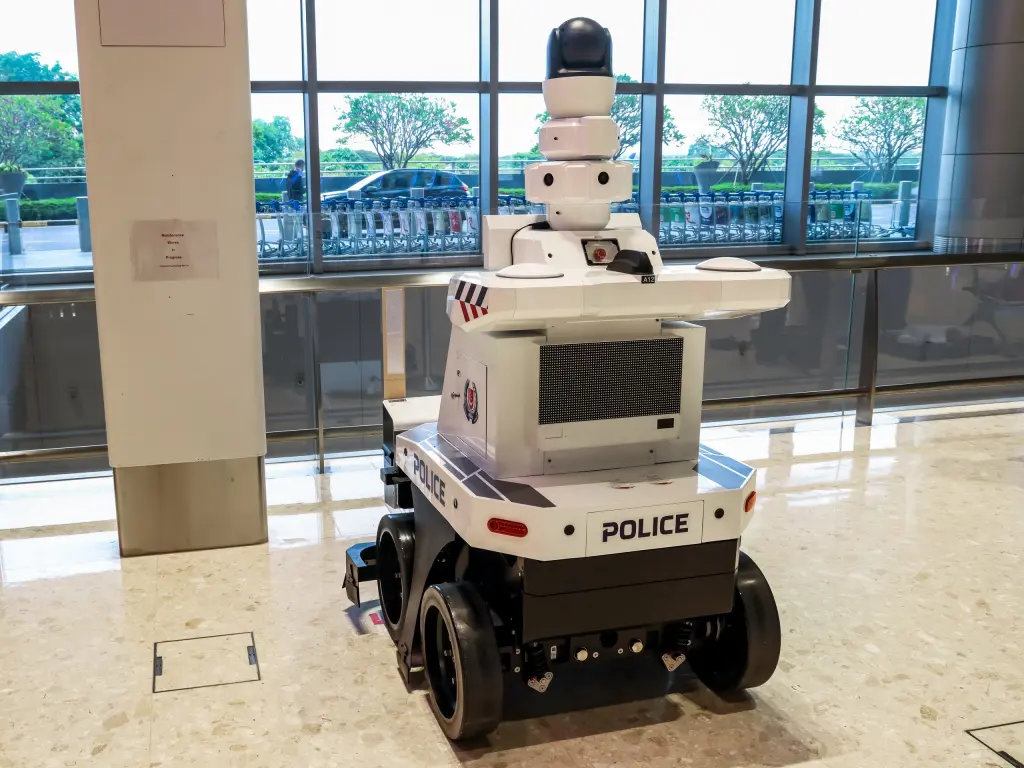
Autonomous robots have been a huge help in maintaining public safety / Photo credit: Shutterstock
More recently, the SPF launched the Report Lodging Co-pilot, which uses AI to guide the public through the report-lodging process, prompting them to fill in crucial missing information.
This reduces the time officers need to contact those who lodge reports for information.
At a broader level, this is a successful use case that encourages the use of new technologies for public safety. On top of that, working with Hatch allows Loi and his team to keep this mission going.
Bridging startups and public safety
Startups operate with a fresh mindset, making them a crucial source of novel solutions.
“Smaller startups can be more nimble than bigger tech firms when it comes to innovation,” Loi explains.
He adds that startups often provide a “unique perspective” on how their tech can be implemented, plus they’re more willing to adapt their solutions for public safety use cases compared to larger players with established product roadmaps.

Photo credit: Shutterstock
This agility allows them to tackle niche problems that bigger companies might overlook.
However, public safety is an area that some tech providers might not pay enough attention to, as they often lack insights into how government agencies can tap into the external ecosystem for new technologies.
“If it’s unclear how government agencies will use their technology for public safety, startups and tech firms will tend to shy away from engaging them to avoid any potential backlash,” Loi points out.
Some startups might also think that engaging the government would be a lengthy, troublesome process. In other words, it could lead to a misconception that the risk or effort – in comparison to pursuing other business opportunities, especially for leaner teams – might not be worth it.
Cracking the formula
Effectively bringing startups into the public safety space requires an organized, calibrated approach.
One option Hatch offers is a program that allows public safety end users to present their problem statements directly to the tech community. Called Dimension X, it’s an open innovation challenge looking for startup-driven deep-tech solutions globally to solve the Home Team’s operational challenges.
Hatch also provides financial support through this program so startups can develop their prototypes for end users. A prime example is Hatch’s partnership with Epic Blue.
Satellite-based location positioning can fail in a highly urbanized environment like Singapore, which has extensive underground networks. This means the command center often has to rely on verbal communication to locate ground patrol units, according to Loi.

Photo credit: Shutterstock
The collaboration with Epic Blue aims to solve this issue by providing better situational awareness for ground commanders. The Belgium-headquartered startup lets fielded teams quickly add and share 3D floor plans and venue maps, giving them a common visual to shorten response times.
Besides the immediate benefit of the solution, the whole exercise encourages public safety agencies to try even more new approaches going forward, with the goal of eventual deployment that would benefit officers out on the field.
“With Dimension X, such exposure to new technology solutions on the global scale enables SPF to explore even more niche technologies,” Loi says.
A future-forward approach
For agencies to stay ahead of evolving threats, continuously integrating science-driven innovations is not just an option, but a necessity.
“We don’t have a monopoly on knowledge,” says Loi. “Through the engagement with the tech community, we can bounce ideas off each other and explore new collaborations.”
At Hatch, the process of engaging with public safety agencies is simplified, and tech startups are guided step-by-step on how to qualify for the prize money, he adds.
This collaborative ecosystem helps not only individual agencies but also Singapore as a whole. Moreover, it pushes the boundaries of what’s possible in public safety, which requires a commitment to open cooperation.
“The next step is to facilitate and spark discussions between the local system integrators and these startups so that the shortlisted ideas can be taken to the next step of deployment,” Loi notes further, emphasizing the importance of Hatch’s work in matching tech ideas to real-world impact.
Hatch is an innovation center driven by the mission to curate and accelerate dual-use technologies that enhance public safety and security. To find out more about the Dimension X program, click here.
This content was produced by Tech in Asia Studios, which connects brands with Asia’s tech community. Learn more about partnering with Tech in Asia Studios.
Stay updated on the go with our mobile app.
Get latest insights with smoother, more personalized experience through TIA mobile app.
Recommended reads
 Indonesian AI startup goes global
 Forrest Li on scaling Sea, building smarter bots, and founder grit
 An AI assistant that joins sales calls and scores team skills
 SGX’s CEO says it doesn’t need a unicorn to win
 SMEs want AI too, but not the kind Big Tech is selling
 Oatside’s alt-milk rise hits a profitable gear
 Alibaba’s financial health in 12 charts
 Asia’s telcos bundle AI into mobile plans. Will it pay off?
 M-Daq chases bigger clients as revenue falls, losses grow
 VC tracker: Accel raises US$3.5b, including US$550m for India





Editing by Jonathan Chew, Winston Zhang, and Mina Deocareza
(And yes, we’re serious about ethics and transparency. More information here.)





