
Summary:
- Startups often hit a scaling wall when venture credits expire, finding themselves burdened by overengineered technical architectures and rising cloud costs that threaten their survival.
- Oracle offers an alternative to traditional hyperscalers, providing high-performance infrastructure and “converged databases” that allow startups to simplify their tech stacks and manage multicloud environments more efficiently.
- By focusing on AI readiness, Oracle helps startups in various sectors including biotech, integrating practical AI solutions that drive worker productivity and market expansion while maintaining critical security and governance.
- Learn more about how Oracle can help you build, scale, and innovate with confidence through this webcast.
In the early days of a startup’s life, every win feels like a leap forward.
But for many founders, success brings a new, quieter kind of crisis: the scaling wall.
For example, let’s take a hypothetical regional ecommerce platform. After a successful series A funding round, it finds that its backend has buckled under holiday traffic.
While the platform’s marketing team celebrates record-high user acquisition, its chief technology officer (CTO) is awake at 3:00 a.m., manually patching a distributed architecture that has become too complex to manage and too expensive to maintain.
This is the inflection point where the excitement of growth meets the cold reality of infrastructure.

Ying Loong Chin, senior vice president and regional managing director for ASEAN and South Asia Growing Economies at Oracle / Photo credit: Oracle
The transition from a scrappy newcomer to a scaled digital native is fraught with technical traps that can sink even the most promising ventures, notes Ying Loong Chin, senior vice president and regional managing director for ASEAN and South Asia Growing Economies at Oracle.
“For startups, the first priority is staying resilient,” he says. “The companies that last are the ones that can keep adapting, scaling, and moving with the market.”
Pillars of survival
When a startup raises capital, the funds typically flow into three primary areas: people, marketing, and tech.
While marketing spend can be dialled up or down as needed, technology investments – especially cloud infrastructure – scale alongside the business as the user base grows, taking up significant space in a company’s budget.
Many founders begin with venture capital-backed cloud credits that make it easy to move quickly and experiment. As those credits wind down, it becomes important to take a closer look at ongoing cloud costs and ensure the architecture is optimized, well understood, and aligned to the company’s next stage of growth.
“Free credits help you get started. But long-term success depends on choosing technology that still makes sense when real costs begin,” Chin explains.
This is where startups face their first major decision point: do they continue with their current platform and cost model, or do they move to something else?
The overengineering trap
A common mistake Chin observes is “overindexing” on technical complexity too early. In the race to be cutting-edge, CTOs often build complex distributed services when a simple monolithic app would suffice.
“A lot of startups make the mistake of building too much, too early,” he says. “The biggest challenge is making sure tech doesn’t become a barrier or a hindrance to growing the market. Simple and focused usually wins.”

Photo credit: ProStockStudio / Shutterstock
Once a market is proven, the tech stack can evolve, but doing so too early consumes the very cash needed to stay alive. At the end of the day, what matters is building something that people actually want.
“Your customers are not focused on how complex your architecture is. They care about whether you can deliver a great product, reliably and at scale,” Chin advises.
A partner for the long haul
To navigate this journey, startups need to choose cloud partners that deliver high performance without locking them into a technical corner. These partners should also offer price predictability, built-in security, and the deployment flexibility needed to scale fast.
Oracle, for one, has spent the last decade reinventing its role in the ecosystem to meet these specific needs.
While often associated with large-scale enterprises, Oracle has pivoted to become the one of the world’s major hyperscalers, specifically designing its second-generation cloud for modern performance.
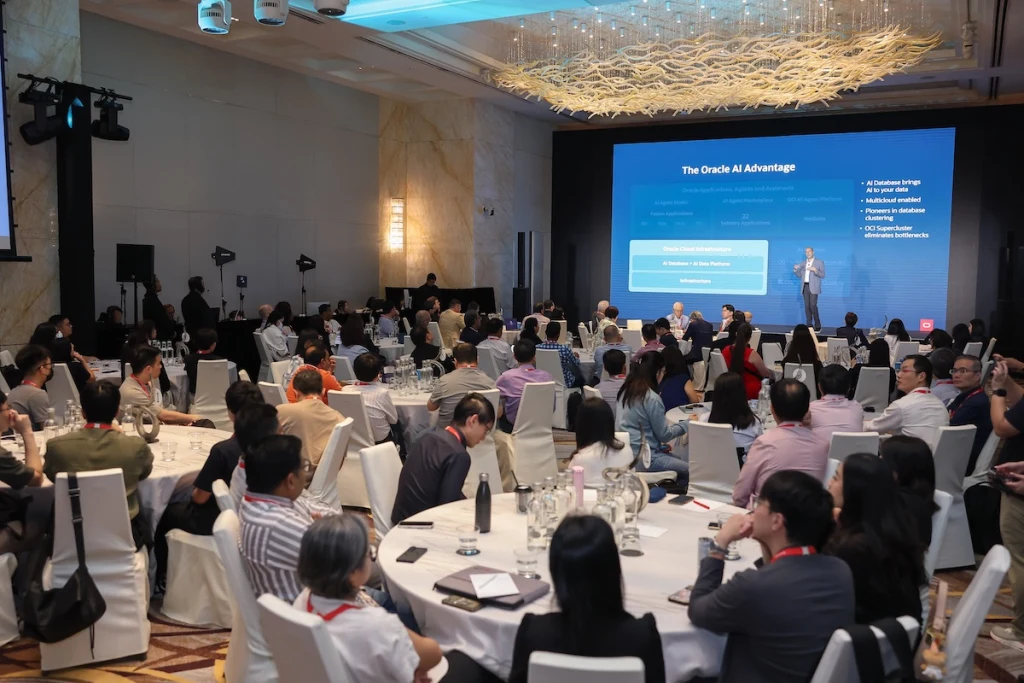
Attendees at an Oracle Cloud event / Photo credit: Oracle
For startups, Oracle offers a unique full-stack proposition that goes beyond simple compute power.
This includes the company’s flagship Oracle Autonomous AI Database, the Oracle Cloud ERP, and its AI infrastructure, which powers some of the world’s largest generative AI workloads.
With cloud-native Oracle Fusion Cloud Applications, as well as multicloud connectivity and a comprehensive range of data products all under one roof, startups get enterprise-grade capabilities without the integration headaches.
“We built cloud in a much different way,” Chin notes. “Oracle’s built its cloud architecture with performance, predictability, and enterprise-grade scale in mind – you get the whole thing. This created a performance architecture where our networking, storage, and AI is just fundamentally faster.”

Photo credit: Urbanscape / Shutterstock
Central to Oracle’s approach is the recognition that modern startups rarely – if ever – stick to a single vendor.
Instead of demanding exclusivity, the firm has embraced a multicloud philosophy that allows its services to act as high-performance plug-ins for existing stacks. This flexibility is crucial to mid- to late-stage startups, which may already be using different cloud providers for other needs.
“You don’t have to just give up everything you’re doing to move to Oracle,” Chin explains. “You can start to add Oracle into the mix and let us solve problems that maybe the other cloud providers haven’t been able to solve for you.”
Delivering AI without the complexity
This modern infrastructure is particularly potent when it comes to leveraging artificial intelligence.
For many startups, AI adds a daunting new layer of complexity to the tech stack, often requiring them to move data between different specialized databases to handle vectors – the mathematical representation of data that AI models understand.
Learn more about how Oracle can help you build at scale
Oracle’s strategy is to simplify this by bringing AI directly into the existing data layer.
“With Oracle, we bring AI to your data. We’ll bring vectors, large language models, and Model Context Protocol to wherever your data lives,” says Chin.
This converged approach allows startups to ship AI features faster and with less overhead.
A prime example of this can be seen in the biotech sector. Chin highlights a recent collaboration with Mirxes, a leading company in the Asia Pacific that specializes in molecular blood tests for early detection of cancer. This is a field where data isn’t just valuable, but mission-critical.

Photo credit: Mirxes
Mirxes, which listed on the Hong Kong Stock Exchange in 2025, faced a significant scaling challenge. Clinicians using its services received information-dense outputs that often required additional context or clarification, within time-constrained care settings.
Addressing these queries triggered a manual back-and-forth between commercial teams and scientific experts, a process that was resource-intensive and limited to business hours.
Working with Oracle’s AI Customer Excellence Center in Singapore, Mirxes developed a clinician-facing AI assistant specifically designed to answer questions about its cancer diagnostic products and services as well as the underlying scientific evidence.
“Imagine if you want to solve the same problem using other technologies,” Chin says. “You would need various formats of data – relational, JSON, vector stores – and you’d need different database technologies for each. With Oracle, we have a converged database that supports all these formats in one place.”
The result was a qualitative shift in operations. The AI assistant provided 24/7 access to product and scientific information, reducing response times and easing the burden on internal experts. Mirxes’ sales team became more self-sufficient, while clinicians gained faster clarification without replacing direct scientific engagement where it was needed.
By integrating AI directly into their existing database, Mirxes avoided the cost, latency, and governance risks involved with moving data across fragmented third-party AI products.
AI readiness, vibe coding, and beyond
Looking ahead, Chin believes that the fundamental principles of startup survival won’t change, but the workflows certainly will.
He explains that the industry is entering the era of “AI readiness,” where even non-AI companies must structure their data to be compatible with machine learning. The rise of vibe-coding will help speed up experimentation and development, but it also introduces new risks.
“Something you vibe-coded on Saturday probably shouldn’t hit the website on Monday morning,” Chin cautions. “AI can dramatically accelerate development, but speed without governance creates risk.”
“Startups need to pair rapid experimentation with the right safeguards around security, architecture, and operational control if they want innovation to translate into sustainable growth,” he adds.
As the barriers to entry for building a startup fall, the competition for efficiency will only intensify.
Oracle aims to be the bedrock for this new generation, providing the infrastructure that allows smaller teams with less capital to go after larger markets.
“AI is not a passing trend; it is real and it is a foundational shift in how businesses build, operate, and compete,” Chin says. “If you’re not using AI to build a better startup, you’re going to have a hard time competing with somebody who is.”
Oracle is the backbone behind tomorrow’s billion-dollar disruptors, providing the cloud, AI, and data foundation that digital natives trust to move fast and stay agile.
Check out this deep dive into how Oracle can help you build, scale, and innovate with confidence through this webcast.
This content was produced by Tech in Asia Studios, which connects brands with Asia’s tech community. Learn more about partnering with Tech in Asia Studios.
Stay updated on the go with our mobile app.
Get latest insights with smoother, more personalized experience through TIA mobile app.
Recommended reads
 SEA financials tracker: Moladin’s revenue rises 6% in 2025
 Flipkart’s costly late push into quick commerce and food delivery
 Inside Singapore’s government team that kills its own products
 Once an IPO hopeful, SCI Ecommerce nears collapse
 Who’s betting big on ChatGPT ads? Not Asian brands
 VC tracker: Granite Asia launches US$50 million fund
 GCash trims IPO ambitions to meet market realities
 Igloo CEO eyes global M&A: ‘We have an appetite to grow more’
 Why SBI paid a premium for Ajaib amid a tough market
 OpenAI warns building for today will cause technical debt





Editing by Stefanie Yeo, Winston Zhang, and Eileen C. Ang
(And yes, we’re serious about ethics and transparency. More information here.)



📅 Upcoming Events
22 October 2026
Payoneer x CSPN Summit 2026