- Premium Content It takes our newsroom weeks - if not months - to investigate and produce stories for our premium content. You can’t find them anywhere else.
 Scott Shuey · · 6 min read
Nanobots take on achy teeth in 2026. Is cancer next?
A sensitive tooth is the body’s way of telling a person to go see a dentist – or else.
While the painful sensation of drinking something too hot or too cold with a sensitive tooth is bad enough, it could also be an indication that something bad is going on underneath the enamel surface. One of the most common treatments for this condition is two of the worst words that a person could hear while sitting in a dental chair: root canal.
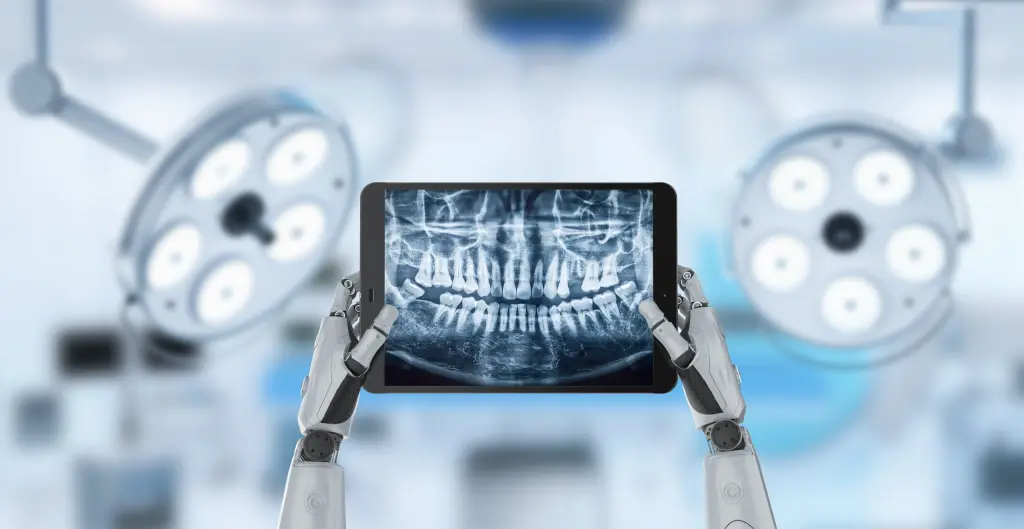
Photo credit: Shutterstock
But a startup founded in 2020 by three scientists out of the Indian Institute of Science might have developed an easier way of treating that tooth: put some nanobots on it.
Bangalore-based Theranautilus hopes customers will be able to buy its nanobots over the counter as early as 2026.
For those unfamiliar with nanotechnology, nanobots are tiny machines that are smaller than the human eye can see. Theranautilus’ nanobots are about 35 nanometers or 0.00003 millimeters in size. For comparison, a strand of human hair is approximately 80,000 to 100,000 nanometers wide.
Building nanobots with dentistry skills
The Theranautilus team consists of its chairman Ambarish Ghosh, who is a member of the Indian National Science Academy and The National Academy of Sciences – India; co-founder Debayan Dasgupta; and CEO Peddi Shanmukh Srinivas. They collectively have over 20 years of experience in developing nanotechnology.
The nanobots that they’ve developed can get to the dentinal tubules, which refers to the microscopic channels under the enamel that protect the tooth pulp. Almost 4,000 bots can fit into each tubule, creating heat that can kill bacteria and delivering medicine to heal the tooth.
The technology isn’t just theoretical. The firm has used its nanotechnology in experiments on teeth, successfully moving the bots into hard-to-reach areas of the tooth.
The bots can do this without using any chemicals or antibiotics since antimicrobial resistant bacteria (AMR) “are very good in developing resistance towards the traditional technology or traditional methods of killing them,” Srinivas tells Tech in Asia.
But the nanobots can also deliver a bioceramic drug deep into the teeth and induce cementification – the formation of new bone – to help the tooth heal faster, Srinivas says.
Cancer-curing bots?
It may be difficult to imagine what these bots look like. Unlike the image created by speculative science fiction, nanobots don’t move around on tiny legs or shoot lasers.
Instead, they are tiny pieces of silicon dioxide molded into specific shapes and embedded with a piece of iron. The bots can be moved via magnetics, which also provides the energy source to generate heat and kill the bacteria.
The applications for this technology go far beyond dental care. While Theranautilus believes it can commercialize its nanotech, the team is planning to combat something much worse than a toothache.
Small tech, growing market
Available at home or the clinic?
Stay ahead in Asia’s tech landscape
This is premium content. Subscribe to read the full story.
A nanotech startup created by university scientists in India could release an OTC product for tooth pain by 2026.
We know this is not ideal. ⌛ Sign up in 20 seconds. Cancel anytime.
Our subscriber community includes professionals from these companies:





Stay updated on the go with our mobile app.
Get latest insights with smoother, more personalized experience through TIA mobile app.