- Premium Content It takes our newsroom weeks - if not months - to investigate and produce stories for our premium content. You can’t find them anywhere else.
 Putra Muskita · · 5 min read
Malaysia = next big thing in tech? Khailee Ng explains
Malaysia has long occupied a middle ground in Southeast Asia’s tech scene. The country is too small for massive investments like Indonesia but lacking Singapore’s global reach.
This situation may be about to shift. Khailee Ng, managing partner at global early-stage VC firm 500 Global, believes that Malaysia is on the cusp of an “inflection point.”
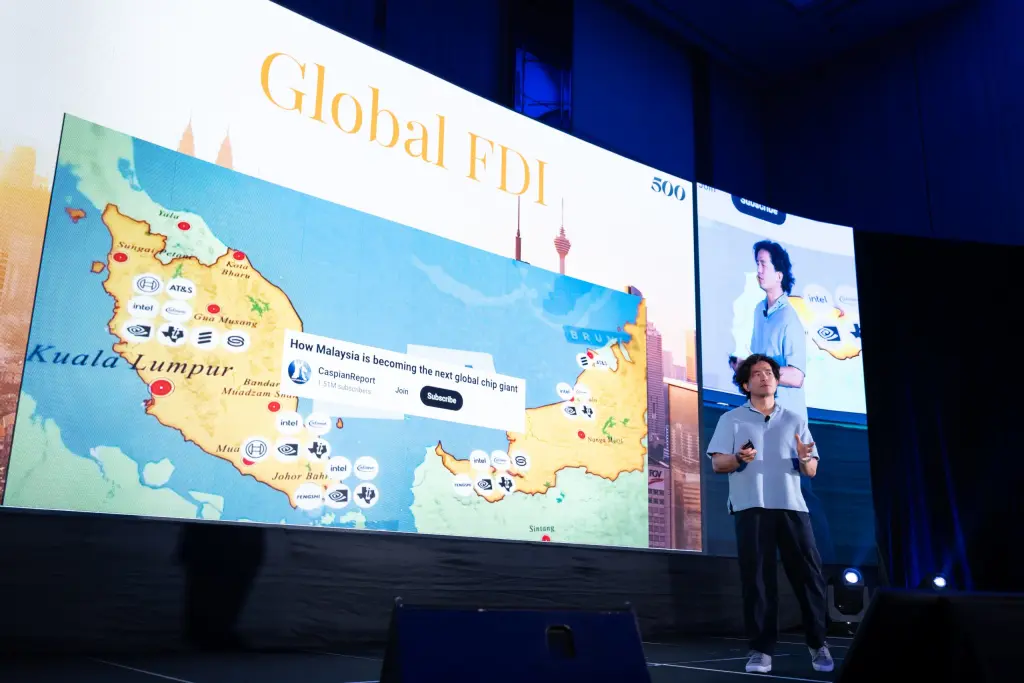
Khailee Ng, managing partner at 500 Global, speaking at the Tech in Asia Conference Kuala Lumpur. / Photo credit: Tech in Asia
In just a span of months, tech behemoths Microsoft, Nvidia, and Google, along with chipmakers Infineon and Intel, have committed to investing billions of US dollars to build AI infrastructure in the country.
In August 2023, German chipmaker Infineon announced its plan to build the world’s largest production site for silicon carbide chips in Malaysia. The factory will produce chips used in advanced engineering like electric cars and wind turbines.
In May, Prime Minister Anwar Ibrahim said the country has already attracted about 76.1 billion ringgit (US$16.9 billion) in foreign investment this year. Malaysian founders may not find a better time to build their companies, according to Ng, who’s one of the most prominent figures in Malaysia’s startup and tech scene.
With the wave of investments sweeping the nation, the question, as Ng aptly posed, is: “How do we ride it?”
Path to becoming an ‘innovation powerhouse’
Speaking at the recent Tech in Asia Conference Kuala Lumpur, Ng noted that some might question big tech’s investments in semiconductors, AI, and data centers will be enough to propel Malaysia to high-income status.
Such investments are “not for the invention of AI. They’re not for the design of the semiconductors. They’re involved in packaging, assembling, testing,” Ng said. Still, he emphasized that it’s crucial for Malaysian workers to gain important skills in these jobs.
He stressed that the US and South Korea began by imitating more advanced nations before becoming innovation powerhouses in their own right. The same trend is now happening in China.
“Once upon a time, all of these nations were accused of being just low value imitators,” he said. “But imitation and learning best practices, learning the fundamental skills is a stepping stone that you cannot skip on your way up.”

Image credit: Made by Tech in Asia using Midjourney
Be the 1%
Stay ahead in Asia’s tech landscape
This is premium content. Subscribe to read the full story.
500 Global’s managing director told Malaysian founders that there’s no better time to build companies.
We know this is not ideal. ⌛ Sign up in 20 seconds. Cancel anytime.
Our subscriber community includes professionals from these companies:





Stay updated on the go with our mobile app.
Get latest insights with smoother, more personalized experience through TIA mobile app.