
Summary:
- As more SMBs in Indonesia and across Southeast Asia manage orders, customer inquiries, and communities through WhatsApp, Telegram, and social media, staying responsive has become an operational challenge.
- AI tools such as Hostinger’s 1-Click Hermes Agent can help automate routine workflows like message summaries, reports, reminders, customer support, and follow-ups, while humans remain essential for judgment, empathy, and creative direction.
- Hostinger’s virtual private server (VPS) infrastructure gives AI agents a reliable environment that’s always on without requiring SMBs to manage complex deployment and server maintenance.
- You can use Hostinger to deploy your AI agent here.
Don’t you wish you could snap your fingers and a genie magically appears to reply to the 1,001 unread WhatsApp messages waiting for you? That’s the dream for many small and mid-size business (SMB) owners in Indonesia and across Southeast Asia, where business messaging has become prevalent.
“WhatsApp and Telegram are no longer just chat apps. They are now primary business channels in the region,” says Afina Emas, affiliate manager for Southeast Asia at Hostinger, a web hosting and cloud infrastructure platform. “SMBs use them to receive orders, answer customer inquiries, send notifications, and even close sales.”

Afina Emas, affiliate manager for Southeast Asia at Hostinger / Photo credit: Hostinger
As of January 2025, Indonesia alone had 212 million internet users and 143 million active social media user identities. That reach is powerful, but it also means businesses need to be constantly available across these channels – something that is difficult to do manually and without a large customer service team.
But with agentic AI, having someone – or something – that can always respond to customers on social media channels seems less like a farfetched fantasy and more of a tangible reality.
Automating momentum
Based in Bandung Barat, Faiz Intifada is a visual communication designer at Lumbung Tour Haramain, a travel company focused on Umrah (Islamic pilgrimage to Mecca) services. He also creates AI education content for non-technical users and runs VibeDev ID, a vibe coding community in Indonesia.
As VibeDev ID grew, Intifada had to deal with hundreds of WhatsApp messages from members sharing updates, asking questions, or discussing AI tools. The challenge was not the volume of messages itself but trying to work out which conversations actually needed attention.

Faiz Intifada, founder of VibeDev ID / Photo credit: Faiz Intifada
“At the core, I wanted to automate momentum,” Intifada says. “I wanted to move on creative work, products, and education while someone else handled the busywork, reminders, summaries, and things I would otherwise procrastinate on.”
That led Intifada to deploy Hostinger’s 1-Click Hermes Agent, an open-source, self-improving AI agent built by Nous Research designed to execute complex tasks and expand its capabilities over time. Hostinger’s one-click deployment helps businesses use and run agents such as OpenClaw and Hermes Agent through familiar channels like WhatsApp and Telegram without taking on the technical burden themselves.
Still, Intifada was skeptical at first.
“I thought AI agents were mostly marketing. I had used chatbots and AI writing tools, so when people started calling these things as ‘agents,’ it sounded like the same tools with a fancier name,” he explains.
Find out how Hostinger’s 1-Click Hermes Agent can help you
What changed his mind was seeing the agent go beyond chatbot functions. While a typical assistant usually waits in a separate tab for a prompt, Hermes Agent could stay connected to his workflow: summarizing VibeDev ID’s WhatsApp discussions every 12 hours, helping with light moderation, tracking routine updates, drafting content, and supporting research.
“It was not chatbot behavior. It felt like having a teammate who could work independently but still checked in with me,” says Intifada.
Always-on agents need always-on infrastructure
Just like how a genie lives in a lamp, an AI agent needs reliable infrastructure. To be useful, it has to remain operational around the clock, maintain a stable environment, and stay connected to communication channels, even when the owner is offline.
“As a non-IT person, I needed a server environment that just works without forcing me to become a system administrator first,” Intifada says.
Intifada points out the limitations of relying on local hardware, such as dealing with unstable internet, power outages, port forwarding, and manually restarting services whenever something breaks. Here’s where Hostinger’s VPS infrastructure steps in to keep AI agents accessible, connected, and always on.
“With Hostinger, I can set the agent to restart automatically through systemd and trust that the server stays online,” Intifada says. “That consistent uptime is what turns the agent from an interesting experiment into a real part of my workflow.”
I Made Tresnayana, VPS product designer at Hostinger, points out that complexity is a major barrier for SMBs looking to adopt and run AI agents.

I Made Tresnayana, VPS product designer at Hostinger / Photo credit: Hostinger
“Most small businesses don’t have a development team to set up and maintain the infrastructure, so they either skip it entirely or overpay for managed solutions that don’t fit their needs,” he says.
Through Hostinger’s Application Catalog, tools like OpenClaw and Hermes Agent can be deployed with minimal technical friction, bypassing the standard hurdles of hosting, configuration, and upkeep. Users can opt for managed services where Hostinger oversees security patches, updates, and server maintenance, or choose VPS-based configurations that offer technical users deeper administrative authority.
The setup matters because it makes the technical side feel less overwhelming and easier to approach. Instead of dealing with multiple tools or confusing steps, Hostinger’s hPanel tool brings everything into one place, including server details, login access, and a simple browser-based terminal.
This saves time and reduces the chance of mistakes, especially for users without a technical background. Even security layers like firewalls and Distributed Denial of Service (DDoS) protection could be managed with a few clicks, without needing to understand complicated rules or code.
Staying on top of things
Once the AI agent became part of his workflow, Intifada found that the biggest change was that he no longer lost track of what’s happening.
“I respond faster not because I am online more, but because I know exactly where to focus,” he says. “That sense of momentum is hard to measure, but it is the main reason the agent has stayed in my workflow.”
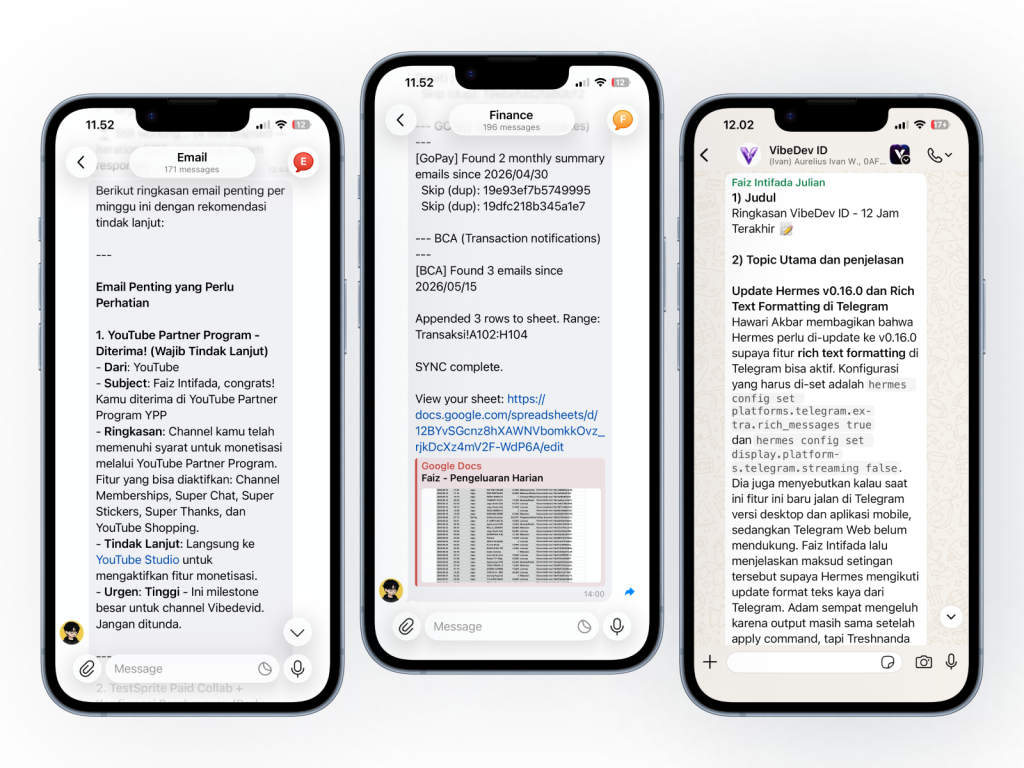
Hermes Agent helps Intifada summarize emails, track financial updates, and monitor his vibe coding community through messaging channels / Photo credit: Faiz Intifada
However, there are still clear limits to what can be delegated to agents. Intifada says that judgment, relationships, and creative direction remain human. While the agent can draft, summarize, and execute, he still decides what is worth building, how a brand should sound, and when a conversation needs empathy rather than speed.
Hostinger’s Emas frames the boundary similarly: AI agents are better suited for repetitive and structured tasks, while humans should handle emotionally charged complaints, strategic decisions, negotiations, and relationship building.
As agents become more autonomous, guardrails also matter. For higher-impact actions, Emas points to measures such as human confirmation, restricting the agent’s access to only necessary tools, keeping action logs, and involving people in sensitive decisions.
“The greater the impact of an action, the greater the human involvement required,” she says.
Not a magic tool
Realistically, agentic AI is not a total replacement for human staff or a fix-all. Instead, it is a supportive layer that allows small teams to remain responsive without being overwhelmed by attending to every minor task.
As Intifada observes, Hermes Agent is “not perfect, not magic, but genuinely useful for someone like me who wants to build without doing everything manually.”
While the potential of agentic AI is substantial, successful adoption isn’t just about what agents can do. Businesses still need to identify specific use cases for automation and providers need to make the infrastructure simple enough that SMBs can actually run these tools without deep technical knowledge.
“When it does work, the shift is significant,” Tresnayana says. “Agentic AI moves SMBs from reactive to proactive. Instead of responding to problems, their systems can handle them automatically. For a small team, that kind of leverage used to be out of reach. Now it’s finally within reach.”
Hostinger has been an AI-native growth platform since 2025. It offers SMBs the infrastructure to deploy AI agents quickly, without the usual DevOps overhead. Hostinger’s VPS supports Hermes Agent, an open-source AI tool by Nous Research that can reason, chain actions, and handle multi-step workflows without constant human input.
Ready to deploy your AI agent? Start with Hostinger.
This content was produced by Tech in Asia Studios, which connects brands with Asia’s tech community. Learn more about partnering with Tech in Asia Studios.
Stay updated on the go with our mobile app.
Get latest insights with smoother, more personalized experience through TIA mobile app.
Recommended reads
 Indonesian AI startup goes global
 Forrest Li on scaling Sea, building smarter bots, and founder grit
 An AI assistant that joins sales calls and scores team skills
 SGX’s CEO says it doesn’t need a unicorn to win
 SMEs want AI too, but not the kind Big Tech is selling
 Oatside’s alt-milk rise hits a profitable gear
 Alibaba’s financial health in 12 charts
 Asia’s telcos bundle AI into mobile plans. Will it pay off?
 M-Daq chases bigger clients as revenue falls, losses grow
 VC tracker: Accel raises US$3.5b, including US$550m for India





Editing by Stefanie Yeo and Eileen C. Ang
(And yes, we’re serious about ethics and transparency. More information here.)





