
Between 2011 and 2012, Shenzhen-based electronics peripheral maker Rapoo cut more than 65 percent of its workers. About 2,100 people lost their jobs at Rapoo that year; it was the kind of gutting that often follows grim financial results and precedes bankruptcy proceedings. But Rapoo wasn’t in financial trouble. It had simply replaced those 2,100 workers with 75 robots.
Company executives have been enthusiastic proponents of robots ever since, and it’s no wonder. Rapoo CEO Deng Qiuwei told China Business News that the robots are saving the company RMB80 million (US$13 million) a year.
China is the largest market in the world for manufacturing robots, but that’s only because China’s manufacturing sector is absolutely massive. In fact, according to statistics from the International Federation of Robotics (IFR), China’s robot population is pretty tiny, especially when compared to its Asian neighbors. Korea has 396 robots for every 10,000 human factory workers. Japan has 332. The global average is 58 robots per 10,000 human workers. China only has 23 per 10,000.
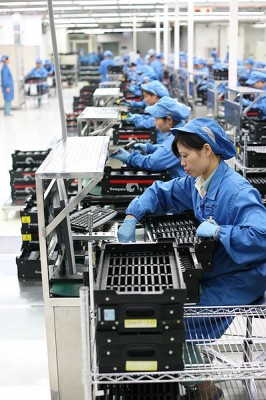
The cost of hiring humans
But the number of robots in China’s manufacturing sector is growing. The IFR expects 50,000 robots to be sold in the Middle Kingdom this year, up from 36,560 last year and 22,987 in 2012. But 2017, the organization projects that China will be buying around 100,000 robots every year.
Industrial robots aren’t cheap, of course, and integrating them into a factory can be a lot of work. But more and more Chinese manufacturers are bringing in robots because of the problems with the human workforce. There are, according to Huayang Multimedia Electronics company VP Luo Mingdeng, three core issues with China’s industrial labor force right now: “recruiting workers is hard, paying workers is expensive, worker overflow is excessive.”
The decrease in young people looking for manufacturing jobs, in concert with the rise of China’s manufacturing sector, is responsible for the first and third issues. Because the workforce isn’t large enough to satisfactorily meet the demands of every factory, recruiting workers is difficult. Companies have to compete to attract them. And even when they do find the right worker, keeping them is often difficult. Finding work at a factory is not difficult, and many workers won’t hesitate to leave if they think they can get a better job somewhere else. The result is that in addition to paying their salaries, Chinese manufacturers also have to put a lot of money into finding and training new employees.
And while worker salaries in China aren’t high by Western standards, they’ve been rising steadily, and new minimum wage laws in some areas have raised worker salaries considerably. Shanghai’s minimum wage now, for example, is nearly double what it was in 2010.
A growing market for robots
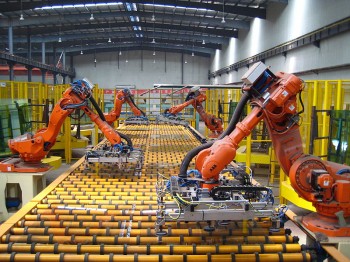
With workers difficult to attract, pay, and retain, analysts expect significant growth in China’s robotics market. Zhang Xiaofei, chairman of the GG Robotics Research Institute, told China Business News that sales of robots in the country are up 32.5% already this year compared to 2013, and he expects sales figures to reach 45,000 before the year ends. By 2015, he expects the domestic robotics market to be worth RMB 1 trillion (US$162 million), and by 2020 that figure will triple to RMB 3 trillion.
The largest obstacles, at present, are up-front costs and task complexity. Some manufacturers, especially mid-size and small firms, simply can’t afford the up-front costs and production line downtime that would be required to overhaul their factories with robots. Moreover, the robots many of these companies, like electronic companies, require are more complex than those needed in other industries. A machine that can correctly assemble the parts of a tiny computer chip in a dust-free environment is necessarily more expensive than a basic welding machine that doesn’t need such precise control and doesn’t need to worry about dust.





Stay updated on the go with our mobile app.
Get latest insights with smoother, more personalized experience through TIA mobile app.